Projectile motion (AQA A-Level Physics): Revision Notes
📚Revision Notes
4.1.4 Projectile motion
Note
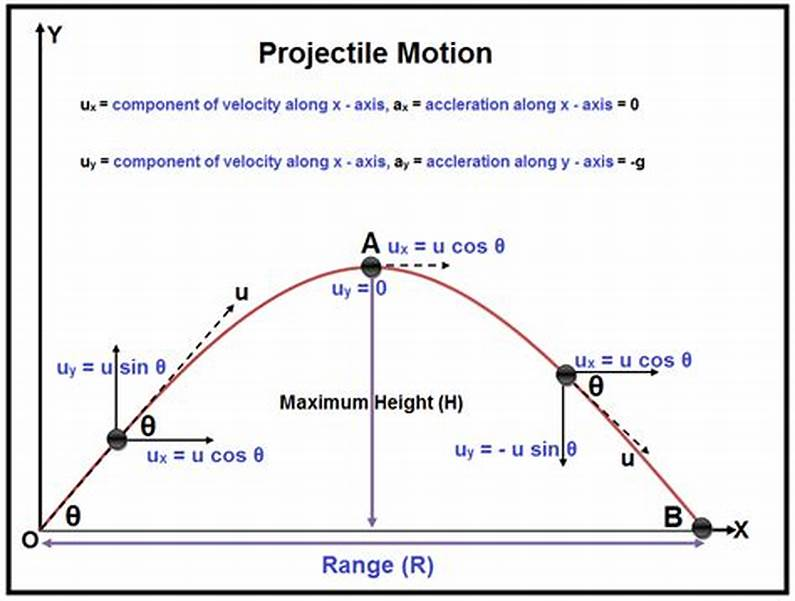
Projectile motion involves the movement of an object through the air, with its vertical and horizontal components acting independently. The object's horizontal and vertical motions can be analysed separately using the uniform acceleration equations, assuming constant acceleration due to gravity and ignoring air resistance.
Note
Key Points:
- Vertical and Horizontal Components: The object's velocity is often resolved into vertical and horizontal components based on the angle of projection. These components are analysed separately to find the projectile's overall motion.
Note
Example Problem:
A ball is launched at 20 m/s at an angle of 60° to the horizontal. We want to determine:
The time taken for the ball to reach its highest point and fall back to the ground.
The maximum height reached by the ball.
Step 1: Resolve Initial Velocity
- Vertical component: 20 sin 60° = 17.3 m/s
- Horizontal component: 20 cos 60° = 10 m/s In this example, we only need the vertical component to find the maximum height (for simplicity). However, other questions may require both components.
Step 2: Calculate Maximum Height
- At maximum height, the vertical velocity (v) = 0.
- Initial vertical velocity u = 17.3 m/s
- Acceleration due to gravity a = -9.81 m/s² Using v² = u² + 2as :
Thus, the maximum height is 15.3 m.
Step 3: Calculate Time to Reach Maximum Height
Using v = u + at:
Since the time taken to rise is equal to the time taken to fall, the total time in the air is 2 × 1.76 = 3.5 s.
Additional Concepts
- Free Fall: An object in free fall is only affected by gravity, accelerating downwards at 9.81 m/s².
- Friction and Air Resistance:
- Friction opposes motion and converts kinetic energy into other forms, such as heat.
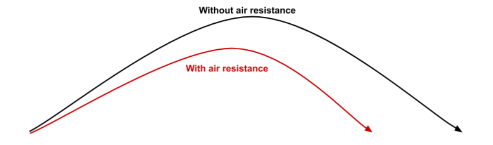
- Air Resistance increases with speed, reducing both the height and horizontal distance a projectile reaches.
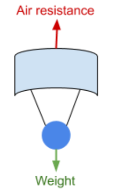
- Terminal Speed: The constant speed an object reaches when the forces of gravity and air resistance are balanced, meaning no further acceleration occurs.
Influence of Air Resistance
Air resistance impacts both vertical and horizontal motion:
- With air resistance, the maximum height and range of the projectile decrease.
- This effect is illustrated by comparing paths with and without air resistance, where the projectile with resistance achieves a lower height and shorter horizontal distance. By understanding these components and solving problems step-by-step, we can accurately predict projectile motion under various conditions.