Newton’s laws of motion (AQA A-Level Physics): Revision Notes
📚Revision Notes
4.1.5 Newton's laws of motion
Newton's First Law
- An object will remain at rest or move at a constant velocity unless acted upon by a resultant (net) force. This law emphasises the concept of inertia, which is the resistance of an object to change its state of motion.
Newton's Second Law
- The acceleration of an object is directly proportional to the resultant force acting on it and inversely proportional to its mass. This is represented by the formula:
where is the resultant force in newtons , is the mass of the object in kilogrammes (), and is the acceleration in metres per second squared .
Newton's Third Law
- For every action, there is an equal and opposite reaction. This means that for every force exerted by one object on another, the second object exerts an equal force in the opposite direction on the first object.
Free-Body Diagrams
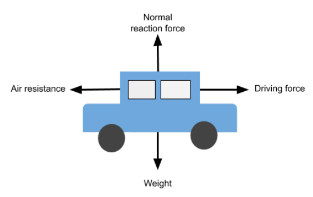
- A free-body diagram shows all the forces acting on an object. Forces are represented as arrows pointing in the direction of each force, with the length of each arrow indicating the relative magnitude. This tool helps in analysing how forces balance or interact with each other.
Note
Example Problem using Newton's Second Law and Free-Body Diagram
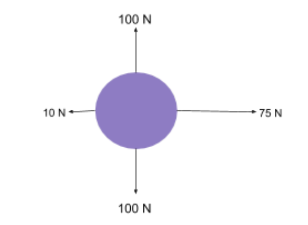
Problem: Calculate the acceleration of a ball, given the forces acting on it in a specific diagram.
- Find the mass of the ball if only the weight is given.
- Since weight is given, and we know , we can rearrange to find .
- For example, if the weight of the ball is 100 N, and , then:
- Determine the resultant force ().
- If the forces on the ball are 100 N upwards, 100 N downwards, 75 N to the right, and 10 N to the left:
- The vertical forces (100 N up and 100 N down) cancel each other out.
- For the horizontal forces: to the right.
- Apply Newton's Second Law to find acceleration :
Acceleration: 6.4 m/s² to the right