Bulk properties of solids (AQA A-Level Physics): Revision Notes
📚Revision Notes
4.2.1 Bulk properties of solids
Density
- Density is defined as the mass per unit volume of a material.
- It provides a measure of how compact a substance is.
Hooke's Law
- Hooke's Law states that extension is directly proportional to the force applied (assuming environmental factors like temperature remain constant).
- This relationship can be seen as a straight line through the origin on a force-extension graph.
- Formula:
- Where:
- = force,
- = spring constant (a measure of the material's stiffness),
- = extension.
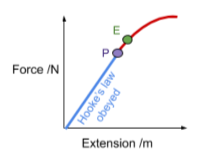
Limit of Proportionality
- The limit of proportionality is the point on a force-extension graph beyond which Hooke's Law no longer applies.
- Beyond this point, if force is further increased, the material reaches the elastic limit and may deform plastically (permanent deformation).
Stress and Strain
- Tensile Stress is defined as the force applied per unit cross-sectional area.
- Formula:
- = force, = cross-sectional area.
- Tensile Strain is the extension per unit original length.
- Formula:
- = extension, = original length.
Elastic Strain Energy
- When a material is stretched or compressed, energy is stored as elastic strain energy.
- For variable forces, this energy can be calculated as the area under the force-extension graph.
- Formula for Elastic Strain Energy: .
Breaking Stress
- Breaking Stress is the stress level at which a material will fracture.
- It varies with conditions such as temperature.
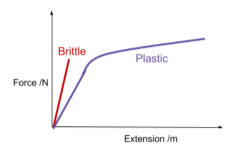
Behaviour of Materials on Force-Extension Graphs
- Plastic: Materials that exhibit significant extension with load beyond the elastic limit.
- Brittle: Materials that extend very little and tend to fracture at low extensions.
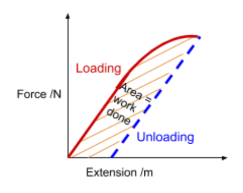
Elastic vs. Plastic Behaviour
- Elastic Behaviour: The material returns to its original shape when the force is removed, storing energy as elastic strain energy.
- Plastic Behaviour: The material undergoes permanent deformation; energy is dissipated as heat rather than stored as strain energy.
Application of Elastic Strain Energy
- In safety features like crumple zones in cars:
- These deform plastically, absorbing energy during collisions, which reduces the impact force experienced by passengers.
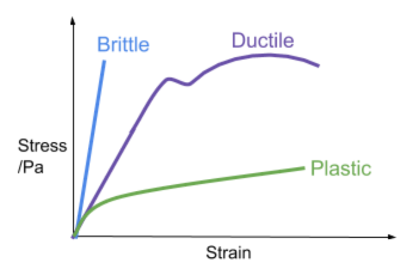
Stress-Strain Graphs
- Stress-strain graphs represent the behaviour of materials rather than specific objects.
- They indicate ultimate tensile stress (UTS) – the maximum stress a material can withstand.
- The graph's shape can also reveal if a material is:
- Ductile (undergoes a large amount of plastic deformation),
- Brittle (fractures easily without much deformation),
- Plastic (exhibits significant deformation before breaking).
Note
Example of Elastic Strain Energy Transfer
- When a spring is stretched, kinetic energy is converted to elastic strain energy.
- Upon releasing the spring, this strain energy can convert back to kinetic energy, and, if in a gravitational field, to gravitational potential energy.