Required Practicals (AQA A-Level Physics): Revision Notes
📚Revision Notes
Uncertainties and Methods
SI Units and Their Prefixes
- Fundamental SI Units include:
-
Mass (m): kilogramme (kg)
-
Length (l): metre (m)
-
Time (t): second (s)
-
Electric Current (I): ampere (A)
-
Temperature (T): kelvin (K)
-
Amount of Substance (n): mole (mol) Units for derived quantities, like force and voltage, can be obtained from these base units. For example:
-
Force : kg·m/s² or N (newton)
-
Voltage : derived as
-
- SI Prefixes scale units by powers of ten. Common prefixes include:
- kilo (k):
- mega (M):
- milli (m):
- micro (µ):
Example
Example Conversions:
- To convert energy in electron volts (eV) to joules (J), use .
- Converting kWh to joules: .
Limitation of Physical Measurements
Types of Errors:
- Random Errors:
- Affect precision and cause scattered readings.
- Example: electronic noise in measurement.
- Minimising Random Errors:
- Take multiple measurements and calculate the mean.
- Use digital equipment (e.g., data loggers).
- Choose appropriate tools (e.g., a micrometer for small lengths).
- Systematic Errors:
- Affect accuracy by consistently skewing results in one direction.
- Example: zero error on a balance.
- Reducing Systematic Errors:
- Calibrate instruments regularly.
- Correct for background radiation in radiation measurements.
- Measure liquids at eye level to avoid parallax errors.
Note
Key Terms:
- Precision: Consistency of measurements.
- Accuracy: Closeness to the true value.
- Resolution: Smallest measurable change.
- Repeatability: Same experimenter, same method, same results.
- Reproducibility: Different experimenter/method, same results.
Types of Uncertainty:
- Absolute Uncertainty: Fixed uncertainty e.g., .
- Fractional Uncertainty: Absolute uncertainty divided by the measurement e.g., .
- Percentage Uncertainty: Fractional uncertainty as a percentage e.g., .
Calculating and Reducing Uncertainty
-
Reduce Percentage/Fractional Uncertainty by measuring larger quantities when possible (e.g., a longer rope).
-
Uncertainty in a Reading: half the smallest scale division (e.g.,) for a thermometer with divisions).
-
Uncertainty for Multiple Readings: half the range (e.g., if measurements range from to , the uncertainty is ). Combining Uncertainties:
-
Addition/Subtraction: Add absolute uncertainties.
-
Multiplication/Division: Add percentage uncertainties.
-
Raising to a Power: Multiply percentage uncertainty by the power.
Example
Example Calculation: If the radius of a circle is , the percentage uncertainty in the area would be:
- Percentage uncertainty in =
- Area uncertainty = since area depends on .
Uncertainties and Graphs
-
Represent uncertainties with error bars on graphs.
-
A line of best fit should go through all error bars (excluding outliers). Finding Uncertainty in Gradients:
-
Draw steepest and shallowest lines within error bars.
-
Calculate the difference in gradients to find percentage uncertainty:
Estimation of Physical Quantities
-
Orders of Magnitude: Power of ten approximations for size comparison (e.g., nucleus diameter is around ). Experiment Design:
-
Variables:
- Independent: What you change.
- Dependent: What you measure.
- Control: Variables that stay constant.
-
Data Types:
- Discrete: Specific values (e.g., count of objects).
- Continuous: Range of values (e.g., temperature).
- Categorical: Qualitative data (e.g., colour).
Graphing Relationships:
- Linear Relationships: For , plot against for a straight line.
- Reciprocal Relationships: For , plot against .
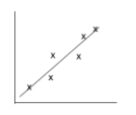
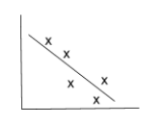
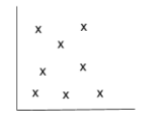
Logarithmic and Exponential Functions:
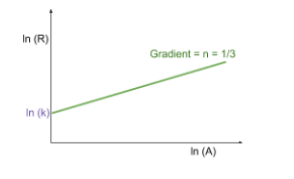
- Convert equations like into a linear form by taking logarithms:
Plotting against gives a straight line with gradient .