Determination of Resistivity of a Wire (AQA A-Level Physics): Revision Notes
📚 Revision Notes
Determination of Resistivity of a Wire
Equipment
- 1 m length of constantan wire: Used as the sample material for testing.
- Voltmeter: To measure the potential difference across the wire.
- Ammeter: To measure the current flowing through the wire.
- Low voltage power supply ( V DC): Provides a controlled current through the wire.
- Micrometer: For measuring the wire's diameter, which is used to calculate the cross-sectional area.
- Metre ruler: To measure and adjust the length of the wire in the circuit.
infoNote
Method
- Measure Wire Diameter:
- Using the micrometre, measure the diameter of the constantan wire at several points along its length. Calculate the mean diameter to ensure accuracy, as this is used to determine the cross-sectional area of the wire.
- Set Up Circuit:
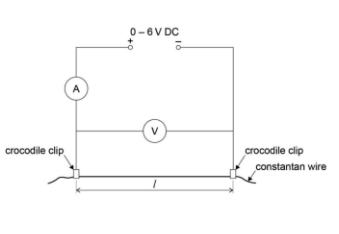
- Connect the apparatus as shown in the diagram, with the power supply, ammeter, and voltmeter connected to the wire via crocodile clips.
- Adjust Length:
- Set the length of the wire to 0.100 m, measured from one crocodile clip to the other using the metre ruler.
- Measure Current and Voltage:
- Switch on the power supply and record the current from the ammeter and the voltage from the voltmeter.
- Calculate the resistance of the wire section using Ohm's law:
- Repeat for Different Lengths:
- Increase by increments of 0.100 m, up to a maximum length of 0.800 m, and repeat the measurements of , and for each length.
- Repeat the entire process twice more to obtain average values of for each length .
Graphs and Calculations
- Calculate Cross-Sectional Area:
- Use the mean diameter to calculate the cross-sectional area of the wire:
- Graph of Resistance vs. Length:
- Plot a graph of the mean resistance (y-axis) against length (x-axis).
- Draw a line of best fit. The gradient of this graph represents .
- Determine Resistivity :
- The resistivity of the material can be calculated using:
- Multiply the gradient by the cross-sectional area to find .
infoNote
Safety
- Heating of Wire: Disconnect the crocodile clips between measurements to prevent the wire from heating up, which can alter its resistance and cause burns if touched.
- High Currents: If the current is high, lower the voltage on the power supply to avoid overheating. Wear safety goggles in case of any wire snapping under tension.
Improvements and Notes
- Managing Wire Heating:
- If the wire heats up, it may change its resistance. Disconnect the wire between measurements to allow it to cool.
- Kinks and Tension in Wire:
- Ensure the wire is straight and free of kinks. Tensioning the wire gently will make sure that the length measurements are accurate and reduce measurement error.
infoNote
Key Concepts
- Resistivity : A material property that quantifies how strongly a material opposes the flow of electric current. It depends on the material and its temperature.
- Ohm's Law: For a uniform wire, defines the relationship between voltage, current, and resistance.
- Graphical Analysis: By plotting resistance vs. length, the linear relationship allows us to calculate resistivity from the gradient, linking macroscopic measurements (resistance and length) to a fundamental property of the material. This experiment provides hands-on experience with electrical resistance and demonstrates how resistivity can be determined practically, reinforcing both theoretical and practical understanding of electrical properties.