Simple Harmonic Motion (AQA A-Level Physics): Revision Notes
📚 Revision Notes
Simple Harmonic Motion
Part 1: Mass-Spring System
Equipment
- Spring: The oscillating element.
- 50g masses with holder: Allows for mass adjustment up to 500g.
- Stand and clamp: To securely hold the spring.
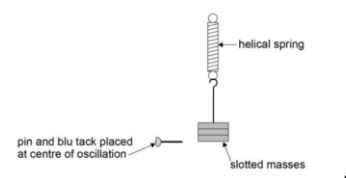
- Pin and Blu-Tack: Used as a fiducial marker at the equilibrium position.
- Metre ruler: For accurate positioning.
- Stopwatch: To time oscillations.
infoNote
Method
- Setup:
- Assemble the apparatus as shown, with the spring attached to the stand and a mass holder at the bottom. Place the fiducial marker at the system's equilibrium position.
- Start Oscillations:
- Displace the mass holder vertically downwards by a small distance and release. The system will oscillate vertically.
- Measure Oscillation Time:
- Start timing as the mass passes the fiducial marker. Measure the time for 10 oscillations and record it as T₁₀.
- Calculate the time period T for one oscillation by dividing T₁₀ by 10.
- Increase Mass:
- Add a 50g mass, and repeat the timing procedure. Record the time period T for each total mass up to 500g.
- Repeat for Accuracy:
- Perform each measurement at least twice more to ensure accuracy.
Graphs and Calculations
- Graph of T² vs. m:
- Plot T² (y-axis) against mass m (x-axis). Draw a line of best fit.
- The gradient of this graph is 4π²/k, where k is the spring constant.
- Equation of Motion:
- The period of a mass-spring system in SHM is given by:
- Using the gradient of the graph, calculate k for the spring.
infoNote
Safety
- Falling Masses: Be careful with suspended masses to prevent injury if they fall. Avoid pulling the spring too far downwards.
Improvements and Notes
- Vertical Oscillation: Ensure the spring oscillates vertically; any horizontal motion can affect timing accuracy.
- Use of Fiducial Marker: The marker should be placed at the centre of oscillation to reduce timing errors.
- Data Logger: Using a motion tracker or data logger can improve timing accuracy by removing human reaction time errors.
Part 2: Simple Pendulum
Equipment
- Pendulum bob on 2m string: For generating oscillations.
- Stand and clamp: To secure the pendulum.
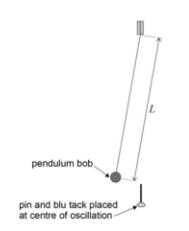
- Pin and Blu-Tack: Fiducial marker at equilibrium position.
- Metre ruler: To measure string length.
- Stopwatch: To time oscillations.
- Two wooden blocks: To support the pendulum setup.
Method
- Setup:
- Set up the pendulum with a string length L of 1.5m (distance from the suspension point to the bob's centre of mass). Place the fiducial marker at the equilibrium position.
- Initiate Oscillations:
- Displace the pendulum by a small angle (less than 15°) and release. Ensure the motion is in a straight line.
- Measure Oscillation Time:
- Start timing when the bob passes the fiducial marker. Measure the time for 10 oscillations and record as T₁₀.
- Calculate the period T for one oscillation by dividing T₁₀ by 10.
- Decrease Length:
- Shorten L by 0.100m increments, measuring T for each length down to 0.500m.
- Repeat for Accuracy:
- Repeat each measurement twice more to obtain mean values.
Graphs and Calculations
- Graph of T² vs. L:
- Plot T² (y-axis) against pendulum length L (x-axis) and draw a line of best fit.
- The gradient of this graph is 4π²/g, where g is the acceleration due to gravity.
- Equation of Motion:
- The period of a pendulum in SHM is:
- Calculate g from the gradient.
Safety
- Low Risk: There are minimal safety concerns, but ensure the pendulum has enough space to swing without obstruction.
Improvements and Notes
- Small Bob: Use a small pendulum bob to make length measurements easier.
- Length Accuracy: Measure from the centre of mass of the bob for accurate L.
- Data Logging: As with the mass-spring system, a motion tracker can improve timing accuracy by eliminating manual timing errors.
infoNote
Key Concepts
- Simple Harmonic Motion (SHM): Both systems exhibit SHM, characterised by a restoring force proportional to displacement.
- Graphical Analysis: For both systems, plotting T² against mass (for spring) or length (for pendulum) provides a way to calculate spring constants and gravitational acceleration.
- Equation Derivations: Understanding the derivations of T in both systems reinforces the mathematics behind oscillatory motion in physics.