AS Level Paper 2 Exam (Edexcel A-Level Business): Revision Notes
📚Revision Notes
AS Level Paper 2 Exam
Advance planning for success
Effective preparation is crucial for exam success. Start by creating a structured revision schedule that spans several weeks rather than cramming at the last minute. Allocate specific topics to cover each week and commit to following your plan.
Note
Focus additional time on challenging topics that you find difficult, revisiting them multiple times until you feel confident. This repeated exposure helps cement your understanding and builds confidence for the exam.
Important
Avoid the temptation to predict which questions will appear on the exam (question spotting). Instead, revise all content thoroughly so you can approach any question with confidence. Question spotting is a risky strategy that often leads to poor performance.
Paper 2 structure and timing
AS Paper 2 focuses on Theme 2: Managing business activities and lasts 1 hour 30 minutes. The paper is divided into three sections, and you must answer all questions – there is no choice. This can actually help you, as you won't waste time deciding which questions to tackle.
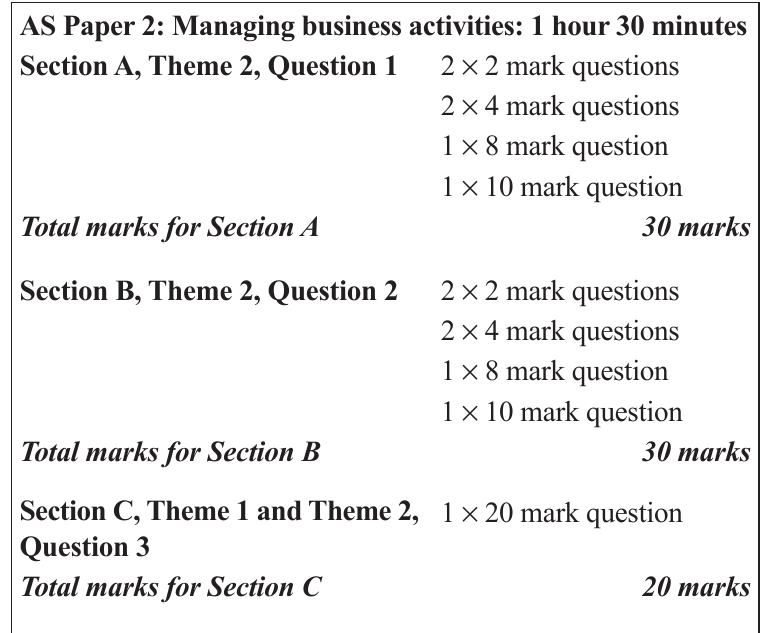
The paper totals 80 marks and breaks down as follows:
| Section | Content | Question types | Total marks |
|---|---|---|---|
| Section A | Theme 2, Question 1 | 2×2 marks, 2×4 marks, 1×8 marks, 1×10 marks | 30 marks |
| Section B | Theme 2, Question 2 | 2×2 marks, 2×4 marks, 1×8 marks, 1×10 marks | 30 marks |
| Section C | Themes 1 and 2, Question 3 | 1×20 marks | 20 marks |
Note
Notice that Sections A and B have identical structures, each worth 30 marks. Section C is unique, testing both themes in a single extended question worth 20 marks. This structure means you need to manage your time carefully across all three sections.
Understanding each section
Section A questions
In Section A, you will receive Extracts A–C as stimulus material. You must answer Question 1, parts a–f. Each part requires a different depth of response depending on the mark allocation. Use the marks as a guide for how much detail and time to invest in each part.
Section B questions
Section B provides Extract D as stimulus material. You must answer Question 2, parts a–f. Like Section A, these questions vary in depth and complexity. Pay close attention to the mark allocation to gauge how much you should write.
Section C questions
Section C gives you Extract E as stimulus material. Question 3 is not divided into parts and requires an extended written response. This 20-mark question demands more detailed, developed writing that demonstrates multiple skills. Plan your time carefully to ensure you can write a thorough answer.
Important
Section C is worth 25% of your total marks but requires sustained, high-quality writing. Don't underestimate the time needed to craft a well-structured, analytical response that demonstrates all four assessment objectives.
Time management strategy
Use the mark allocations to guide your time management. As a rough guide, aim for approximately one minute per mark. This means:
Note
Recommended Time Allocations:
- 2-mark questions: around 2 minutes
- 4-mark questions: around 4 minutes
- 8-mark questions: around 8 minutes
- 10-mark questions: around 10 minutes
- 20-mark question: around 20 minutes
Remember to leave time for reading the extracts carefully and checking your answers. A good strategy is to spend the first 5-10 minutes reading all extracts and understanding the context before you start writing.
Assessment objectives (AOs)
Every question tests specific skills called assessment objectives. Understanding what examiners are looking for helps you structure better answers.
AO1 - Knowledge
Knowledge involves demonstrating that you understand fundamental business concepts. You need to:
- Recognise and correctly use business terminology, concepts and theories
- Show understanding of how businesses and stakeholders are affected by different issues
Knowledge questions typically carry just 2 or 4 marks. While all questions test knowledge to some extent, these lower-mark questions focus primarily on recall and understanding of key terms or concepts.
Example
Example Approach for AO1:
If asked to define price elasticity of demand, provide a clear, concise definition showing you understand the concept:
"Price elasticity of demand measures the responsiveness of quantity demanded to a change in price. It is calculated as the percentage change in quantity demanded divided by the percentage change in price."
This demonstrates accurate knowledge of both the concept and its measurement.
AO2 - Application
Application means taking your business knowledge and relating it directly to the specific context given in the question. This is crucial in Business – generic answers won't score well. Application might involve:
- Using business formulas in relevant situations (e.g. calculating break-even output for the business in the extract)
- Applying theories to explain why the business took a particular action
- Using frameworks to analyse the potential impact of decisions on the specific business described
Important
Most examination questions require application. Your answers must connect directly to the business, industry or situation described in the extract. Avoid writing general points that could apply to any business. Instead, explain implications for the particular company or sector mentioned.
Example
Example Approach for AO2:
Don't just explain what market segmentation is – explain how the specific business in the extract could use market segmentation and why this matters for their particular situation.
Generic answer (poor): "Market segmentation involves dividing the market into groups with similar characteristics. This helps businesses target customers more effectively."
Applied answer (good): "Given that the coffee shop in Extract A operates in a university town with diverse customer needs, they could segment their market by student status (students vs. professionals) and usage occasion (morning commuters vs. study sessions). This would allow them to tailor their product offerings – such as discounted meal deals for students during off-peak hours and premium workspace-friendly options for professionals."
AO3 - Analysis
Analysis involves breaking down information to understand deeper implications and relationships. You need to demonstrate that you can examine causes, effects and connections. This might involve:
- Explaining cause-and-effect relationships (e.g. identifying from data that falling sales might result from new competitors entering the market)
- Breaking down complex information to identify specific causes or problems (e.g. recognising that quality improvements stem from implementing continuous improvement programmes)
- Using analytical techniques appropriately (e.g. calculating and interpreting ROCE to assess profitability)
Questions worth more than 4 marks will require analysis. Some 4-mark questions may also test analytical skills. You'll need to construct logical arguments, explain reasons for events, or discuss advantages and disadvantages of different courses of action.
Note
Use connectives like "this leads to...", "as a result...", "because..." to develop your chains of reasoning. These words signal to examiners that you're building analytical arguments rather than just listing points.
Example
Example Approach for AO3:
Don't just state that high staff turnover is bad – analyse why it's problematic for this specific business:
"The 40% annual staff turnover rate at the restaurant (Extract B) is particularly problematic because the business relies on building regular customer relationships. This leads to several interconnected issues: firstly, recruitment and training costs will increase significantly, reducing profit margins in an already competitive market. As a result, the restaurant has less capital available for menu development or marketing. Furthermore, because experienced staff leave frequently, new employees lack the product knowledge needed to make effective recommendations, which consequently reduces average transaction values and damages the restaurant's reputation for expertise that it promotes in Extract B."
Notice how each point connects to create a chain of reasoning specific to this business context.
AO4 - Evaluation
Evaluation means making reasoned judgements based on evidence. You must weigh up different factors and reach supported conclusions. Evaluation might involve:
- Weighing the relative importance of different arguments or factors before reaching a conclusion
- Drawing justified conclusions from evidence presented
- Assessing which issues matter most to the specific business
- Recommending courses of action supported by logical reasoning and evidence
Questions carrying 8 marks or more typically test evaluation. Remember that in Business Studies, there's often no single "right" answer. Examiners focus on whether your judgement is plausible and whether you've built a convincing argument to support it.
Important
Strong evaluation requires you to make judgements throughout your answer, not just in a final paragraph. Use phrases like "the most significant factor is...", "however, this depends on...", "ultimately...", and "on balance..." to demonstrate evaluative thinking.
Example
Example Approach for AO4:
When evaluating whether a business should expand internationally, consider both sides (benefits and risks), assess which factors matter most in this context, and reach a justified conclusion:
"While international expansion offers the clothing retailer significant growth opportunities, the most significant factor to consider is their limited experience operating outside the UK market mentioned in Extract C. The potential benefits of accessing larger markets and spreading risk are considerable, however, this depends on whether they have the financial resources to sustain potential losses during the establishment phase.
The extract indicates strong UK profitability ($2.4m annual profit), which provides a buffer, yet their current £800,000 cash reserves may be insufficient given that international expansion typically requires £1-2m initial investment. On balance, a more prudent approach would be to consolidate their UK position first, build cash reserves to £1.5m over the next 18 months, and then pursue international expansion with reduced financial risk. This staged approach ultimately protects the core business while still pursuing growth objectives."
This answer weighs multiple factors, makes interim judgements, and reaches a justified conclusion based on the specific context.
Effective answering technique
For lower-mark questions (2-4 marks)
These primarily test knowledge and basic application. Keep answers concise but ensure you:
- Define key terms accurately
- Apply points to the context where possible
- Write clearly and directly
Note
For 2-mark questions, aim for one or two developed sentences. For 4-mark questions, write a short paragraph (3-5 sentences) that includes definition and application.
For medium-mark questions (8-10 marks)
These require knowledge, application and analysis, with some evaluation in 10-mark questions. You should:
- Apply concepts to the business context throughout
- Develop analytical chains of reasoning
- Explain causes and consequences
- Consider multiple perspectives
- Draw interim conclusions (especially for 10-mark questions)
Note
Structure these answers with clear paragraphs – typically 2-3 analytical paragraphs for 8-mark questions, and 3-4 paragraphs (including evaluative points) for 10-mark questions. Each paragraph should develop one main argument with supporting application and analysis.
For the 20-mark question
This extended response requires all four assessment objectives. You need to:
- Demonstrate thorough knowledge of relevant concepts
- Apply theories and frameworks to the specific context
- Develop detailed analytical arguments
- Evaluate different perspectives and factors
- Reach a balanced, justified overall judgement
- Structure your response logically with clear paragraphs
Important
Consider using short plans for longer questions to organise your thoughts before writing. Spend 2-3 minutes planning the 20-mark question to ensure you cover multiple perspectives and build toward a justified conclusion. A good structure might include: introduction, 3-4 analytical paragraphs exploring different factors, and a concluding evaluative paragraph.
Summary
Key Points to Remember:
- Paper 2 lasts 1 hour 30 minutes and covers Theme 2: Managing business activities
- You must answer all questions across three sections (no choice)
- Sections A and B each contain Extracts and multi-part questions worth 30 marks
- Section C contains one extended 20-mark question requiring sustained writing
- Use mark allocations to guide time spent on each question (roughly 1 minute per mark)
- All answers must demonstrate application to the specific business context – avoid generic responses
- Higher-mark questions (8+ marks) require analysis and evaluation, not just knowledge
- There's often no single right answer – focus on building plausible, well-supported arguments
- Use appropriate connectives ("this leads to...", "because...", "however...") to demonstrate analytical and evaluative thinking
- Plan your approach to the 20-mark question before writing to ensure comprehensive coverage