Exponential Form (Edexcel A-Level Further Mathematics): Revision Notes
📚Revision Notes
1.2.1 Exponential Form
Overview
The exponential form of complex numbers is a powerful tool in mathematics, particularly in handling complex number operations like multiplication and division. This form is closely tied to Euler's Formula, which connects the exponential function with trigonometric functions.
Let's start by exploring the background and deriving the exponential form step-by-step.
The Exponential Function
The exponential function can be expanded using its Maclaurin series as:
For real numbers, this function grows exponentially, but it can also be applied when is a complex number.
Maclaurin Series for and
Similarly, we have the Maclaurin expansions for and :
These expansions define the trigonometric functions in terms of powers of .
The Key Insight: Let
To understand the relationship between exponentials and trigonometric functions, we substitute (where is the imaginary unit) into the expansion for :
Now, simplify each term:
- So,
Group real and imaginary parts:
But from the Maclaurin expansions, we recognise these as:
This is Euler's Formula:
The Exponential Form of a Complex Number
For a complex number , written in polar form as:
we can equivalently write:
Here:
- is the modulus (or magnitude) of the complex number:
- is the argument (or angle) of the complex number:
Why Use Exponential Form?
The exponential form simplifies many operations:
Multiplication of complex numbers:
Then:
The moduli multiply, and the arguments add.
Division of complex numbers:
Finding powers () and roots () becomes straightforward using De Moivre's Theorem.
Note
Example 1: Converting to Exponential Form Let's convert the complex number to exponential form.
Step 1: Find the modulus :
Step 2: Find the argument :
Step 3: Write in exponential form:
So the exponential form of is
Note
Example 2: Multiplying Complex Numbers in Exponential Form Multiply and
Step 1: Multiply the moduli:
Step 2: Add the arguments:
Step 3: Write the result:
So the product is
Note
Key Takeaways:
- The exponential form of a complex number is written as , where is the modulus and is the argument.
- The exponential form simplifies operations like multiplication, division, and raising complex numbers to powers.
- Euler's formula, , is the key to converting between trigonometric and exponential forms of complex numbers. This form is especially helpful when dealing with advanced operations in complex numbers, as it makes calculations much easier!
Applications of Complex Numbers to Trig Identities
Using the exponential form of complex numbers, we can derive important trigonometric identities involving and . These identities help simplify trigonometric expressions and connect them with exponential functions.
Key Identity: Euler's Formula
From Euler's formula, we know:
Using the even-odd properties of and :
- (even function).
- (odd function). Thus:
Deriving Trigonometric Identities
Identity 1: in terms of exponentials
Note
Let's calculate:
Step 1: Substitute the expressions for and :
Step 2: Simplify the terms:
The imaginary parts and cancel out:
Thus:
Identity 2: in terms of exponentials
Note
Now consider:
Step 1: Substitute the expressions for and :
Step 2: Simplify the terms:
The real parts and cancel out:
Thus:
Final Results
We've derived two important identities:
These identities are fundamental for simplifying trigonometric expressions and solving equations involving complex exponentials.
Note
Example: Express in exponential form.
Using the identity:
we replace with :
This is the exponential form of
Note
Example: Derive the Double Angle Formula for
From Euler's formula:
Squaring
Expand:
Using
This confirms the familiar double-angle identity of cosine.
Note
Example: Write solely in terms of .
is our starting point.
Notice that is the real part of the above expression.
Using De Moivre's Theorem, we get:
Using the binomial expansion on this, we get:
Gathering together the real and imaginary parts:
Thus
Note
Example: Write in terms of , where :
Using the identity:
We get:
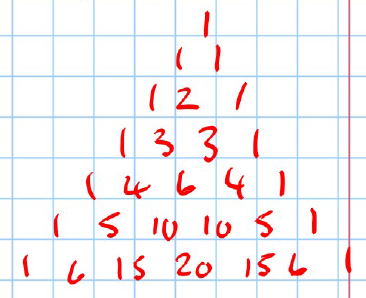
Expanding:
Now gathering together terms that contain powers of the same magnitude:
Key Takeaways
Key Exponential Identities:
Even and Odd Functions:
- Common Mistake: Forgetting that when simplifying exponential terms.
Proof
Exponential forms of complex numbers simplify operations like multiplication and division, making it easy to prove key results and solve problems. Here, we'll go through proofs and examples with clear explanations.
Proof: Argument of a Product
Note
Let:
We'll find the argument of
Step 1: Multiply the complex numbers
Using Euler's formula:
This shows that the argument of
- Argument of :
- Argument of :
- Argument of :
Thus:
Proof: Modulus of a Product
The modulus of a complex number is given by
Note
Example: For and
Step 1: Multiply and :
Step 2: Take the modulus:
Since and , it follows that:
Note
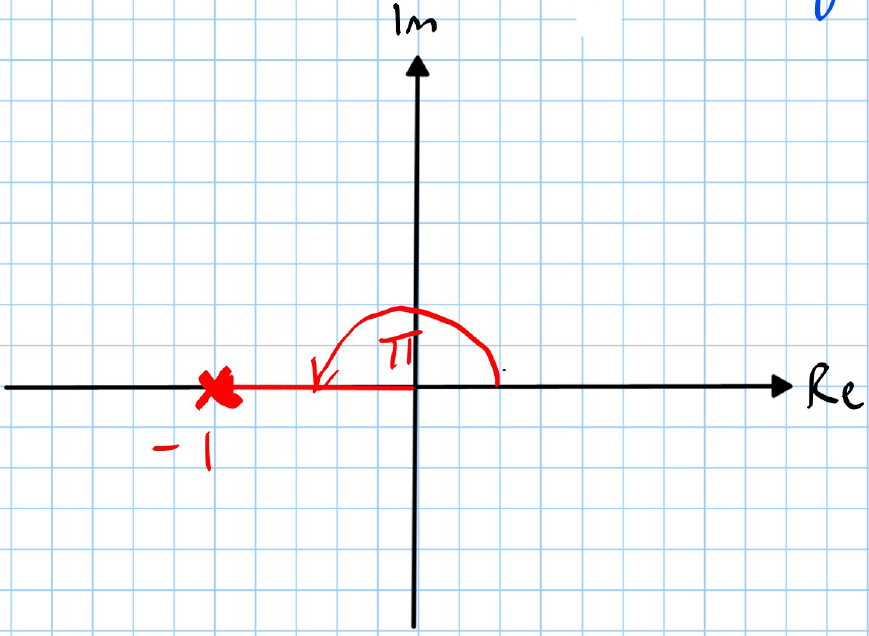
Example: Illustrating on an Argand Diagram
Using Euler's formula:
On the Argand diagram:
corresponds to the point , which lies on the negative real axis.
Note
Example: Calculating
To evaluate , we use the exponential form of :
Raise both sides to the power of :
Simplify using
Thus:
This surprising result shows that is a real number!
Note
Example: Finding
To evaluate , recall that:
Taking the natural logarithm of both sides:
Using the property
Thus:
Note
Key Takeaways
- Argument of a Product:
- Modulus of a Product: