Uniform Distribution (Edexcel A-Level Further Mathematics): Revision Notes
📚Revision Notes
16.1.4 Uniform Distribution
Continuous Uniform Distribution
The discrete uniform distribution models an event with n possible outcomes where each outcome has an equal probability of occurring. The continuous uniform distribution is similar in nature and is also referred to as the "rectangular distribution" for this reason:
(Graph showing a rectangle with height between points a and , and the area under the curve is .)
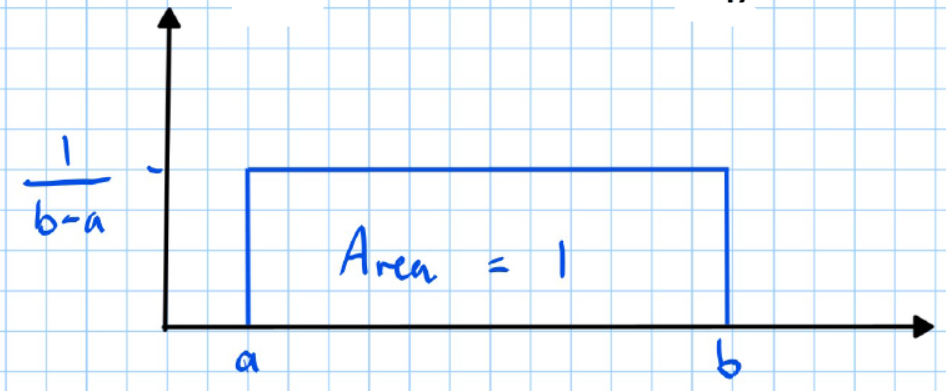
The height of the rectangle is such that , therefore:
(Table showing the continuous uniform distribution over [] , the probability density function (P.D.F.), expectation , and variance

Note
Example Problem (Q5, Jan 2009, Q2):
The continuous random variable is uniformly distributed over the interval .
(a) Write down fully the probability density function of .
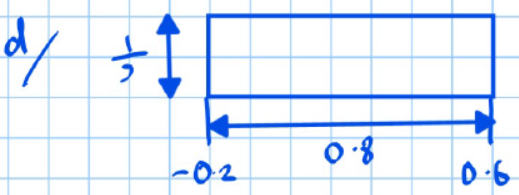
(b) Sketch the probability density function of .
Find:
(c)
(d)
(a) is given by:
(b)

(c)
(d)
The Uniform Discrete Distribution
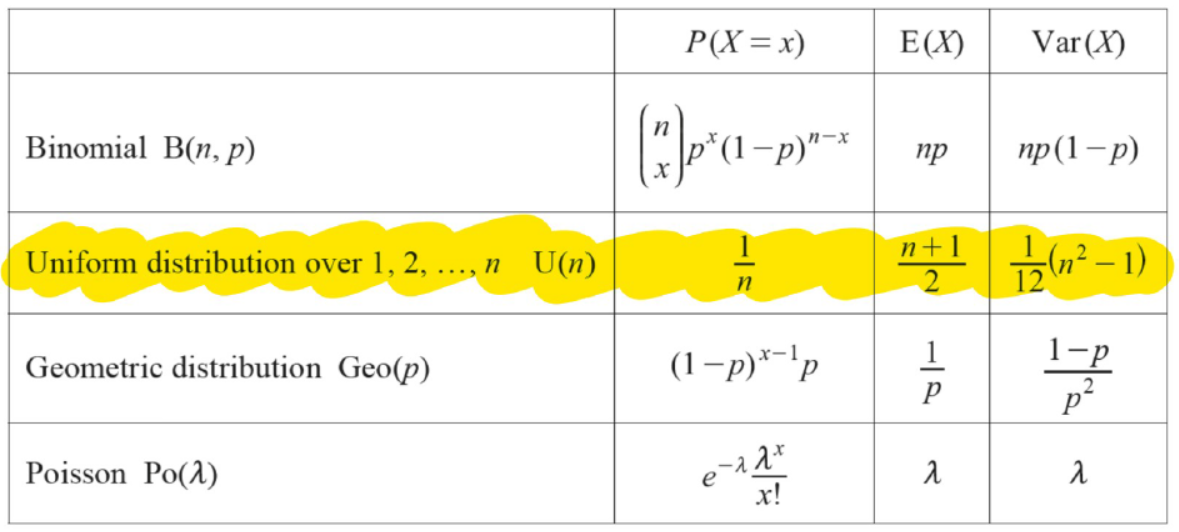
This probability distribution describes a situation in which we play a game once and the game has n different outcomes. Each outcome is equally likely.
Example
Example: A dice is thrown, and the number on the dice is noted. The following table details the probability distribution of this, where is "the score obtained":
This is an example of a uniform distribution and can be more succinctly written as:
Example
Example: Put in a table.
Example
Example : A fair spinner has outcomes 2, 4, 6, or 8. Find the expected mean score and expected variance after a large number of spins.
(Note: This situation is not quite a uniform distribution because the outcomes are not consecutive integers starting at . However, for now, let's pretend they are.)
However, this is not the mean and variance we need. If we consider and , we do get the quantities we need since the outcomes are double that of .
Example
Example: A fair die is numbered 7, 10, 13, 16, 19, 22. Find the expected score per throw and the variance after a large number of throws.
If , then the outcomes are described by .