Counting Methods, Permutations and Combinations (Edexcel A-Level Further Mathematics): Revision Notes
📚Revision Notes
16.1.5 Counting Methods, Permutations and Combinations
Counting Methods
Example
Example 1: How many numbers can be made if all of the numbers are arranged in a line without repetition?
(Number of possibilities for each space.)
Thus:
Example
Example 2: How many different "words" can be made using the letters ?
Repetition Example
Example
Example: How many numbers can be made by rearranging "" without using the same digit twice (other than )?
The "long way": If the digit '' is fixed in the first position, there are ways of arranging the remaining digits.
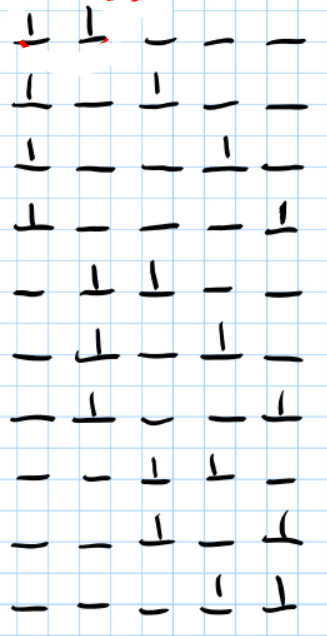
Since:
Quick Way: Divide Out Repetitions
as if there were no repeats, divide out repetitions, i.e., appears two times, so arrangements should be disregarded.)
Example
Example: How many "words" can be created from the following letters: "SHANNONABBOTT"?
Example
Example: How many numbers can be created from "11234" that are above 32,000?
We start by considering the first digit:
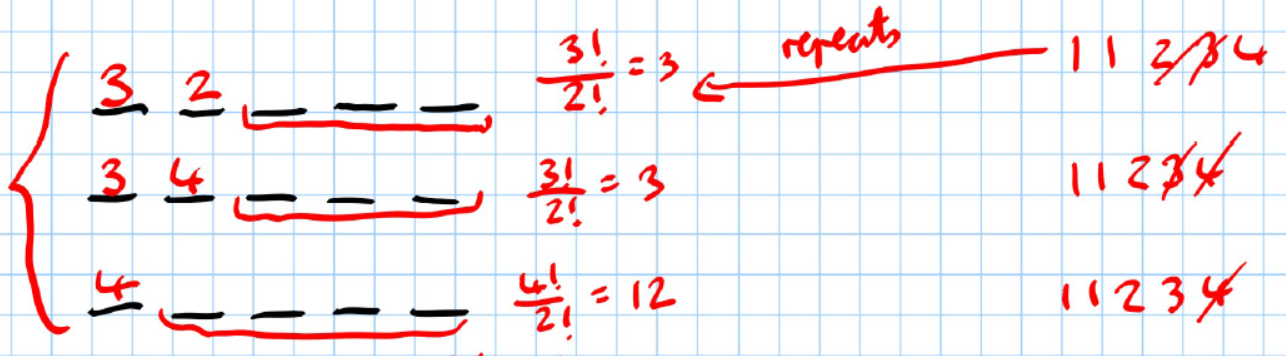
Thus:
- For even slightly different questions, draw out possibilities. Therefore:
Add or Multiply?
- When considering different possibilities, we add.
- When working within a possibility, we multiply.
Example
Example: How many odd numbers can be made from "12345"?
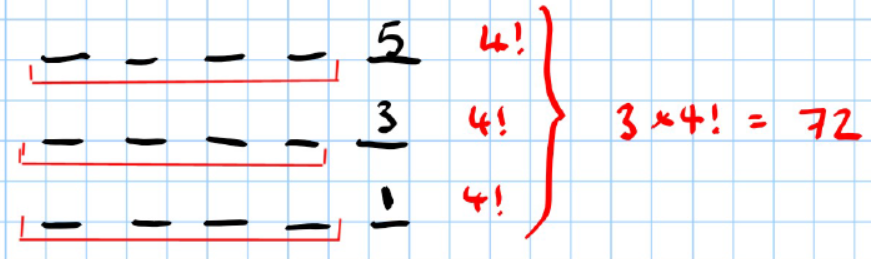
For the last digit to be odd (1, 3, 5):
Permutations and Combinations
Permutations involve choosing items where the order of choice is important.
Example
Example: Arranging numbers or letters, like multiplying a fixed number of matrices.
Combinations involve choosing items where the order does not matter.
Example
Example: Choosing a team from a squad or ordering a meal from a takeaway.
Worked Examples
Example
Example: From the numbers "", three different numbers are chosen. How many different numbers can be created in this case?
- Ask: Is the order important? → Yes.
- Draw out possibilities.
- Calculate:
Example
Example: How many "words" are possible when three letters from the alphabet are arranged randomly?
Example
Example: A team of is chosen from a squad of . Assuming all players can play all positions, how many possible teams are there?
Strategy: Classify players as "Chosen" or "Not Chosen".
- You will have and . C C C C C C C C C C C NC NC NC NC NC NC NC NC NC
Considering arrangement and repetitions:
Thus:
Note: Combinations function used when order of choice does not matter.