Globalisation Accelerated by Advances in Transport, Communication, and Business (Edexcel A-Level Geography): Revision Notes
📚Revision Notes
Globalisation Accelerated by Advances in Transport, Communication, and Business
Globalisation
The process of widening and deepening global connections, interdependence and flows
Lengthening Connections
Between people and places. Products can be sourced from further away from ever before
Deepening Connections
Sense of being connected to others is more deeply embedded into everyday life 📝 eg. through spread of culture
Faster Connections
Airtravel along with railway, cars etc has ↑ the speed at which people can travel to locations.
Also telecommunications allow people to connect almost anywhere immediately
Global Flows
- Capital: Globally, money goes through the world stock markets daily (a range of businesses are involved). All an aim to buy & sell goods in order to make a profit
- Commodities**:** Products (cheap manufactured goods ↑ this), raw materials and services
- Information**:** The internet has allowed for real-time transfer of information. Social networks have ↑ in popularity & size. On demand TV has ↑ the amount of information shared digitally also 📝 (eg. News).
- People**:** Migrants and tourists
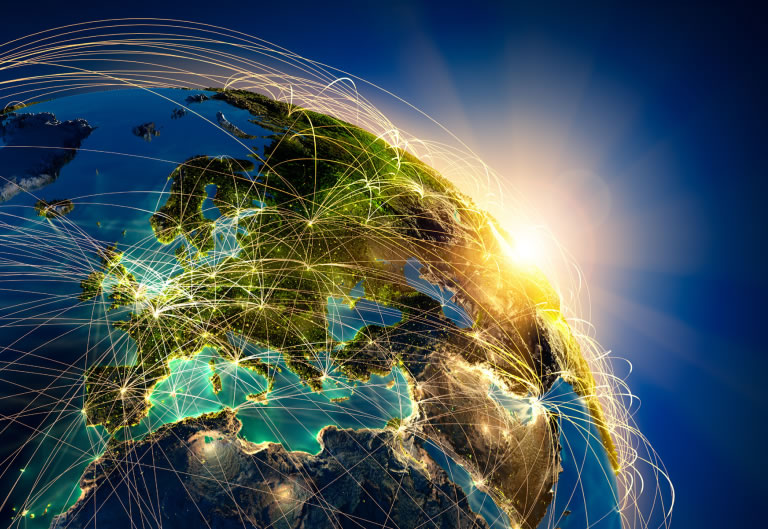
-
Global Flows*
The 'Shrinking World'
🔗Idea that the world is getting smaller due to faster transportation and better telecommunications
Transport Benefits
- Costs → Started to ↓ in the 19th century and then continued to ↓ in the 20th and 21st centuries due to transport becoming faster and more efficient (containerisation)
- Speed → ↑ in speed, especially w/ jet aircrafts since the 1960s
Innovations
- Steam Power → Britain became the leading world power in the 1800s using steam technology
- Railways → In the 1800s, railway networks expanded globally. In modern day, railway network building still remains a priority for governments globally
- Jet Aircrafts → Arrival of the Boeing 747 in the 1960s, made international travel more common. Recent expansion of the budget airlines sector = cheaper flights
- Containerisation → Approx 200 mil container movements occur each year - some see it as the backbone of the economy. Large amounts of products can be transported efficiently across the world in intermodal containers
- Intermodal Containers - Large-capacity storage units which can be transported long distances using multiple types of transport, such as shipping and rail without the freight being taken out of the container

-
Innovations*
🔗 Developments in transportation has a significant impact on the theory of a shrinking world
ICT Development
-
Telecommunications | Telephone & the telegraph | The first telegraph cables across the Atlantic in the 1860s replaced a 3 wk boat journey w/ instantaneous communication | |---|---| | Broadband & fibre optics | With the advent of broadband internet in the 1980s and 1990s, large amounts of data moved quickly through cyberspace | | GIS & GPS | The first GPS was launched in the 1970s • now 40 situated 10, 000km above the earth | | The Internet, social networks & skype | Started as part of a scheme funded by the US defence department during the Cold War. Since then connectivity between people and places has grown exponentially |
-
How Technology has Enhanced Globalisation | Economic | ICT enables managers of distant offices to keep in touch more easily w/ the rest of their company.
↳ Helped for TNCs to expand into new territories (for both making & selling of products) ∴
creating a bigger global presence for TNCs | |---|---| | Political | Global networks help to raise awareness about certain political issues & advocate for change on a global scale | | Social | Ability to maintain long distance social relationships (often enhances migration) • Migrants are able to keep strong links with family and friends they have left behind | | Cultural | Cultural traits, 📝 eg. language & music are adopted at a much faster pace than before thanks to it being broadcasted on social media platforms & TV |
- Electronic Banking in Developing Countries
- Mobile phones are connecting people and places in areas which were previously cut off
- In 2005, 6% of Africans owned mobile phones, in 2019 it was 60%
- In 2007, Safaricom and Vodafone launched M-Pesa, a mobile phone service that allows direct transfer of money
- This revolutionised life for businesses in Kenya, Tanzania and others
- ⅓ of annual GDP is now sent through M-Pesa
- People in towns and cities use mobiles to make payments for utility bills & school fees
- Fishermen & farmers can check market prices before selling products
- Mini-loans can be taken out to help rural families out of poverty
- But, still much less accessible than more developed countries and it is still expensive