Economic Conditions (OCR A-Level History A): Revision Notes
📚Revision Notes
Economic and Social Conditions
Note
What you need to know - In 1558, England's financial challenges included inflation, raising finances, and managing crown income through ordinary revenue and parliamentary taxation. War expenses and economic issues led to financial reforms and strained overseas trade. Local unrest grew due to economic and social problems, prompting the Statute of Artificers (1563) and the Act for the Relief of the Poor (1598).
The Financial and Economic Situation in 1558
The financial situation of England was difficult when Elizabeth became queen.
- She inherited debts from Mary I amounting to £227,000 - nearly half of which was owed to the Antwerp Exchange with a high interest rate.
- Finances were under strain due to Mary's foreign policy and finding sources of income proved to be difficult.
The statesman Sir Walter Mildmay recounted that Elizabeth had inherited a realm:
"… miserably overwhelmed with Popery, dangerously afflicted with War, and grievously afflicted with Debts; the burthen of which three cannot be remembered without grief…" Sir Walter Mildmay
The financial problems that Elizabeth faced were interlinked and her response was different for each.
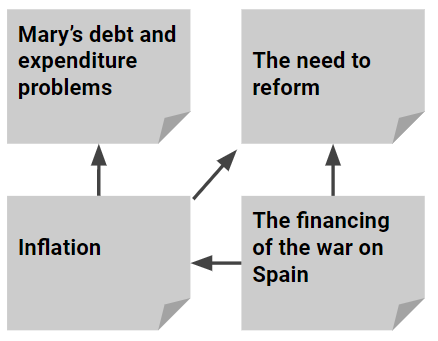
Note
Fortunately, the Queen inherited the Marian Book of Rates and the services of Lord Treasurer Marquess of Winchester and the financier, Sir Thomas Gresham.
Whilst the Queen was a careful spender, her foreign policies especially in the later years would engage her in financial issues. The financial difficulties in 1588 had to be addressed to strengthen her rule.
England was not in a good position when Mary died: it was allied with Spain (not helpful to the Protestant cause) and at war against its traditional enemies, France and Scotland. The inflation due to the debasement of coinage of previous Tudor monarchs worsened the situation. The Queen had two possible solutions to manage these financial problems.
- Increase Crown revenue.
- Reduce the expenditure.
Sources of Crown Income
Ordinary Income
- Crown lands - lands held by the king by inheritance or confiscation from traitors.
- Customs duties - payment collected for English defences.
- Profits of justice - fees paid for royal writs and letters, and fines levied by the court.
- Fundraising from patronage.
Extraordinary Income
- Parliamentary subsidy - basic tax, one-fifteenth of the value of goods in rural areas and one-tenth in urban areas.
Note
Extraordinary income came to the Crown only on specific occasions and for very particular reasons.
Elizabeth could raise money from these numerous sources of income.
- At the time of her succession, the government did not have a lot of cash reserve and plenty of Crown lands were already sold by her predecessors.
- Raising money from taxes was unpopular and meant that Parliament could make demands from the Queen.
- Consequently, she had to analyse the problems and find ways to raise finances.
Problem of Inflation
Note
England was not alone in experiencing inflation during the period. Other European countries suffered much swifter rises in prices.
During Elizabeth's reign, the 75% inflation rate in England from 1558 to 1603 had numerous causes.
Reasons for the High Inflation Rate
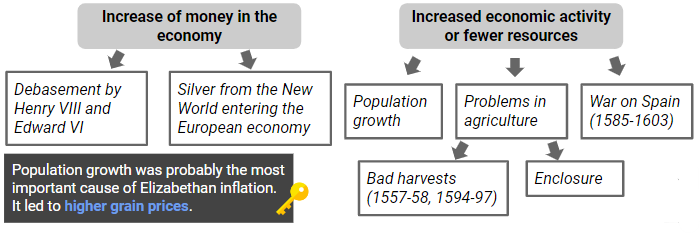
Economic Legislation to Control Inflation Effects
These acts were passed to stop inflation but failed to serve their purpose. The acts targeted different aspects that caused inflation such as high grain prices, enclosures and high wages, which were not the main causes and thus did not help control the situation. Except for the Statute regarding the export of corn that stopped grain exports as a cause of rising food prices, the other acts even caused poverty and conflict.
Act For Maintaining Tillage, 1563
- All land which had been under tillage for four years since 1528 could not be converted to pasture. It was repealed in 1592-3.
Statute of Artificers, 1563
- The maximum wage was fixed, but not the minimum. All unemployed people were obliged to find work.
Statute regarding the Export of Corn, 1592-3
- This banned the export of corn unless the home prices were below twenty shillings a quarter.
Statute against the Conversions to Pasture and Statute Against the Engrossing of Farms, 1598
- These acts were designed to stop further enclosures.
Methods of Raising Finances
Note
To handle the financial problems aggravated by certain economic conditions, Elizabeth employed different methods to raise finances from ordinary revenue and parliamentary taxation.
- The Crown benefitted from the revised Book of Rates as more items were taxed.
- The Act against Usury was passed in 1571, which limited the interest rate of loans within England to 10%.
- Gresham's programme of replacing the debased money with newly minted coins made a healthy profit.
- Crown lands considered as surplus were sold and thus contributed towards building a cash reserve.
- Money was collected from seized monastic properties and transferred into private ownership.
- Attacks on Spanish galleys by Elizabethan privateers on certain occasions were profitable.
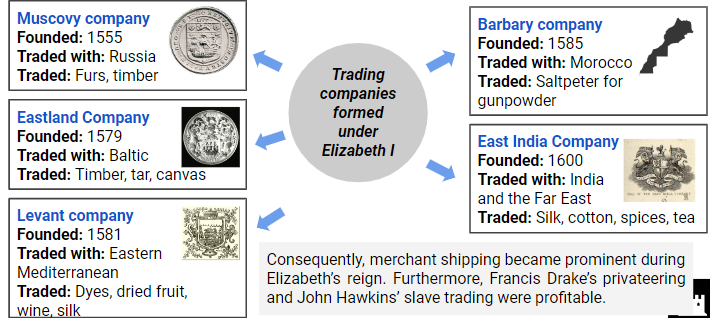
- Participation in joint stock trading companies helped raise revenue.
- More revenues were derived from Fruits and Tenths, vacant bishoprics and fines for not attending church.
Note
With the aid of Lord Treasurer Winchester and Gresham, Elizabeth was able to raise revenue and by 1574, was free of debt.
Whilst royal finances improved, it is believed that Elizabeth's responses were short-term solutions. By the time the war on Spain was declared, the cash reserve was not enough and more funds had to be sourced for the military campaign.
Ordinary revenue was a good source of Crown income. However, it was not fully utilised to improve the financial situation due to inflation.
- Inflation affected the wage-earning labourers the most but in itself was not necessarily bad in Elizabethan England.
- However, the failure to update the system of revenue collection to match the rising prices exacerbated the situation.
- The main areas of ordinary revenue including rental from Crown lands, profits of justice, wardships and customs duties were greatly affected.
- Instead of matching the 75% inflation rate, ordinary revenue saw a percentage increase of 50% and Crown rents 25%. Parliamentary taxation was willingly granted to Elizabeth to raise finances, which consisted of fifteenths and tenths and a subsidy collected by the local gentry and given by the landowners. However, this was not efficient since many landowners were under-assessed and the actual sum collected in a locality was believed to be lower than the actual sum that was sent to London.
Methods of Reducing Costs
Another approach taken by the Crown to improve its financial situation was reducing the royal expenditure. As a result, England did not go bankrupt during Elizabeth's early reign.
How Elizabeth Reduced Royal Expenditure
- She encouraged her courtiers to pay for her summer progress.
- She ended the war with France and avoided conflicts until the 1580s.
- She reduced the size of the royal household.
- She used unpaid local sheriffs and JPs in tax collection, instead of employing state tax collectors.
- She kept away from using financial rewards that cost the Crown and leant towards those that cost others like monopolies.
- She avoided the huge costs of building palaces.
- Instead of building new ships, she ordered the remodelling of old ships to cut the cost of naval expenses.
- She would freeze official salaries when inflation was high.
Impact of War
By the first half of Elizabeth's reign, England was free of debt and was able to raise the cash reserve through a combination of methods. However, England's expenditure was to increase by the second half because of the Spanish war in 1585.
Financial Situation during the Spanish War
- Increased use of extraordinary revenue to make up for the increased expenditure.
- Lack of reform meant ordinary revenue remained about the same, and could not meet the cost of war.
How the Government Raised Revenue to Finance the Spanish War
- Monopolies: Financing the war was costly. Consequently, Elizabeth increasingly used monopolies as a free form of patronage. Monopolists could increase prices without fear of competition.
- Purveyance: It was the right of the Court to buy commodities at a price that they set and was widely used before the war, particularly on royal progress.
- Forced Loans: Elizabeth was forced to borrow, which made the Privy Council unpopular. However, this did little damage to the economy.
- Selling of Crown lands: This raised money quickly without the burden of taxation or interest rates but would affect future Crown income as rents would dramatically decrease.
Note
Parliamentary subsidies also aided Elizabeth during wartime. Elizabeth became the first monarch in English history to have received multiple subsidies from the House of Commons.
Subsidies were granted in 1589, 1593, 1597 and 1601. However, this did not particularly increase the Queen's dependence on Parliament.
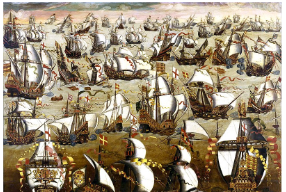
English ships and the Spanish Armada
Note
England emerged victorious in the Anglo-Spanish War but with a £350,000 debt.
Issues of Purveyance and Monopolies
An unintended consequence of raising finance to aid the Spanish war had to do with the issues that surrounded the purveyance and monopolies.
Consequence of Purveyance
Purveyance was used legitimately from 1585 and on a greater scale for the materials to defend England from the Spanish.
- Iron production in the Weald area of Kent suffered because of this practice.
- Weald iron was believed to be of good quality and was central to the strength of the English defence.
- It was in great demand and the price was set so low by the Crown's purveyors.
- As a result, several foundries went out of business.
- Additionally, local taxation increased in the locality to pay for fortifications and militia.
Consequence of Monopolies
Monopolies were thought to benefit only the holder and burden the purchaser. Elizabeth and Robert Cecil were attacked in Parliament for granting monopolies. The Queen gave in and promised to investigate and limit such grants. She addressed Parliament with the famous Golden Speech.
"You may have many a wiser prince sitting in this seat, but you never have had, or shall have, any who loves you better." Elizabeth I, 1601
Overseas Trade
The majority of English exports came from the cloth industry and were the monopoly of the Merchant Adventurers of London. Almost all of this went to Antwerp, a centre of world trade.
Trade was interrupted in 1563, 1568, 1572 and 1576 and had barely continued with the outbreak of the Spanish War in 1585. Finally, when the Scheldt River was closed to English trade, there was a need to find new trade routes and new markets.

New Trade Routes found between 1558 and 1603
1563: Cloth was exported to Emden, just north of the Spanish Netherlands.
1569: Trade moved to Hamburg of the Hanseatic League.
1578: Trade was returned to Emden.
1586: Trade moved to Stade near Hamburg.
Apart from seeking new trade routes, English merchants were encouraged to find new markets with the guarantee of monopoly rights.
Local Unrest Due to Economic and Social Problems
Note
Population growth throughout Elizabeth's reign introduced more problems to society.
Food prices peaked and real wages were at their lowest. Food riots erupted in different parts of the kingdom. Poverty became a major problem.
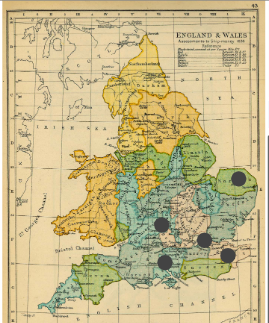
Location of food riots that broke out under Elizabeth I
Causes of poverty
- Population growth strained resources.
- Poor harvests caused starvation and high food prices.
- Sheep farming required fewer labourers.
- Diseases.
- Lack of aid for the poor (monasteries were already dissolved).
- Higher taxation due to the Anglo-Spanish War.
- Trade interruptions led to unemployment.
Why Elizabethans were worried about Poverty
Beggars
Increasing unemployment caused an increase in wandering beggars looking for work.
Disease
Poor nutrition and sanitation lead to outbreaks of infectious diseases. Wandering beggars spread illness.
Rebellions
Discontented nobles would try to win the support of the poor and rebel against the Queen.
Idleness
Very negative sentiment to able-bodied unemployed people. A punishable sin.
Social order
Everyone had their place. Wandering beggars upset the 'natural order' and posed a threat to society.
Crime
Desperate beggars often turned to crime. There was no police force.
The poor people during this period were generally divided into:
Deserving Poor: Poor through no fault of their own and therefore deserving of help through alms, e.g. sick, old, orphans, disabled.
Undeserving Poor: Capable, able-bodied beggars who "couldn't be bothered to find work"
- Abraham men - Faked mental illness.
- Clapperdugeon - Faked sores for sympathy.
- Counterfeit cranks - Used soap foam to fake epilepsy. The government responded with various social legislation.
Social Legislation passed during Elizabeth's Reign
Statute of Artificers, 1563
- This act aimed to maintain high standards of craftsmanship and tie industrial activity to the guild system.
- Seven-year apprenticeships were made compulsory in all urban crafts.
- This set a maximum (but not a minimum) wage.
- Young men had to accept work as labourers and young women were expected to go into service.
Vagabonds Act, 1572
- This act aimed to help the deserving poor with alms.
- Severe penalties were to be enacted against vagrants.
- JPs should keep registers of the poor in their parish and raise a poor rate for those unable to help themselves.
Act for the Relief of the Poor, 1576
- The able-bodied poor were to be directed by the JPs to find work.
- Those who refused were to be sent to a house of correction.
Act for the Relief of the Poor, 1598
- Overseers were assigned to manage the administration of the poor relief.
- They were to secure apprenticeships for children and build hospitals for the sick and old.
- Compulsory poor rates were raised in the parish.
- Each parish should be responsible for its own poor.
Act for the Punishment of Rogues, 1598
- The death penalty was abolished.
- Houses of correction were established for rogues and vagabonds.
- Sturdy beggars were to be whipped and returned to their parishes.
Act for the Relief of the Poor, 1601
- The Elizabethan Poor Law of 1601, combining elements of the previous laws, was enacted and remained in effect for over 200 years.
- It set up a legal framework for the poverty problem.
- Almshouses were encouraged and supported by donations for serving the "deserving poor".
- Vagabonds sent to Houses of Correction didn't address the root cause of poverty.
Note
Whilst these social legislations brought positive changes in England, poverty remained a problem.
Glossary of Terms
Queen Regnant
A female monarch, equivalent in rank to a king, who reigns in her own right.
Patronage
The power to control appointments to office or the right to privileges.
Faction
An informal grouping whose members have shared aims.
Gloriana
An allegory for Elizabeth I, after the name of the heroine of Spenser's epic poem "The Faerie Queene," published in 1590.
Succession Crisis
A crisis arises when an order of succession fails.
Religious Settlement
The religious and political arrangements made for England during the reign of Elizabeth I brought the English Reformation to a conclusion.
Puritanism
The beliefs of English Protestants who sought to purify the Church of England of Roman Catholic practices.
Iconoclasm
The rejection or destruction of religious images as heretical.
Vestment
The robe was worn by the clergy during services.
Puritan Separatism
The practice of separation of Puritans who no longer accepted the Church of England as a true church.
English Renaissance
The cultural and artistic movement in England from the early 16th century to the early 17th century.
Spanish Armada
An enormous 130-ship naval fleet was dispatched by Spain in 1588 as part of a planned invasion of England.
Nine Years' War
The war was fought from 1594 to 1603 between an Irish alliance against English rule in Ireland.
Inflation
The rise in the prices of most goods and services of daily or common use.
Purveyance
The right of the Court to buy commodities at a price they set.
End of Module Summary Questions
Note
What were the issues that Elizabeth encountered relating to her claim to the throne?
Note
What were the roles of the Court, Privy Council and Parliament under Elizabeth I?
Note
How serious was the Puritan challenge and Catholic threat to the Elizabethan Religious Settlement?
Note
How successful was Elizabeth I's management of finances and social issues?
Note
Why was the Elizabethan era regarded as the golden age in English history?