The Energy Change of Reactions (AQA GCSE Chemistry Combined Science): Revision Notes
📚Revision Notes
5.1.4 The Energy Change of Reactions
When a chemical reaction occurs, the amount of energy in the system changes. This change in energy can either involve absorbing energy from the surroundings or releasing energy to the surroundings. This is explained by the principle of conservation of energy, which states:
Energy cannot be created or destroyed; it can only be transferred from one form to another.
System and Surroundings
In the context of energy changes during reactions:
- The system refers to the chemical reaction being studied.
- The surroundings include everything outside the reaction, such as the reaction container and the surrounding environment.
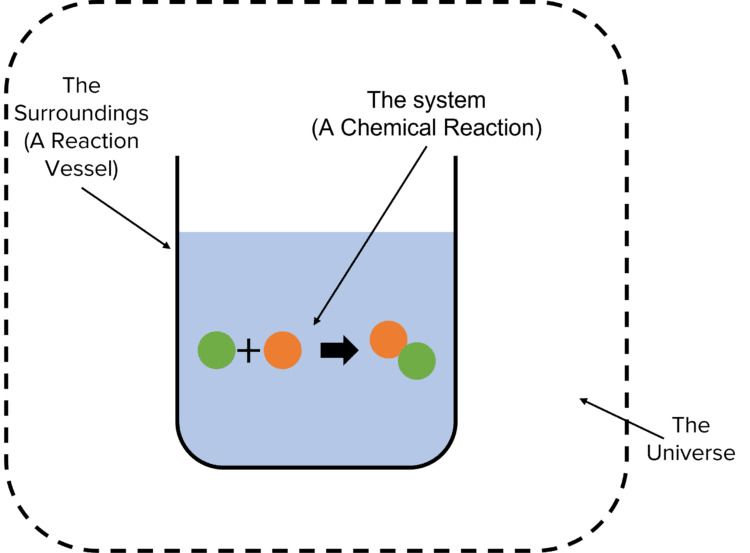
We can also state the principle of the conservation of energy in terms of the universe:
The total energy of the universe remains constant.
Note
This means that if a chemical reaction causes the system to lose energy, that energy must be transferred to the surroundings. Conversely, if the system gains energy, that energy must be absorbed from the surroundings.
Types of Energy Change in Reactions
Chemical reactions can be categorised based on whether energy is released or absorbed:
- Exothermic Reactions:
- In exothermic reactions, the energy stored in the reactants is greater than the energy stored in the products.
- As a result, energy is released to the surroundings, often in the form of heat, causing the temperature of the surroundings to increase.
- Example: Combustion (burning) and neutralisation reactions. If the temperature goes up: The reaction is exothermic.
- Endothermic Reactions:
- In endothermic reactions, the energy stored in the products is greater than the energy stored in the reactants.
- Therefore, energy must be absorbed from the surroundings for the reaction to occur, which often results in a decrease in the temperature of the surroundings.
- Example: Photosynthesis and thermal decomposition reactions. If the temperature goes down: The reaction is endothermic. You can also look at reaction profiles (energy diagrams) to see how energy changes during a reaction and whether energy is being released or absorbed.
Bond Energies
Note
Bond energies are the energy stored within a chemical bond. When a chemical bond is made, energy is released to the surroundings. When a chemical bond is broken, energy must be absorbed from the surroundings.
Every chemical bond will have a specific chemical energy associated with it and these bond energies can be used to calculate the overall energy change of a reaction. To do this, we subtract the energy of the bonds formed by that of the bonds broken.
Note
If the energy change for a given reaction is negative, more energy is released by the bonds formed in the products than is used in breaking the bonds of the reactants.
This means that the reaction releases energy overall.
- If the energy change is negative, the reaction is exothermic.
- When the energy change is positive, the energy released in making bonds is less than what is used to break bonds and so the reaction absorbs energy. This means it that the reaction is endothermic.