Commercial processes (AQA GCSE Design and Technology): Revision Notes
📚Revision Notes
Commercial processes
Commercial processes are essential manufacturing techniques used in the production of electronic and mechanical systems. These automated methods allow for high-speed, accurate assembly of circuit boards and electronic components on an industrial scale. Understanding these processes is crucial for appreciating how modern electronics are manufactured efficiently and reliably.
Note
Commercial processes have revolutionised electronics manufacturing, enabling the mass production of complex devices that power our modern world. Without these automated systems, the smartphones, computers, and electronic devices we rely on daily would be prohibitively expensive and inconsistent in quality.
Pick and place (PNP) assembly
Pick and place assembly represents one of the most important automated manufacturing processes in electronics production. This system uses sophisticated machinery to place electronic components onto circuit boards with remarkable speed and precision.
The process relies on programmable robotic devices that can pick up components at high speed and place them accurately in their designated positions. These machines are particularly well-suited for both surface mount and through-hole components, making them versatile tools in modern manufacturing.
Note
Modern PNP machines can place thousands of components per hour with placement accuracy measured in micrometres, achieving precision levels impossible with manual assembly methods.
Key technologies in PNP assembly
Surface mount technology (SMT) forms the backbone of modern component placement. This robotic system uses vacuum technology to quickly pick components from dispensers and place them precisely onto solder paste or pads on the circuit board. The vacuum system ensures secure handling of even the smallest components without damage.
Through-hole technology offers a more traditional approach where component leads are inserted through pre-drilled holes in the printed circuit board (PCB). While this method is more conventional, it remains important for certain types of components that require stronger mechanical connections.
Important
The combination of these technologies allows PNP machines to handle a wide variety of components, from tiny surface-mount resistors to larger integrated circuits, all within the same automated process. This versatility is crucial for modern mixed-component boards.
Commercial soldering
Once components are placed on circuit boards, they must be permanently attached through soldering. Commercial soldering processes are designed to handle large volumes of circuit boards efficiently while maintaining consistent quality. Two main methods dominate commercial soldering operations.
Flow or re-flow soldering
Flow soldering, also known as re-flow soldering, has become the most popular method for attaching surface mount components. This process can also accommodate through-hole components, making it highly versatile for mixed-component boards.
The process begins with precise application of solder paste to the circuit board using stencils. This ensures that the correct amount of solder is applied to each connection point. Components are then placed onto this paste, which holds them in position temporarily.
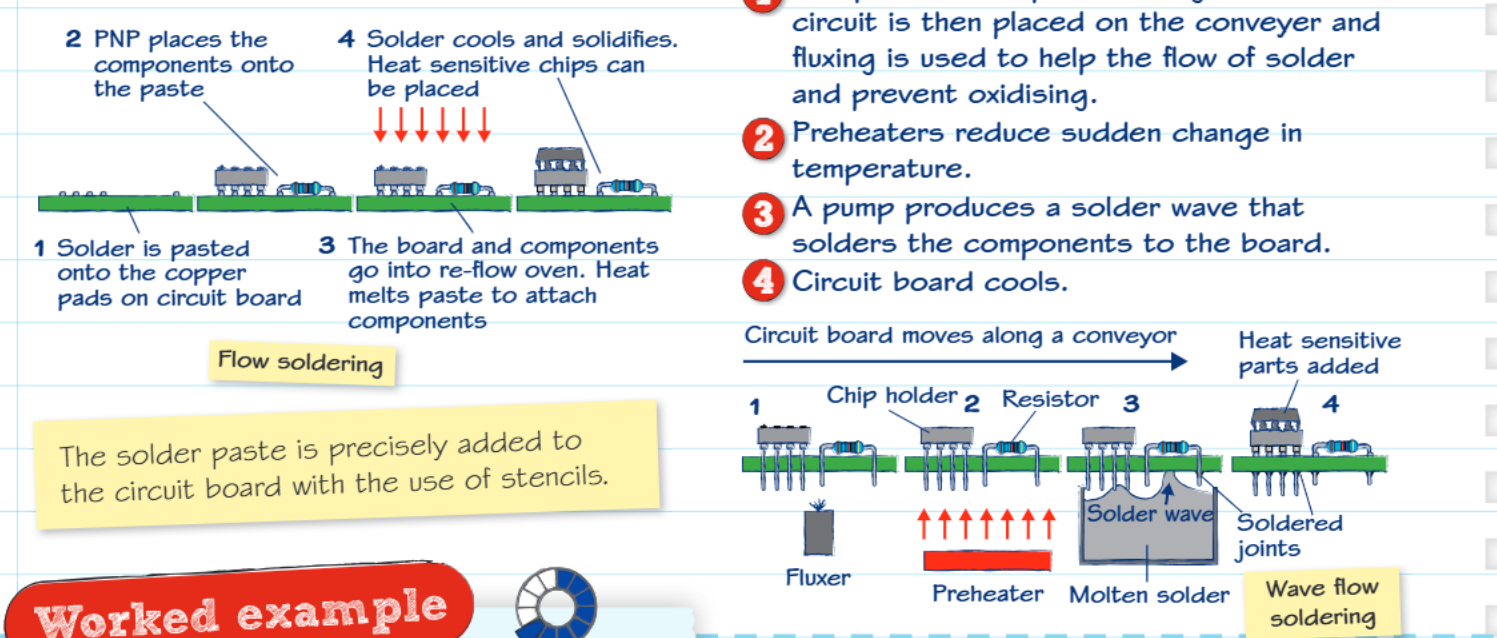 The circuit board with components then passes through a re-flow oven where carefully controlled heating melts the solder paste, creating permanent electrical and mechanical connections. The final cooling stage solidifies these joints, completing the assembly process. Heat-sensitive components can be protected during this process through careful temperature profiling.
Note
Temperature profiling in re-flow ovens is critical for success. The heating curve must be carefully controlled to ensure proper solder flow without damaging sensitive components or causing thermal stress to the circuit board.
Wave flow soldering
Wave flow soldering provides an alternative approach where circuit boards pass over a wave of molten solder contained in a bath. This method proves particularly suitable for surface mount and through-hole components that require robust connections.
The process involves several critical stages. First, components are placed using PNP technology, ensuring accurate positioning before soldering begins. The circuit board then moves along a conveyor system through multiple stations.
Fluxing represents the first treatment stage, where flux is applied to help the solder flow properly and prevent oxidation. Pre-heaters then gradually increase the board temperature, reducing thermal shock that could damage sensitive components.
The heart of the process involves passing the board over a pump-generated solder wave that creates permanent connections between components and the board. Finally, the circuit board cools, solidifying the solder joints and completing the assembly.
Important
Both soldering processes require flux application, though the timing differs. In re-flow soldering, flux is mixed directly into the solder paste, while wave flow soldering applies flux as a separate step in the process sequence.
Advantages of commercial processes
These automated commercial processes offer significant advantages over manual assembly methods. PNP machines eliminate human error in component placement, ensuring consistent accuracy across thousands of boards. The automation also enables continuous operation without breaks, dramatically increasing productivity compared to manual methods.
Commercial soldering processes provide uniform heating and cooling cycles, resulting in more reliable solder joints than hand soldering. The controlled environment also reduces contamination and ensures consistent quality across large production runs.
Note
The economic impact of these processes cannot be overstated. They enable the production of complex electronics at prices accessible to consumers worldwide, driving technological advancement and innovation across industries.
The combination of speed, accuracy, and reliability makes these commercial processes essential for modern electronics manufacturing, enabling the production of complex devices at the scale and quality demanded by today's technology market.
Summary
Key Points to Remember:
- Pick and place (PNP) assembly uses robotic systems to accurately place components at high speed, combining surface mount and through-hole technologies
- Flow/re-flow soldering heats solder paste applied through stencils to create permanent connections, making it ideal for surface mount components
- Wave flow soldering passes boards over molten solder waves, suitable for both surface mount and through-hole components requiring robust connections
- Commercial processes eliminate human error and increase productivity while ensuring consistent quality across large production volumes
- Both soldering methods require flux application to ensure proper solder flow and prevent oxidation, though timing and application methods differ