Exam skills 1 (AQA GCSE Design and Technology): Revision Notes
📚Revision Notes
Exam skills 1
Understanding your exam structure
Your exam will last for two hours and is worth a total of 100 marks. The paper is divided into three distinct sections, each testing different aspects of your knowledge and skills.
Section A (20 marks) focuses on core technical principles through multiple choice and short answer questions. This section tests your broad technical knowledge and understanding of fundamental concepts.
Section B (30 marks) examines specialist technical principles using several short answer questions worth 2-5 marks each, plus one extended response question. This section digs deeper into specific technical areas.
Section C (50 marks) covers designing and making principles through a combination of short answer and extended response questions. This is the largest section and focuses on practical application of your knowledge.
Note
Section Breakdown at a Glance:
- Section A: 20% of total marks (broad technical knowledge)
- Section B: 30% of total marks (specialist knowledge)
- Section C: 50% of total marks (practical application)
Notice that Section C carries the most weight, so allocate your study time accordingly!
Types of questions you'll encounter
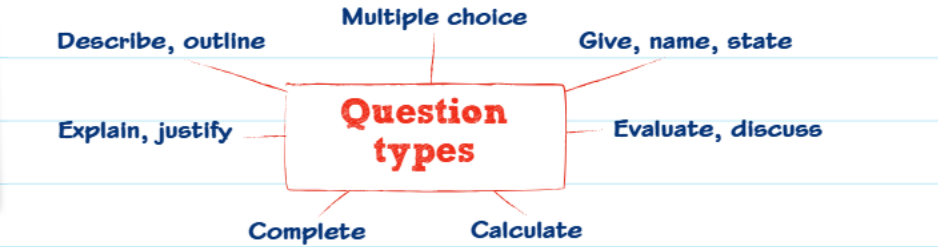 Understanding the different question formats will help you approach each one strategically. Questions can be categorised into several types, each requiring a different approach and level of detail in your response.
Give, name, state questions require you to recall specific information. These are typically one-word answers or simple statements that demonstrate your factual knowledge.
Describe and outline questions ask you to provide more detailed explanations, often requiring you to explain processes or characteristics in a structured way.
Explain and justify questions demand deeper analysis where you need to provide reasons and evidence to support your answers.
Evaluate and discuss questions are the most complex, requiring you to consider different viewpoints, weigh up advantages and disadvantages, and make informed judgments.
Note
Question Complexity Hierarchy: The complexity increases as you move from "give/name/state" questions through to "evaluate/discuss" questions. Higher complexity questions typically carry more marks and require more detailed responses.
Reading questions effectively
Success in any exam starts with understanding exactly what each question is asking. Always read questions carefully and identify the key command words that tell you what type of response is expected.
Pay attention to the context in which questions are set. Most questions relate to specific scenarios, and your answers need to connect directly to that context to earn full marks. For instance, if a question asks why aluminium is suitable for outdoor furniture, you need to consider properties like strength and weather resistance, not just general aluminium properties.
Look at the number of marks allocated to each question as this guides how much detail and how many points you should include in your response. It also helps you manage your time effectively across the entire paper.
Important
Context is Critical! Questions are rarely asking for general knowledge in isolation. They want you to apply your knowledge to specific situations. Always ask yourself: "How does this relate to the scenario described in the question?"
Mastering multiple choice questions
Multiple choice questions can be tricky, but following a systematic approach will improve your success rate significantly.
Start by reading the question carefully and thinking of your own answer before looking at the options provided. This prevents the given choices from influencing your thinking or leading you towards incorrect answers.
Next, read through all the available options and eliminate any answers you know are definitely wrong. This process of elimination increases your chances of selecting the correct answer, even if you're not completely certain.
If you're still unsure after eliminating obviously incorrect options, make your best educated guess from the remaining choices rather than spending too much time on one question.
Important
Never Leave Multiple Choice Questions Blank! Unlike some exams, you won't lose marks for incorrect answers, so always select an option even if you're guessing. A guess gives you a chance of being right - a blank answer guarantees zero marks.
If you get stuck on a particular question, move on to the next one and return later rather than wasting valuable time. This ensures you have enough time to complete the entire paper.
Note
Time Management Strategy: Go through all multiple choice questions once, answering the ones you're confident about. Then return to tackle the more challenging ones with any remaining time.
Approaching short answer questions
Short answer questions typically require brief, focused responses that demonstrate your knowledge without unnecessary detail. These questions often use command words like "give," "name," or "state."
When you see "give," you need to produce an answer from your memory or recall. This usually means providing a specific example, reason, or piece of information.
"Name" questions ask for the correct title or term for something specific. These are often single-word answers or short phrases.
"State" questions require you to answer clearly and briefly, typically providing a straightforward fact or simple explanation.
A helpful technique for all short questions is to circle or highlight the key words in the question. This keeps you focused on exactly what's being asked and prevents you from providing irrelevant information.
Note
Short Answer Strategy: These questions test your ability to be concise and precise. Don't over-complicate your answers - if it's a 1-mark question asking you to "name" something, a single word or short phrase is usually sufficient.
Worked examples in practice
Looking at real examples helps you understand how to apply these strategies effectively.
Example
Worked Example: Ferrous Metal Selection
Question: "Give the name of a suitable ferrous metal that could be used in the manufacture of workshop vices."
Analysis: The key information tells us we need a ferrous (iron-containing) metal suitable for workshop equipment.
Answer: Cast iron
Why this works: Cast iron is strong, durable, and can withstand the forces applied in workshop vices.
Example
Worked Example: Cam Mechanism
Question: "Name the cam shape that causes a follower to gradually rise and fall in a sudden movement."
Analysis: We need to recall knowledge of cam mechanisms and their specific motion patterns.
Answer: Drop (snail) cam
Why this works: This cam type creates the specific gradual rise followed by sudden drop motion described.
Example
Worked Example: Non-renewable Resources
Question: "State one reason why fossil fuels are non-renewable."
Analysis: We need a clear, brief explanation about the nature of fossil fuels.
Answer: Once fossil fuels are burned to release energy, they cannot be replaced or recreated.
Why this works: This directly addresses the non-renewable aspect with a clear cause-and-effect explanation.
Essential exam preparation tips
Make sure you bring all necessary equipment to the examination, including an eraser, ruler, protractor, calculator, compass, and pencils (including coloured pencils). Having the right tools available prevents unnecessary stress during the exam.
Note
Essential Equipment Checklist:
- Eraser
- Ruler
- Protractor
- Calculator
- Compass
- Pencils (including coloured pencils)
Pack these the night before your exam to avoid last-minute panic!
Remember that understanding the context of each question is crucial for providing relevant answers that will earn you full marks. Always relate your responses back to the specific scenario or situation described in the question.
Important
Context Connection is Key! Generic answers rarely earn full marks. Your responses must directly address the specific scenario, material, or situation mentioned in each question.
Summary
Key Points to Remember:
- The exam has three sections with different focuses - know what each section tests
- Always read questions carefully and identify command words before answering
- Use the mark allocation to guide how much detail to include in your responses
- Never leave multiple choice questions blank - always make your best guess
- Circle key words in questions to stay focused on what's being asked
- Context is critical - always relate answers to the specific scenario given
- Bring all necessary equipment and prepare the night before
- Practice with worked examples to understand question patterns