Maths skills 1 (AQA GCSE Design and Technology): Revision Notes
📚Revision Notes
Maths skills 1
Mathematical skills are essential tools you'll need throughout your studies. These fundamental calculations help you work with measurements, shapes, and real-world problems. Let's explore the key concepts of area, volume, and surface area.
Note
The three core mathematical concepts covered in this guide are:
- Area: measures flat, 2-dimensional surfaces
- Volume: measures 3-dimensional space inside objects
- Surface area: measures the total outside surface of 3D shapes
Understanding area calculations
Area measures the amount of 2-dimensional space that a flat shape covers. Think of it as how much paper you'd need to completely cover a shape. Area is always measured in square units like square metres (m²) or square centimetres (cm²).
Important
Always remember that area is measured in square units (m², cm², etc.) - this is crucial for getting the right answer and avoiding unit errors.
Key area formulas you need to know
Rectangles and squares: To find the area, multiply the base by the height. For squares, since all sides are equal, you can simply square one side length.
Triangles: The area equals half the base multiplied by the height. Remember to use the perpendicular height, not the slanted side length.
Circles: Use the formula , where equals approximately 3.142 and is the radius (the distance from the centre to the edge).
Trapeziums: Calculate using half the sum of the parallel sides, then multiply by the height between them.
Note
Quick Formula Reference:
- Rectangle/Square: (or for squares)
- Triangle:
- Circle:
- Trapezium:
Working with volume calculations
Volume tells us how much 3-dimensional space is inside a solid object. Imagine filling the shape with water - volume measures how much water it would hold. Volume is measured in cubic units such as cubic metres (m³) or cubic centimetres (cm³).
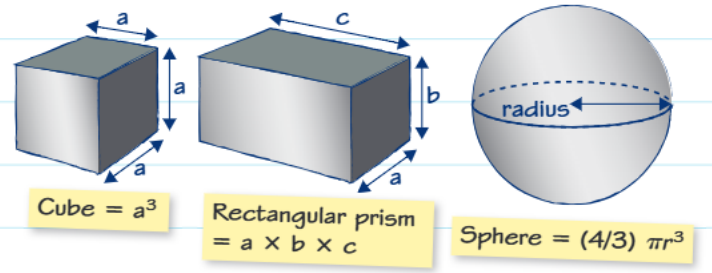 Cubes: When all edges are the same length 'a', the volume equals (a multiplied by itself three times).
Rectangular prisms: Multiply length × width × height, or where these represent the three different dimensions.
Spheres: Use the formula , where is the radius from the centre to the surface.
Note
Understanding volume calculations helps you solve practical problems, like determining how much material you need or calculating weights when you know the density.
Surface area concepts
Surface area measures the total area of all the outside faces of a 3-dimensional shape. Picture wrapping the object in paper - surface area tells you how much paper you'd need.
Working with cylinders
Cylinders are common shapes that appear frequently in calculations. To find their surface area, you need to consider two parts:
Note
Breaking Down Cylinder Surface Area:
The circular ends: Each circle has area , and since there are two ends, their combined area is .
The curved side: When you "unroll" the curved surface, it forms a rectangle. The width equals the cylinder's height, and the length equals the circumference of the circular end (). So the side area equals .
Total surface area: Add both parts together: .
Worked example walkthrough
Example
Worked Example: Complete Cylinder Calculations
Given a cylinder with radius 3.5 cm and height 16 cm:
Step 1 - Finding the cross-sectional area: This is the area of the circular face. Using :
Step 2 - Calculating surface area: Using our formula :
- First part:
- Second part:
- Total:
Step 3 - Finding the volume: Using :
Real-world applications
These calculations aren't just academic exercises - they solve real problems. For example, if you know a part's volume and the material's density, you can calculate its weight. If you know the cost per unit weight, you can determine the total material cost.
Note
Practical Application Example:
Consider an aluminium part using 500 cm³ of material. If aluminium weighs 2.7 grammes per cm³ and costs £3.00 per kilogramme, you can calculate that the part weighs 1350 grammes (1.35 kg) and costs £4.05 to make.
This shows how mathematical skills connect to real-world problem solving in engineering and manufacturing.
Summary
Key Points to Remember:
- Area measures flat surfaces in square units, volume measures space inside objects in cubic units
- Always identify which measurement you need before choosing your formula
- For cylinders, surface area includes both circular ends plus the curved side
- Check your units carefully - make sure they match throughout your calculation
- These skills apply to real-world problems involving materials, costs, and weights