Irony (AQA GCSE English Language): Revision Notes
📚Revision Notes
Irony
What is irony?
Irony is a literary technique that has nothing to do with metal or clothing, but everything to do with the tone and meaning in a piece of writing. When writers use irony, they express the opposite of what they actually mean to convey their true message.
The key to understanding irony lies in recognising that the literal meaning of words or phrases is completely different from the writer's intended meaning. This creates a deliberate contrast that readers can detect through careful analysis of the context.
Note
Writers often employ irony to make their writing more engaging, humourous, or thought-provoking. It can add layers of meaning to a text and help convey the author's viewpoint in a subtle, often light-hearted way.
How to identify irony through context
The most important skill in spotting irony is learning to read the context carefully. Context includes the situation, setting, and surrounding details that help reveal the writer's true intentions.
When you encounter a statement that seems straightforward, ask yourself whether the context supports this literal interpretation. Look for clues in the surrounding text that might suggest the writer means something different from what they've directly stated.
Note
Context is Key: If someone describes pouring rain as "perfect weather for a barbecue," the context of the weather conditions clearly shows this is ironic - the speaker actually means it's terrible weather for outdoor cooking.
A student, having read this section of the text, said: "The writer makes the character's feelings really clear. It feels as if you really get to know her". To what extent do you agree?
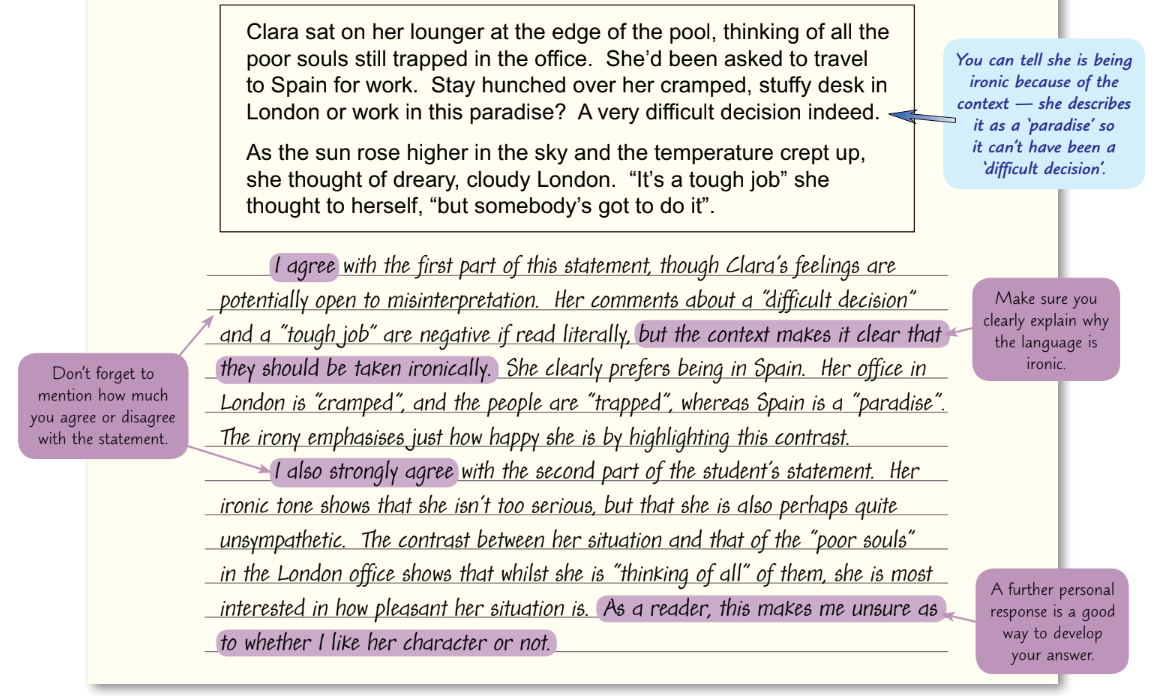
Analysing ironic language in texts
When analysing ironic language, focus on the relationship between what characters say and what they actually mean. Look for contrasts and contradictions that reveal deeper meanings.
Consider how the ironic language affects your understanding of the character or situation. Does it make the character seem more relatable, humourous, or perhaps reveal their true feelings about a situation?
Important
Pay attention to how irony can sometimes make characters appear unsympathetic or reveal their flaws. The contrast between their words and reality can expose their true nature or motivations.
Example analysis techniques
Example
Worked Example: Analysing Ironic Language
When writing about irony in your analysis, make sure to:
Step 1: Clearly explain what the character or narrator is saying literally
Step 2: Identify what they actually mean based on the context
Step 3: Explain how you know this is ironic (what contextual clues reveal this)
Step 4: Discuss the effect this ironic language has on the reader
Step 5: Consider how the irony contributes to character development or theme
Always support your interpretation with specific references to the text and explain your reasoning clearly. Remember that irony can sometimes be subtle, so detailed analysis of context is essential.
Common challenges with irony
Irony can be tricky to spot because the same words can have completely different meanings depending on the context. This is what makes it such an effective literary technique, but it can also make analysis challenging.
Important
Common Pitfalls to Avoid:
Sometimes students struggle to distinguish between what seems like a straightforward statement and genuine irony. The key is always to look at the broader context and consider whether the literal meaning makes sense in the situation described.
Don't assume that negative or critical language is automatically ironic. True irony requires a clear contrast between the literal meaning and the intended meaning, supported by contextual evidence.
Remember!
Summary
Key Points to Remember:
- Irony occurs when writers say the opposite of what they mean to convey their true message
- Context is crucial for identifying ironic language - look at the situation and surrounding details
- Analyse the contrast between literal meaning and intended meaning in your responses
- Consider how irony affects character development and reader understanding
- Always support your interpretation with specific textual evidence and clear explanations