Dividing a line in a given ratio (AQA GCSE Further Maths): Revision Notes
📚Revision Notes
Dividing a line in a given ratio
Introduction to the concept
When working with coordinate geometry, you'll often need to find the coordinates of a point that divides a line segment in a specific ratio. This is a powerful technique that combines ratio work with coordinate geometry to solve various problems.
The key idea is that if you know the coordinates of two endpoints of a line segment, you can calculate where any point lies along that line if you're told the ratio in which it divides the segment.
Understanding through coordinates
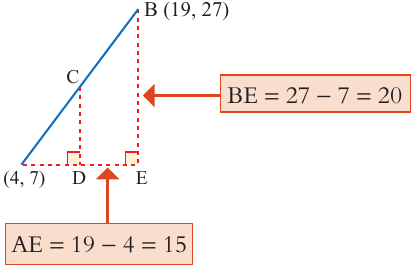
Let's start by looking at a practical example to understand how this works. Consider two points and on a coordinate plane.
Note
When point C divides the line AB in a specific ratio, we can use the horizontal and vertical distances to help us find C's coordinates. In the diagram above, we can see how the horizontal distance and the vertical distance .
If C divides line AB in the ratio , this means . This ratio relationship applies to both the horizontal and vertical components of the line segment.
The section formula
Important
The Section Formula
The section formula is the key tool for solving these problems. When a point C divides a line segment AB internally in the ratio , where A has coordinates and B has coordinates , the coordinates of C can be found using:
This formula works because the coordinates of the dividing point are essentially weighted averages of the endpoint coordinates, where the weights are determined by the ratio.
Step-by-step method
Here's a systematic approach to solve these problems:
Note
Method for Finding Dividing Point Coordinates:
- Identify the given information: Note the coordinates of the two known points and the ratio in which the line is divided
- Determine which ratio applies: Check whether you're given or (these are different!)
- Apply the section formula: Substitute the coordinates and ratio values into the formula
- Calculate separately: Find the x-coordinate and y-coordinate of the dividing point
- Verify your answer: Check that your result makes sense geometrically
Worked example 1: Finding coordinates with internal division
Example
Worked Example: Internal Division
Problem: AB is a straight line where A is and B is . Point C lies on AB such that . Calculate the coordinates of C.
Solution:
Here we have and , with the ratio .
Using the section formula:
For the x-coordinate:
For the y-coordinate:
Therefore, C is at (1, -10).
Worked example 2: Finding coordinates when given partial information
Example
Worked Example: Finding Unknown Endpoint
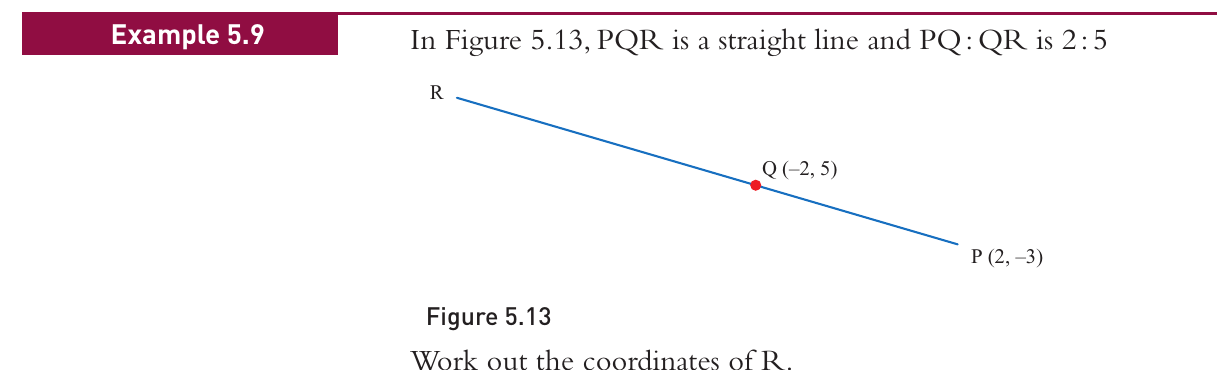
Problem: In the figure above, PQR is a straight line with and . The ratio . Find the coordinates of R.
Solution:
This problem is slightly different because we need to find R, and we're given the ratio rather than .
Since , we can work with and the unknown R, knowing that relates to them in this specific ratio.
Let R have coordinates . We know that Q divides PR in the ratio .
Working with the section formula where Q divides PR in ratio :
For the x-coordinate:
For the y-coordinate:
Therefore, R is at (-12, 25).
Key formulas and definitions
Important
Essential Definitions and Formulas:
Internal Division: When a point lies between two given points on a line segment.
Section Formula: where C divides AB in ratio .
Ratio Notation: means the distance from A to C compared to the distance from C to B is in the ratio to .
Common exam tips and pitfalls
Important
Watch out for these common mistakes:
-
Ratio confusion: Make sure you understand which segments the ratio refers to. is different from .
-
Formula mix-up: In the section formula, the coordinates get "cross-multiplied" with the ratios. The coordinate of the first point multiplies with the second ratio number.
-
Sign errors: Be extra careful with negative coordinates - it's easy to make arithmetic mistakes.
-
Checking your work: Your answer should make geometric sense. If C divides AB in ratio , then C should be closer to B than to A.
Summary
Key Points to Remember:
- The section formula gives you the coordinates of any point that divides a line segment in a given ratio
- When C divides AB in ratio , use:
- The coordinates are weighted averages - the ratios act as weights for the endpoint coordinates
- Always double-check which segments your ratio refers to ( vs makes a big difference)
- Practice with both positive and negative coordinates to avoid arithmetic errors