The midpoint of a line joining two points (AQA GCSE Further Maths): Revision Notes
📚Revision Notes
The midpoint of a line joining two points
What is a midpoint?
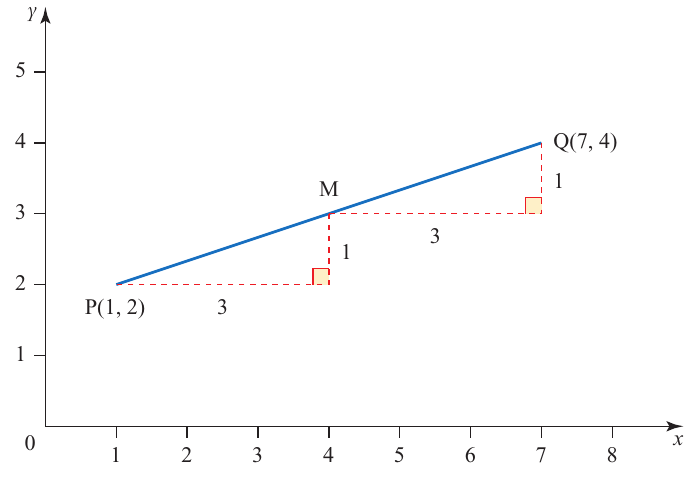
The midpoint of a line segment is the exact centre point that divides the line into two equal parts. When you have two points on a coordinate plane, the midpoint sits exactly halfway between them, both horizontally and vertically.
Note
Looking at the coordinate plane above, you can see points P(1, 2) and Q(7, 4) connected by a line, with point M marking their midpoint. Notice how M sits perfectly in the middle of the line segment PQ.
The midpoint formula
Finding the midpoint is actually quite straightforward - you simply take the average (mean) of the x-coordinates and the average of the y-coordinates.
Important
The midpoint formula: For two points with coordinates and , the midpoint is:
This formula works because the midpoint coordinates are literally the means (averages) of the coordinates of the two endpoints. You add up the x-values and divide by 2, then add up the y-values and divide by 2.
Step-by-step worked examples
Example
Worked Example 1: Finding the midpoint of A(-4, 2) and B(2, 5)
Let's work through this systematically:
Step 1: Identify the coordinates
- Point A: (-4, 2) so and
- Point B: (2, 5) so and
Step 2: Apply the midpoint formula
- x-coordinate of midpoint =
- y-coordinate of midpoint =
Step 3: Write the final answer The midpoint is (-1, 3.5)
Example
Worked Example 2: Working with algebraic expressions
When points are given in terms of variables, the same principle applies. If P has coordinates and Q has coordinates :
Step 1: Apply the formula
- x-coordinate of midpoint =
- y-coordinate of midpoint =
Step 2: Write the answer The midpoint is
This shows that the midpoint formula works with any coordinates, whether they're specific numbers or algebraic expressions.
Key applications and connections
The midpoint formula often appears alongside other coordinate geometry calculations in exam questions. You might be asked to find:
- The midpoint of a line segment (using the formula directly)
- The gradient of the line connecting two points
- The length of the line segment using the distance formula
- Properties of geometric shapes using midpoint calculations
When solving coordinate geometry problems, remember that the midpoint often helps you understand the symmetry and properties of shapes. For instance, the midpoint of a rectangle's diagonal will be the centre of the rectangle.
Common exam tips and problem-solving methods
Important
Watch out for these common traps:
- Make sure you don't mix up the order of coordinates - always keep x-coordinates with x-coordinates and y-coordinates with y-coordinates
- Be careful with negative numbers - when adding negative coordinates, remember your integer rules
- Don't forget to divide by 2 for both coordinates
- Check your arithmetic, especially when dealing with fractions
Problem-solving approach:
- Clearly identify which coordinates belong to which point
- Substitute carefully into the formula
- Show your working step by step
- Double-check your arithmetic
- Write your final answer as a coordinate pair in brackets
Memory aid: Think "average the x's, average the y's" - this reminds you that you're finding the mean position between two points.
Remember!
Summary
Key Points to Remember:
- The midpoint is the exact centre point between two coordinates on a line segment
- Use the formula: Midpoint =
- You're essentially finding the average of the x-coordinates and the average of the y-coordinates
- Always divide both coordinate calculations by 2
- The midpoint formula works with any type of coordinates - positive, negative, fractions, or algebraic expressions