Trigonometric functions for angles of any size (AQA GCSE Further Maths): Revision Notes
📚Revision Notes
Trigonometric functions for angles of any size
Understanding angle measurement conventions
When working with trigonometric functions, it's essential to understand how we measure angles in mathematics. Unlike the simple angle measurements you might be used to, mathematical convention follows a specific system that allows us to work with angles of any size, including those greater than 360°.
In mathematics, we measure angles starting from the positive x-axis (the horizontal line pointing to the right). The direction of measurement follows a crucial rule: moving anticlockwise from the positive x-axis gives us positive angles, while moving clockwise gives us negative angles.
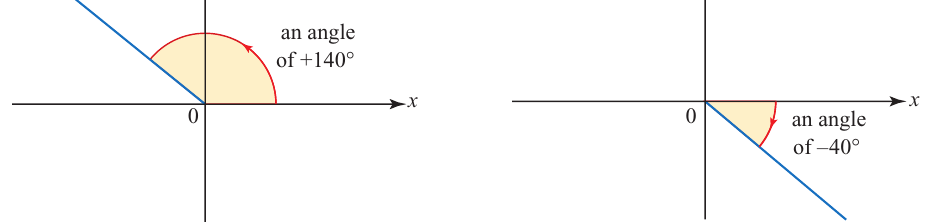
This system allows us to distinguish between different rotational directions and makes calculations with rotational motion much clearer. For example, an angle of +140° means we rotate 140° in the anticlockwise direction from the positive x-axis, while -40° means we rotate 40° in the clockwise direction.
Note
There's one important exception to remember: compass bearings are measured clockwise from the north direction. This is the only common situation where clockwise measurement is considered positive in navigation contexts.
Definitions of trigonometric functions using the unit circle
The traditional definitions of sine, cosine, and tangent that you learned for right-angled triangles can be extended to work with any angle size. This extension uses what mathematicians call the "unit circle" - a circle with radius 1 centred at the origin of a coordinate system.
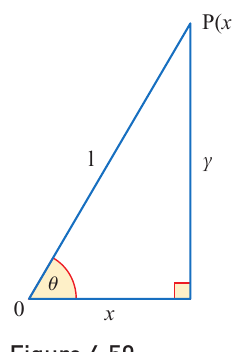
When we place an angle θ (theta) in standard position (vertex at the origin, initial side along the positive x-axis), the terminal side of the angle intersects the unit circle at point P with coordinates (x, y). Since the radius of our circle is 1, we can define the trigonometric functions as:
Key Formulas:
- (the y-coordinate of point P)
- (the x-coordinate of point P)
- (the ratio of y-coordinate to x-coordinate)
These definitions are incredibly powerful because they work for angles of any size, not just those between 0° and 90°. Whether your angle is 45°, 150°, 270°, or even 450°, these relationships always hold true.
Extending beyond 90 degrees
The beauty of this unit circle approach becomes clear when we work with angles larger than 90°. Traditional right-triangle trigonometry breaks down for obtuse angles, but our unit circle definitions continue to work perfectly.
For any angle, no matter how large, we can always find where its terminal side intersects the unit circle and read off the coordinates to determine the trigonometric values. This means we can calculate , , or just as easily as we can find .
This extension is particularly useful in real-world applications involving rotation, oscillation, and wave behaviour, where angles commonly exceed 360° due to multiple complete rotations.
Practical applications
Understanding trigonometric functions for any angle size is crucial for solving complex geometric problems. These concepts appear frequently in GCSE examinations, particularly in problems involving:
- Navigation and bearing calculations
- Heights and distances problems with multiple observation points
- Rotational mechanics and engineering applications
- Wave and oscillation problems in physics
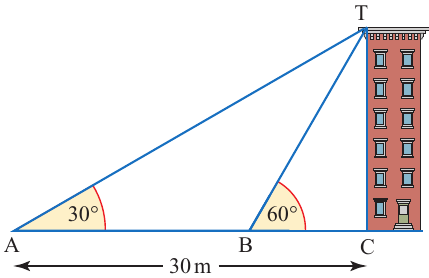
The building height problem shown demonstrates how these concepts apply to real-world situations. When observers at different positions measure angles of elevation to the same object, we can use our extended trigonometric functions to solve for unknown distances and heights, even when the angles involved create complex geometric relationships.
Common exam tips and potential pitfalls
Students often encounter challenges when working with trigonometric functions for any angle size. Being aware of common mistakes and applying effective strategies can significantly improve your performance in examinations.
Important
Watch out for common mistakes:
- Forgetting the sign conventions (positive anticlockwise, negative clockwise)
- Confusing compass bearings (which use clockwise from north) with mathematical angle measurement
- Not recognising that trigonometric functions can have negative values for certain angle ranges
- Mixing up the unit circle definitions with right-triangle definitions
Exam success strategies:
- Always sketch the angle in standard position to visualise the problem
- Check whether your calculator is in degree or radian mode
- Remember that the unit circle approach gives you the exact trigonometric values
- Practice identifying which quadrant an angle lies in to predict the signs of trigonometric functions
Summary
Key Points to Remember:
- Angles are measured anticlockwise from the positive x-axis (positive direction) and clockwise gives negative angles
- The unit circle definitions work for ANY angle size: , ,
- These extended definitions allow us to find trigonometric values for angles greater than 90°
- Compass bearings are the exception - they're measured clockwise from north
- Always visualise angles in standard position to avoid confusion about signs and quadrants