The area of a triangle (AQA GCSE Further Maths): Revision Notes
📚Revision Notes
The area of a triangle
Understanding triangle notation
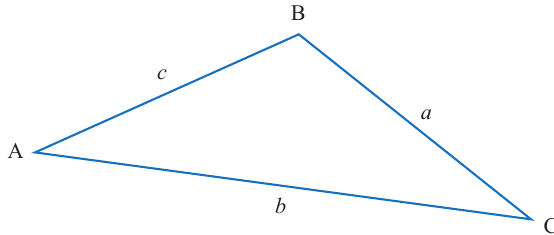
When working with triangles, mathematicians use a standard way of labelling that makes calculations much clearer. In any triangle, we use capital letters A, B, and C to mark the three corners (called vertices). The sides of the triangle get labelled with lowercase letters a, b, and c, where each side is given the letter that corresponds to the vertex opposite to it.
Note
This means that side 'a' is opposite to vertex A, side 'b' is opposite to vertex B, and side 'c' is opposite to vertex C. This consistent labelling system helps us write formulas that work for any triangle, regardless of its shape or size.
The trigonometric area formula
For any triangle, we can calculate its area using this powerful formula:
This formula tells us that the area equals half the product of two sides multiplied by the sine of the angle between them. What makes this formula so useful is that we don't need to know the height of the triangle - we just need two sides and the angle between them.
How the formula works - the proof
To understand why this formula works, let's see how it connects to the basic area formula you already know.
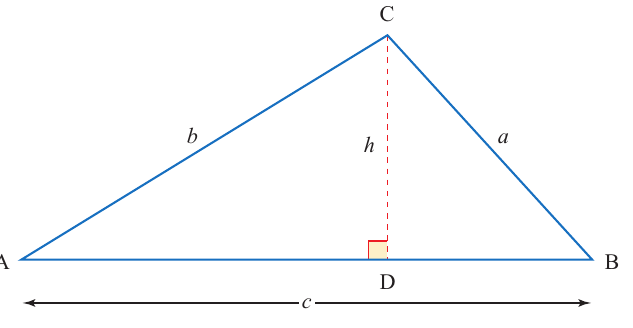
We know that the area of any triangle equals half its base times its height:
In the diagram above, if we use AB as our base (length c) and draw a perpendicular line from C to AB, we get height h. So our area becomes:
Now, looking at the right triangle ACD, we can use trigonometry. The sine of angle A equals the opposite side divided by the hypotenuse:
Rearranging this equation:
When we substitute this back into our area formula:
Note
This proves our trigonometric area formula! The beauty is that this same approach works no matter which vertex we choose as our starting point.
Alternative forms of the formula
Because triangles are symmetrical in their properties, we can write the area formula in three equivalent ways:
Important
A helpful way to remember this is: "Take half the product of any two sides, then multiply by the sine of the angle between those two sides."
Worked example 1: Regular pentagon calculation
Let's see how this formula applies to more complex shapes. Consider a regular pentagon inscribed in a circle with radius 8 cm.
Example
Worked Example: Regular Pentagon Area
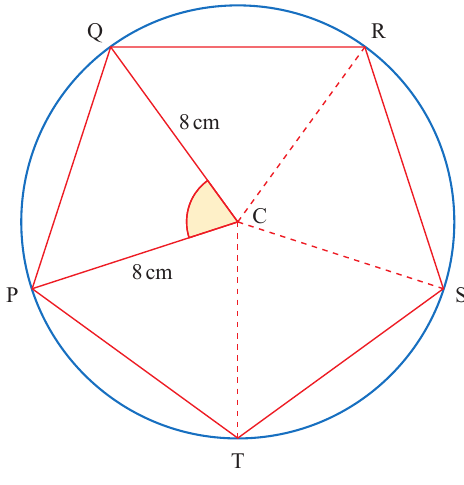
To find the area of triangle CPQ:
- The angle PCQ = 360° ÷ 5 = 72° (since it's a regular pentagon)
- Both sides CP and CQ equal the radius = 8 cm
- Using our formula:
- This gives us: (to 1 decimal place)
For the complete pentagon area: (to 1 decimal place)
Worked example 2: Finding unknown sides
Sometimes we know the area and need to find unknown measurements. Here's an isosceles triangle with area 24 cm² and a 40° angle at the top.
Example
Worked Example: Finding Unknown Side Length
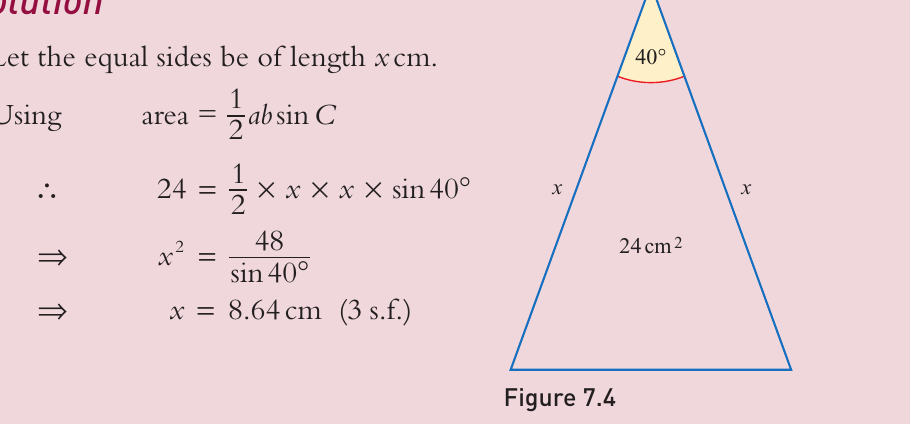
Let the equal sides both have length x cm. Using our formula:
Step 1: Substitute known values
Step 2: Simplify
Step 3: Solve for x²
Step 4: Find x (to 3 significant figures)
This demonstrates how the trigonometric area formula can work backwards to help us find unknown measurements when we know the area.
Key exam tips
When using the trigonometric area formula, these points are essential for exam success:
Important
Critical Points to Remember:
-
Check your angle: Make sure you're using the angle between the two sides you've chosen, not just any angle in the triangle.
-
Calculator mode: Ensure your calculator is in degree mode unless the question specifically uses radians.
-
Significant figures: Always check how many significant figures or decimal places the question asks for in your final answer.
-
Units: Don't forget to include the correct units (usually cm² or m²) in your final answer.
-
Alternative approaches: If you know all three sides but no angles, consider using other methods like Heron's formula instead.
Summary
Key Points to Remember:
-
Triangle sides are labelled with lowercase letters opposite to their corresponding vertices (a opposite A, b opposite B, c opposite C)
-
The trigonometric area formula is: (half the product of two sides times the sine of the included angle)
-
This formula works for ANY triangle - you don't need a right angle or to calculate the height separately
-
The formula has three equivalent forms depending on which angle you use: , , or
-
Always double-check that you're using the angle between the two sides you've selected for your calculation