Using the sine and cosine rules together (AQA GCSE Further Maths): Revision Notes
📚Revision Notes
Using the sine and cosine rules together
When working with triangles, you'll often need to combine both the sine rule and cosine rule to solve complex problems. The key is knowing which rule to use first, and this depends entirely on what information you're given.
Decision-making framework
To solve any triangle completely, you need exactly three independent pieces of information. Here's how to decide which rule to use:
Note
When you have three side lengths: Use the cosine rule to find any angle you need.
Note
When you have two sides and the angle between them (included angle): Use the cosine rule to find the third side length.
Note
When you have two sides and an angle that's not between them: Start with the sine rule to find another angle. Then you can work out the remaining angle using the fact that angles in a triangle sum to 180°. Finally, use either rule to find the missing side.
Note
When you have two angles and one side: Use the sine rule to find another side length. Once you have a fourth measurement, you can find everything else.
Important
Remember that three angles alone aren't independent measurements, since if you know two angles, the third is automatically determined.
Key formulas you'll need
Note
Cosine rule:
- To find a side:
- To find an angle:
Sine rule:
Area formula:
- Area = (where is the angle between sides and )
Worked example: Navigation problem
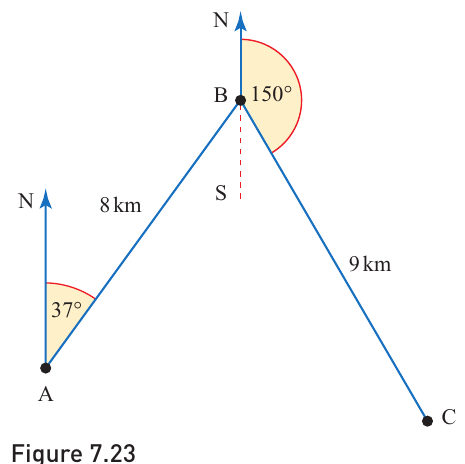
Let's work through a navigation problem involving three towns: Aldbury, Bentham, and Chorton.
Example
Worked Example: Navigation Problem
Given information:
- Bentham is 8km from Aldbury on a bearing of 037°
- Chorton is 9km from Bentham on a bearing of 150°
We need to find:
- The size of angle ABC
- The distance from Chorton to Aldbury
- The bearing of Chorton from Aldbury
Step 1: Find angle ABC
From the bearings, we can work out that:
- Angle ABS = 37° (alternate angles)
- Angle SBC = 30° (adjacent angles on a straight line, since the bearing is 150°)
- Therefore angle ABC = 37° + 30° = 67°
Step 2: Find the distance AC using the cosine rule
We have two sides (AB = 8km, BC = 9km) and the included angle (67°), so we use the cosine rule:
So Chorton is 9.42km from Aldbury.
Step 3: Find the bearing using the sine rule
Now we use the sine rule to find angle BAC:
The bearing of Chorton from Aldbury is 099° (037° + 62°, where 62° is the rounded value of angle A).
Worked example: Finding area
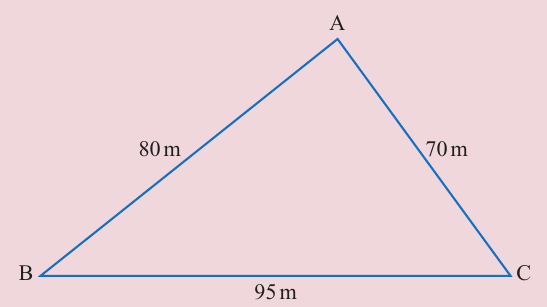
Here's another common type of problem - finding the area of a triangular plot of land.
Example
Worked Example: Finding Area of Triangular Land
Given: A triangular plot with sides of 70m, 80m, and 95m. Find: The area in hectares.
Step 1: Find an angle using the cosine rule
Since we have all three sides, we use the cosine rule to find an angle first:
Step 2: Calculate the area
Now we can use the area formula:
Area =
Area =
Area = 2741m²
Area = 0.27 hectares (to 2 decimal places)
Common exam tips and traps
Important
Always draw a diagram first - This helps you visualise the problem and identify what information you have and what you need to find.
Important
Watch out for bearing problems - Remember that bearings are measured clockwise from North, and you may need to use properties of angles (alternate angles, angles on a straight line) to find the angles in your triangle.
Important
Check for ambiguous cases - When using the sine rule with two sides and a non-included angle, there might be two possible solutions. Always consider whether both make sense in the context.
Important
Keep intermediate values in your calculator - Don't round too early in your calculations, as this can lead to significant errors in your final answer.
Important
Units matter - Always check that your final answer is in the correct units, especially for area problems where you might need to convert between m² and hectares.
Summary
Key Points to Remember:
- You need exactly three independent measurements to solve any triangle completely
- Use cosine rule when you have: all three sides, or two sides with the included angle
- Use sine rule when you have: two angles and a side, or two sides with a non-included angle
- Always draw a clear diagram and label all known information before starting calculations
- In navigation problems, use angle properties to find the angles within your triangle from the given bearings