Engagement Patterns in Sport Between Different Social Groups (AQA GCSE Physical Education): Revision Notes
📚Revision Notes
Engagement Patterns In Sport Between Different Social Groups
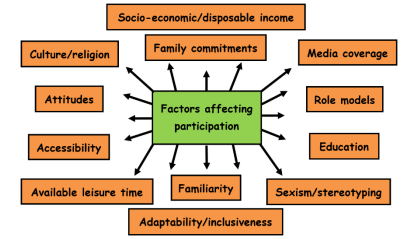
Family/Friends/Peers
| 👉 Explanation | You can be grouped by those you spend time with: • Parents/guardians • Relations • Friends • Siblings • Classmates |
|---|---|
| 👉 Factors affecting participation | Familiarity: You may play the same sport as your family. E.g. you play table tennis because your dad plays table tennis Attitudes: You may not play badminton because your friends don't play Family commitments: You may not play sport because you have to look after younger siblings |
Age
| 👉 Explanation | People are split into groups based on their age: • Children • Teenagers • Adults • Retirees |
|---|---|
| 👉 Factors affecting participation | Accessibility: Many clubs have specific times in which they train/play. If you have other commitments, they cannot play Disposable income: Money may be needed to pay bills rather than play sport Available leisure time: Some people have little spare time due to work commitments Stereotyping: Some people think you are too old to play sport if you are retire |
Gender
| 👉Explanation | Gender groups are determined by a person's sex they are either: • Male • Female |
|---|---|
| 👉 Factors affecting participation | Role models: There are a lack of female role models in many sports Media Coverage: Lack of TV coverage of female sports Sexism: Some girls do not want to play rugby as they think others will think they are masculine Stereotyping: Some males do not want to play netball as they think it is a sport for females |
Race/Religion/Culture
| 👉Explanation | People are grouped based on their: • Culture • specific origin |
|---|---|
| 👉 Factors affecting participation | Cultural influences: Family or peers influence whether someone does an activity or not Disposable income: Due to economic grouping some people from minority groups may have less money. Someone without a permanent job would not have the money needed to access many sports Stereotyping: People from different backgrounds are steered towards or away from certain activities. E.g. people from African origin may be encouraged to participate in athletics rather than activities such as swimming |
Disability
| 👉 Explanation | People are split into groups dependent on their disability |
|---|---|
| 👉 Factors affecting participation | Adaptability: There are many adapted activities available to people with disabilities such as wheel chair tennis and rugby. Adapting sports for the disabled can be expensive and venues are limited Inclusiveness: Sports sessions may not run for people with disabilities. This means it is not inclusive. They are unable to take part in mainstream activities Accessibility: Lack of clubs and facilities in the local area for disabled groups as well as Physical barriers such as lack of ramps or pool hoists. Disposable income: Specialist equipment may be expensive Stereotyping: Someone with a disability think they are unable to participate or others assuming those with disabilities are unable to take part Media coverage: Although there has been an increase in media coverage it is limited Role models: Due to the limited media coverage there is a lack of disabled role models to aspire to |