The Berlin Wall and US-Soviet relations (Edexcel GCSE History): Revision Notes
📚Revision Notes
The Berlin Wall and US-Soviet relations
Introduction
The construction of the Berlin Wall in 1961 represented a crucial turning point in Cold War relations between the United States and Soviet Union. While the Wall created a physical barrier that would divide Berlin for nearly three decades, it paradoxically helped reduce the immediate risk of military conflict over the city. The Wall's construction and the subsequent American response, particularly President Kennedy's famous 1963 visit, became defining moments in the broader Cold War struggle.
Note
The Berlin Wall's construction created a fascinating paradox: while it physically divided the city and symbolised Cold War tensions, it actually helped prevent a potential military confrontation between the superpowers over Berlin.
The impact of the Berlin Wall (1961)
The construction of the Berlin Wall in August 1961 had far-reaching consequences for both superpowers and the people of Berlin. The immediate effect was that Western forces, including British, US, and French troops, remained stationed in West Berlin, maintaining their presence despite the new barrier.
One of the most significant impacts was how the Wall solved the refugee crisis that had been plaguing East Germany. Before its construction, East Germans could freely travel to West Germany, leading to a massive brain drain from the communist state. The Wall effectively ended this population haemorrhage, trapping East Germans within their own borders.
Interestingly, the number of military alerts and tensions in Berlin actually declined following the Wall's construction. President Kennedy himself acknowledged this reality, commenting that while the Wall was not an ideal solution, it was "at least better than a war." This pragmatic view suggested that the Soviets were no longer actively seeking to unify all of Berlin under communist control, as Khrushchev had originally demanded in November 1958.
However, the Wall created a complex propaganda situation. For the Soviet Union, it represented a significant humiliation, as it demonstrated that East Germans preferred living under capitalism and had to be physically prevented from escaping to West Germany. Conversely, for the West, the Wall became a powerful propaganda victory, symbolising the failures of communist rule.
Note
The Berlin Wall served different propaganda purposes for each side. While the West used it to highlight communist failures, the Soviet Union found it embarrassing as it revealed the preference of East Germans for Western capitalism.
The Wall evolved into a notorious barrier that starkly contrasted the freedoms enjoyed by West Berliners with the restrictions imposed on East Berliners. West Berlin transformed into an enduring symbol of freedom during the Cold War, with the Wall highlighting the fundamental differences between the two systems.
Important
The human cost of the Berlin Wall was devastating - over 200 people lost their lives attempting to cross the Wall over the years. This tragic toll became one of the most powerful symbols of the Cold War's impact on ordinary people.
An unintended consequence of the Wall was its effect on Soviet leader Khrushchev's perception of American resolve. He mistakenly interpreted Kennedy's acceptance of the Wall as a sign of weakness, which encouraged him to consider more aggressive actions, including the deployment of missiles in Cuba that would later trigger the Cuban Missile Crisis.
Kennedy's visit to West Berlin (1963)
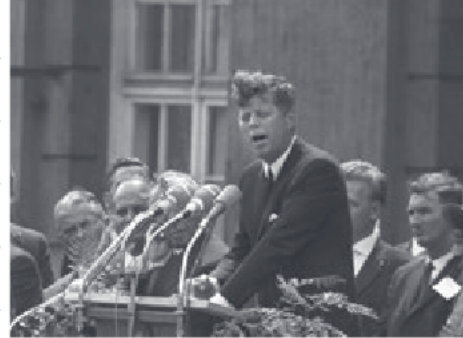
On 26 June 1963, President Kennedy made a historic visit to West Berlin that would become one of the most memorable moments of the Cold War. During his speech, Kennedy famously declared "Ich bin ein Berliner" (I am a Berliner), a phrase that resonated powerfully with his German audience and became symbolic of American commitment to West Berlin's freedom.
Example
Historic Speech: "Ich bin ein Berliner"
On 26 June 1963, President Kennedy delivered one of the most famous speeches of the Cold War era in West Berlin. Standing before an enthusiastic crowd, he declared "Ich bin ein Berliner" (I am a Berliner), demonstrating American solidarity with the people of West Berlin. The speech was delivered at a time when the city remained a flashpoint of East-West tensions, making Kennedy's personal appearance particularly significant.
Kennedy's speech represented far more than mere words - it was a deliberate expression of solidarity with the people of West Berlin. By choosing to visit West Berlin personally, Kennedy demonstrated that both the United States and NATO were fully prepared to defend the city from any communist attack. This personal commitment carried significant weight during the tense Cold War period.
The timing of Kennedy's visit was also strategically important. Coming after the resolution of the Cuban Missile Crisis, the speech served to show both German and American audiences that Kennedy was not "soft on communism." This was crucial for maintaining credibility in the ongoing ideological struggle with the Soviet Union.
The Iron Curtain divides East and West
The construction of the Berlin Wall represented the final piece in what Winston Churchill had famously termed the "Iron Curtain." The Wall filled the last remaining gap in this ideological barrier, meaning that Europe was now completely divided between East and West.
This division created a stark reality: there were now effectively two Germanys, each representing fundamentally different ideologies. West Germany embraced capitalism and democratic governance, while East Germany operated under communist rule. These competing systems stood as living examples of the broader Cold War struggle between different ways of organising society and government.
Note
The division of Germany into two separate states represented more than just political boundaries - it created a living laboratory where two competing ideological systems could be directly compared by their citizens and the world.
The division extended beyond ideology to military alliances as well. On one side of the Iron Curtain stood NATO (the North Atlantic Treaty Organisation), while on the other side was the Warsaw Pact. These rival alliance systems meant that the division of Berlin symbolised the broader division of Europe into two opposing camps, each backed by nuclear superpowers.
Timeline of key events
- November 1958: Khrushchev demands Western forces leave Berlin
- August 1961: Construction of the Berlin Wall begins
- 1961-1963: Over 200 people die attempting to cross the Wall
- 26 June 1963: Kennedy visits West Berlin and delivers famous "Ich bin ein Berliner" speech
- October 1962: Cuban Missile Crisis occurs (influenced partly by Khrushchev's misreading of Kennedy's response to the Wall)
Summary
Key Points to Remember:
- The Berlin Wall (1961) paradoxically reduced immediate military tensions while creating a powerful Cold War symbol
- Kennedy's "Ich bin ein Berliner" speech (26 June 1963) demonstrated unwavering US commitment to West Berlin's freedom
- The Wall completed the Iron Curtain's division of Europe into capitalist NATO countries and communist Warsaw Pact nations
- Over 200 people died trying to cross the Wall, highlighting the human cost of Cold War divisions
- Khrushchev's misinterpretation of Kennedy's response to the Wall contributed to escalating tensions that led to the Cuban Missile Crisis