China’s Carbon Emissions (OCR GCSE Geography B (Geography for Enquiring Minds)): Revision Notes
📚Revision Notes
China's Carbon Emissions
Introduction
China has become the world's largest energy consumer, surpassing all other nations. The country's rapid economic development has driven dramatic increases in both energy consumption and carbon emissions. Understanding China's emissions is essential for grasping global climate change challenges.
Note
China's transformation into an industrial powerhouse has occurred over a remarkably short period, making it a unique case study in the relationship between economic development and environmental impact.
China's contribution to global emissions
Growth in emissions
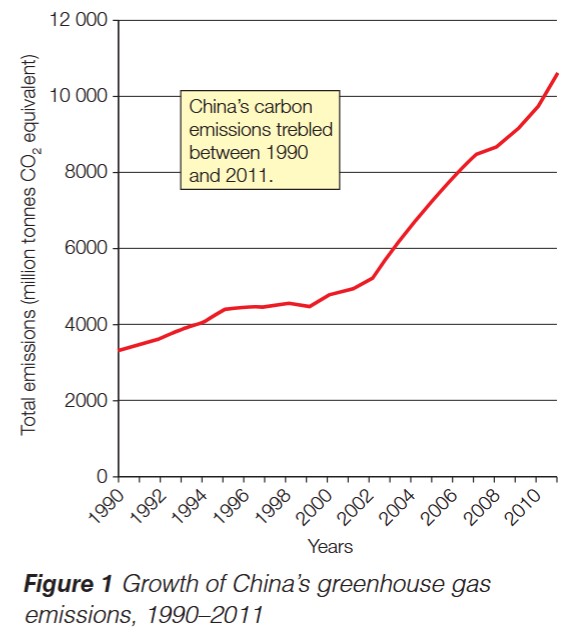
Between 1990 and 2011, China's carbon emissions trebled (multiplied by three). This represents one of the most significant increases in greenhouse gas emissions ever recorded by a single nation. The emissions rose from approximately 4,000 million tonnes of CO2 equivalent in 1990 to over 10,000 million tonnes by 2011.
Is it fair to blame China?
China frequently faces criticism for the global rise in carbon emissions. However, this criticism may be unfair for several important reasons:
Historical development pattern
China is following a similar development path to industrialized nations like the UK during their historical industrialization. Advanced countries went through their own period of high emissions during the 19th and early 20th centuries when they developed their manufacturing industries.
Note
Development Context
The UK, USA, and other Western nations experienced similar emissions growth during their industrialization periods. The key difference is timing—they developed over 150-200 years, while China's transformation has occurred in just 30-40 years.
Manufacturing for global consumption
A significant proportion of global consumer products are now produced in China. When we purchase goods manufactured in China, we are contributing to these emissions indirectly. The carbon footprint of these products arguably belongs to the consumers worldwide, not just to China.
Cumulative emissions comparison
When examining cumulative (total) emissions over the past 250 years, China's contribution is considerably lower than that of the USA and Europe. These developed regions have been emitting greenhouse gases for much longer periods during their industrialization and subsequent economic growth.
Important
Historical Responsibility
While China currently produces high annual emissions, the USA and Europe have contributed far more to the total atmospheric CO2 over the past 250 years. This distinction between annual and cumulative emissions is crucial for understanding climate responsibility.
Development context
China developed its manufacturing industries during the 19th and 20th centuries, similar to Western nations. The country is attempting to raise living standards for its population, just as developed countries did historically.
China's dependence on coal
Coal in China's energy mix
Coal accounts for two-thirds (66%) of China's total energy supply, making it the dominant energy source in the country. Coal is the most polluting fossil fuel of all available energy sources, producing significant amounts of carbon dioxide and other harmful pollutants when burned.
Note
Why Coal?
China's heavy reliance on coal stems from several factors: abundant domestic coal reserves, lower costs compared to imported alternatives, and existing infrastructure built around coal-based energy. This dependence is difficult to change quickly due to economic and technical constraints.
Coal and manufacturing
Coal plays a critical role beyond power stations. It is extensively used by many of China's manufacturing industries, particularly in heavy industry and steel production. This industrial use makes it extremely difficult to reduce coal consumption quickly.
The steel industry and coal dependence
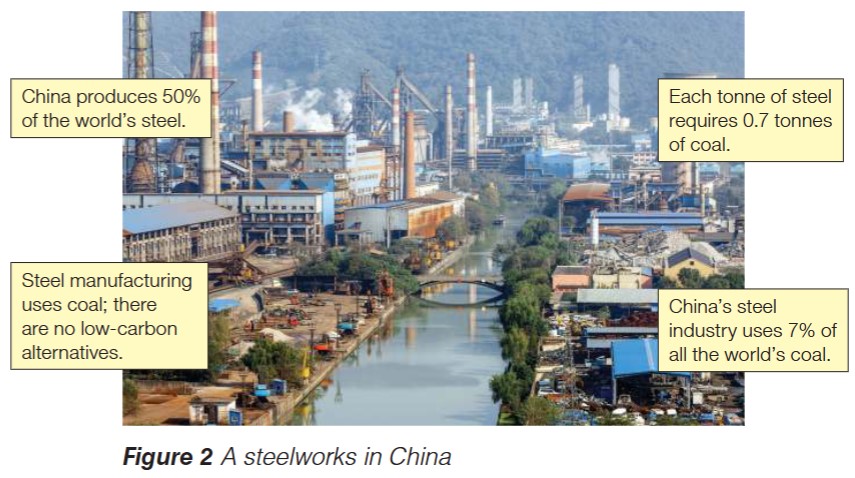
China's steel industry demonstrates the country's coal dependence through several key statistics:
Production levels
China produces 50% of the world's steel, making it by far the largest steel manufacturer globally. This massive production requires enormous energy inputs.
Coal requirements
Each tonne of steel manufactured requires 0.7 tonnes of coal. This direct relationship means that high steel production automatically translates to high coal consumption.
Global coal consumption
China's steel industry alone uses 7% of all the world's coal. This single sector's consumption highlights the scale of China's coal dependence.
Lack of alternatives
Steel manufacturing uses coal as an essential component of the production process, and currently there are no viable low-carbon alternatives. This means reducing emissions from steel production is extremely challenging with current technology.
Important
The Steel-Coal Connection
Steel production is fundamentally linked to coal use. Coal serves not just as an energy source but as a chemical reducing agent in the steelmaking process. Until breakthrough technologies emerge, reducing steel production is the only way to significantly cut coal consumption in this sector.
Exam guidance
Note
Answering Questions on China's Carbon Emissions
For 'describe' questions:
- Use data from graphs and figures
- Mention specific time periods and values
- Describe trends (e.g., trebled between 1990 and 2011)
For 'explain' questions:
- Link economic growth to energy consumption
- Connect manufacturing growth to emissions
- Explain the role of coal in different sectors
- Discuss China's development stage
For 'assess' or 'evaluate' questions:
- Present balanced arguments
- Consider historical context and fairness
- Compare with developed nations
- Discuss cumulative versus annual emissions
- Consider who benefits from Chinese manufacturing
Summary
Key Points to Remember:
-
China's carbon emissions trebled between 1990 and 2011, rising from approximately 4,000 to over 10,000 million tonnes of CO2 equivalent.
-
Coal provides 66% of China's energy, making it the most coal-dependent major economy and explaining its high emissions levels.
-
China produces 50% of the world's steel, with each tonne requiring 0.7 tonnes of coal – currently there are no low-carbon alternatives for steel production.
-
Blaming China solely for global emissions may be unfair because: it is following the same development path as Western nations did historically; many goods are manufactured for global consumption; and its cumulative emissions over 250 years are less than the USA and Europe.
-
When assessing China's responsibility for emissions, consider both who produces the goods (China) and who consumes them (global markets), as well as historical versus current emissions.