China’s Water Crisis (OCR GCSE Geography B (Geography for Enquiring Minds)): Revision Notes
📚Revision Notes
China's Water Crisis
The nature of China's water problem
China is experiencing a severe water scarcity problem. The situation is particularly critical in the North China Plain, where economic development requires substantial water resources.
Important
The scale of the crisis is alarming:
- Over 50% of China's rivers have completely disappeared
- Half of the remaining rivers suffer from pollution
- The problem is most severe in the dry northern regions where industrial and agricultural growth demands increasing water supplies
The South-North Water Transfer Project (SNWTP)
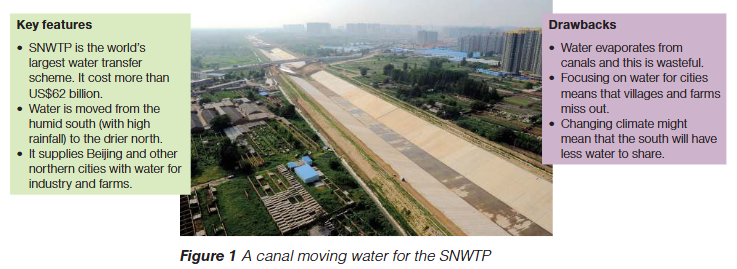
To address this water crisis, the Chinese government developed the South-North Water Transfer Project, commonly known as SNWTP. This represents the world's largest water transfer scheme and cost over US$82 billion to construct.
Note
The fundamental concept is straightforward: water is transferred from the wet southern regions (which receive high rainfall) to the arid northern areas where water is scarce.
How the project works
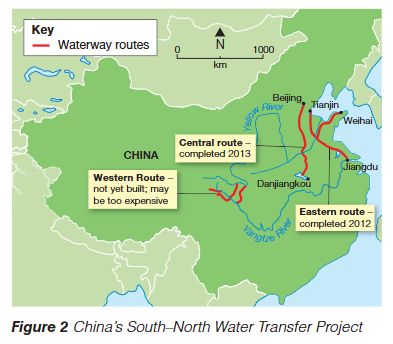
The SNWTP operates by transferring water along three separate routes connecting China's two largest river basins: the Yangtze River in the south and the Yellow River in the north.
Note
The three routes are:
Central route - Completed in 2013, this route transfers water through the middle of the country.
Eastern route - Completed in 2012, this follows the eastern part of China.
Western route - This route has not yet been built as it may prove too expensive to construct.
Key features of the SNWTP
The South-North Water Transfer Project has several important characteristics:
Scale and investment - As the world's largest water transfer scheme, it required investment exceeding US$82 billion.
Water source and destination - Water is moved from the humid south, which experiences high rainfall, to supply the drier northern regions.
Urban and agricultural supply - The project supplies major cities including Beijing and Tianjin with water for both industrial production and farming activities.
Drawbacks and challenges
Despite its ambitious scale, the SNWTP faces several significant challenges:
Important
Water wastage - Substantial amounts of water evaporate from the open canals during transfer, representing a wasteful loss of this precious resource.
Urban focus - The project concentrates on supplying water to cities, which means that rural villages and farms may miss out on receiving adequate water supplies.
Climate change uncertainty - Changing climate patterns might mean that the southern regions will have less water available to share in the future, potentially undermining the entire project.
Summary
Key Points to Remember:
- China faces a critical water shortage, with over half its rivers disappeared and half the remainder polluted
- The North China Plain is particularly affected as economic growth increases water demand
- The SNWTP is the world's largest water transfer project, costing over US$82 billion
- Water moves from the wet Yangtze River basin in the south to the dry Yellow River basin in the north along three routes
- Two routes (Central and Eastern) are operational; the Western route remains unbuilt due to costs
- Key challenges include water evaporation from canals, urban bias leaving rural areas underserved, and climate change threatening future water availability in the south