Sustainable Development (OCR GCSE Geography B (Geography for Enquiring Minds)): Revision Notes
📚Revision Notes
Sustainable development
China's changing priorities
China's approach to development is shifting significantly. The Chinese government now prioritises quality of growth rather than simply achieving high economic growth rates. This change reflects growing concern about environmental problems that have emerged after years of rapid industrialisation.
Note
For decades, the Chinese government either ignored or denied environmental issues caused by economic expansion. However, the population's increasing awareness of environmental damage has forced a policy rethink.
The key question facing China today is: can the country achieve both economic growth and sustainable development?
Economic growth and the environment
The relationship between development and environmental damage
When countries pursue rapid economic development, there are typically severe environmental consequences. Evidence from the past 250 years demonstrates a clear correlation between economic growth and environmental degradation.
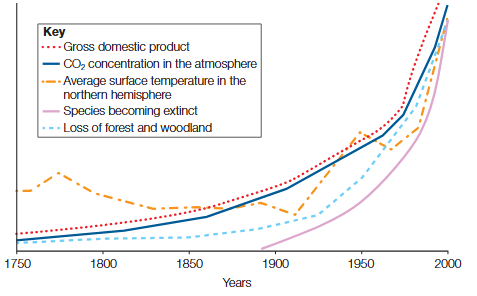
The graph reveals several concerning trends as GDP (Gross Domestic Product) has risen:
- CO₂ levels in the atmosphere increase - contributing to climate change
- Surface temperatures rise - evidence of global warming
- Species become extinct at accelerating rates - biodiversity loss
- Forest and woodland areas disappear - deforestation and habitat destruction
Important
All these environmental indicators show exponential increases, particularly since 1950, mirroring the rapid rise in global economic activity.
Note
Exam tip: When describing graphs showing environmental change over time, identify the overall trend (e.g. exponential increase), note key turning points, and link changes to specific time periods or events.
Sustainable options for China
China faces challenging decisions about how to develop more sustainably. These options involve trade-offs between economic growth, social needs, and environmental protection. The country must consider changes across four key sectors:
Economic growth
China's manufacturing sector has driven economic expansion but created significant pollution. Two main pathways exist:
Transition from manufacturing to services - This involves closing factories and opening offices. Service industries typically generate less pollution than heavy manufacturing. However, this could mean job losses in industrial regions and requires investment in education and skills training.
Note
Trade-offs to consider:
- Benefit: Lower pollution levels from service-based economy
- Challenge: Job losses in industrial regions
- Requirement: Investment in education and skills training
Maintain manufacturing but adopt cleaner technologies - Factories remain open but switch to cleaner fuels and implement pollution-reducing technology. This protects jobs but requires significant investment and may reduce profit margins.
Important
Exam guidance: When evaluating development strategies, consider:
- Economic impacts (jobs, GDP)
- Social impacts (quality of life, health)
- Environmental impacts (pollution, resource use)
Water management
China faces severe water stress, with water scarcity in northern regions and surplus in the south. Sustainable water management options include:
Inter-regional water transfer schemes - Build canals and tunnels to move water from wetter southern regions to drier northern areas. This is expensive infrastructure requiring huge capital investment and can disrupt ecosystems.
Note
Considerations:
- Requires massive infrastructure investment
- Can disrupt local ecosystems
- Provides long-term solution to regional water imbalance
Improve water efficiency and reduce pollution - Charge more for water to discourage wasteful use, then invest revenue in repairing leaking pipes and cleaning up polluted water sources. This approach requires less infrastructure but may be unpopular with the public and businesses.
Energy provision
Energy production is a major source of China's carbon emissions. The country can pursue different energy strategies:
Switch from coal to cleaner non-renewable sources - Replace coal-fired power stations with gas-powered facilities. Gas produces less CO₂ and air pollution than coal, but remains a finite, non-renewable resource that contributes to climate change.
Transition to renewable energy - Invest heavily in wind farms and solar power installations. These produce clean energy indefinitely but require substantial upfront costs and may not yet provide sufficient, reliable baseload power.
Important
Key concept: Non-renewable energy sources (coal, oil, gas) will eventually run out and produce greenhouse gases. Renewable sources (wind, solar) are sustainable long-term but often require greater initial investment.
Transport infrastructure
Urban transport creates significant air pollution and congestion in Chinese cities. Sustainable transport options include:
Ban cars from city centres - Prohibit private vehicles and encourage walking and cycling instead. This dramatically reduces air pollution and improves public health, but may prove unpopular and difficult to enforce. It also requires investment in cycling infrastructure.
Note
Benefits and challenges:
- Major reduction in urban air pollution
- Improved public health outcomes
- Challenge: Public resistance and enforcement difficulties
- Requirement: Investment in cycling infrastructure
Enhance public transport networks - Expand train and bus services so they become more convenient than private cars. This reduces overall emissions per person but requires major investment in infrastructure and may take years to change behaviour patterns.
Making sustainable choices
These options demonstrate that sustainable development requires difficult compromises. Each pathway has advantages and disadvantages. China must balance:
Note
The three pillars of sustainable development:
- Economic considerations - maintaining growth and employment
- Social factors - public health, quality of life, and fairness
- Environmental protection - reducing pollution and conserving resources
The choices China makes will have global implications, given its size and economic importance.
Important
Exam tip: When asked to evaluate sustainable development strategies, use a framework:
- Identify the strategy
- Explain how it works
- Assess its effectiveness
- Consider limitations or drawbacks
- Reach a balanced judgment
Remember!
Summary
Key Points to Remember:
-
China is shifting from prioritising economic growth rate to quality of growth that considers environmental impacts
-
Historical data shows strong correlation between GDP growth and environmental damage (rising CO₂, temperatures, extinction rates, and forest loss)
-
Sustainable development requires difficult choices across four key sectors: economic growth, water, energy, and transport
-
Each sustainable option involves trade-offs - for example, switching to services from manufacturing or maintaining industry with cleaner technology
-
Water management choices include expensive transfer schemes or improving efficiency through pricing and infrastructure repair
-
Energy options range from switching to cleaner fossil fuels (gas) to investing in renewable sources (wind and solar)
-
Transport solutions involve either restricting car use or making public transport more attractive through investment