Waiting for the Big One (OCR GCSE Geography B (Geography for Enquiring Minds)): Revision Notes
📚Revision Notes
Waiting for the Big One
California's earthquake risk
California is one of the most earthquake-prone regions in the USA. This is because Southern California is located on the San Andreas Fault, which marks the boundary where the North American Plate and the Pacific Plate meet. These two massive tectonic plates are constantly moving, creating enormous pressure along the fault line. When this pressure is released, earthquakes occur frequently along different parts of the fault.
Note
A plate boundary is where two tectonic plates meet. At the San Andreas Fault, the North American and Pacific plates slide past each other in opposite directions, creating tremendous friction and pressure that is released as earthquakes.
The San Andreas Fault
The San Andreas Fault is a major geological feature that runs through California. It represents a plate boundary where two tectonic plates slide past each other. This type of boundary creates significant seismic activity because the plates do not move smoothly – instead, they stick and then suddenly slip, releasing energy as earthquakes.
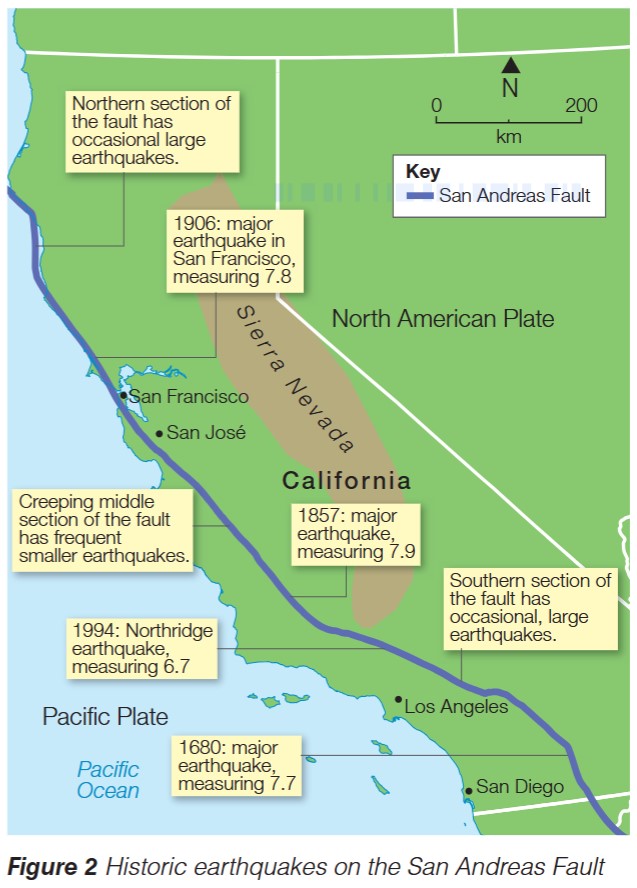
The fault can be divided into three distinct sections, each with different earthquake characteristics:
Northern section: This area experiences occasional large earthquakes. The most notable was the 1906 San Francisco earthquake, which measured 7.8 on the Richter Scale and caused devastating damage to the city.
Middle section: This is known as the "creeping" section of the fault. Here, the plates move more gradually and continuously, which results in frequent smaller earthquakes rather than major ones. This regular movement actually reduces the risk of a massive earthquake in this area.
Southern section: This area also experiences occasional large earthquakes. However, it is currently of greatest concern because there has not been a major earthquake here for 150 years, meaning pressure has been building up for a very long time.
Important
The southern section of the San Andreas Fault is the most concerning area because pressure has been building for 150 years without a major earthquake. The longer the time since the last major earthquake, the more energy accumulates, making the eventual earthquake potentially more powerful and destructive.
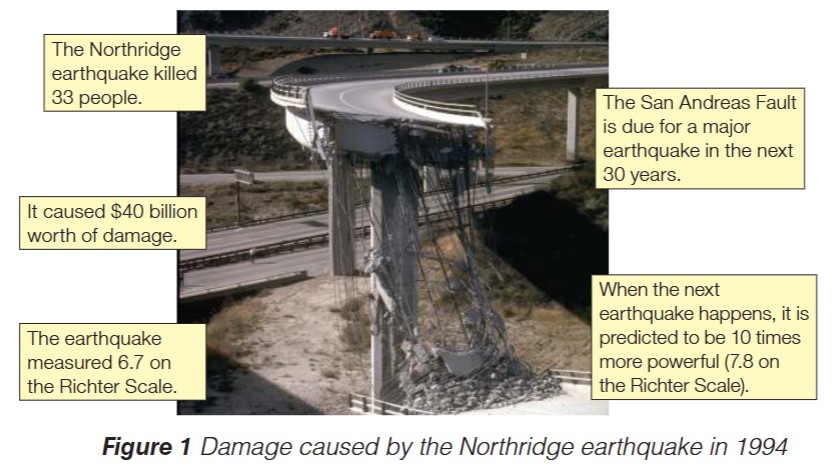
The 1994 Northridge earthquake
The Northridge earthquake serves as an important case study for understanding the impact of major earthquakes in California. This earthquake struck on 17 January 1994 and provides clear evidence of the destructive power of seismic events in built-up areas.
Example
Case Study: The 1994 Northridge Earthquake
Key facts about the Northridge earthquake:
- Magnitude: 6.7 on the Richter Scale
- Deaths: 33 people were killed
- Economic damage: $40 billion worth of damage was caused
- Infrastructure impact: Major roads and highways collapsed, including elevated motorway sections (as shown in the photograph below)
The collapsed highway overpasses demonstrate how earthquake forces can cause complete structural failure of major infrastructure. These roadways were designed to carry heavy traffic, but the intense shaking caused supporting columns to fail and entire sections of road to collapse.
Historical context
The Northridge earthquake was not an isolated event. California has experienced several major earthquakes throughout its recorded history:
- 1857: A major earthquake measuring 7.9 on the Richier Scale struck the southern section of the fault
- 1906: The devastating San Francisco earthquake measured 7.8 on the Richter Scale
- 1980: Another major earthquake measuring 7.7 occurred
- 1994: The Northridge earthquake measured 6.7
This pattern of repeated major earthquakes shows that California faces ongoing seismic risk, and earthquakes will continue to occur in the future.
Predictions for the future
Scientists who study earthquakes have made concerning predictions about California's seismic future. They refer to the next major earthquake as "The Big One."
What is predicted?
The next major earthquake is expected to occur at the southern end of the San Andreas Fault. This section is particularly concerning because:
- There has not been a major earthquake there for 150 years
- Pressure has been building along this section for over a century
- When it does occur, it is predicted to happen within the next 30 years
Important
The "Big One" - Critical Prediction
The San Andreas Fault is due for a major earthquake in the next 30 years. This prediction is based on the length of time since the last major earthquake and the amount of pressure that has accumulated along the fault line.
Expected magnitude and power
The predicted earthquake is expected to measure 7.8 on the Richter Scale. To put this in perspective:
- The Northridge earthquake measured 6.7
- The predicted earthquake at 7.8 would be approximately 10 times more powerful than Northridge
- This means the shaking would be much more intense and last longer
- Damage would be far more extensive than the $40 billion caused by Northridge
Note
Understanding Earthquake Magnitude
The Richter Scale is logarithmic, meaning each whole number increase represents a tenfold increase in the amplitude of seismic waves. A magnitude 7.8 earthquake releases approximately 10 times more energy than a magnitude 6.7 earthquake, resulting in significantly more powerful shaking and greater potential for destruction.
Why this matters
The southern section of the San Andreas Fault runs close to major population centers, including Los Angeles and San Diego. Millions of people live and work in this area, which means a major earthquake would affect:
- Millions of residents
- Critical infrastructure (roads, bridges, water supplies, electricity)
- The economy of California and beyond
- Emergency services and rescue capabilities
The longer the time since the last major earthquake in this section, the more pressure builds up along the fault. This makes the eventual earthquake potentially more powerful when it finally occurs.
Summary
Key Points to Remember:
-
California sits on the San Andreas Fault, which marks the boundary between the North American Plate and the Pacific Plate, making it highly vulnerable to earthquakes
-
The 1994 Northridge earthquake (magnitude 6.7) killed 33 people and caused $40 billion in damage, demonstrating the destructive power of earthquakes in urban areas
-
The San Andreas Fault has three sections: the northern section with occasional large earthquakes, the creeping middle section with frequent smaller earthquakes, and the southern section with occasional large earthquakes
-
"The Big One" is predicted within the next 30 years at the southern end of the fault, where there hasn't been a major earthquake for 150 years
-
The predicted earthquake will measure 7.8 on the Richter Scale, making it approximately 10 times more powerful than the Northridge earthquake, with potentially catastrophic consequences for major cities like Los Angeles