Improving London’s Transport (OCR GCSE Geography B (Geography for Enquiring Minds)): Revision Notes
📚Revision Notes
Improving London's transport
London's transport challenges
London benefits from a comprehensive and interconnected public transport network. However, the system faces significant capacity challenges as the city's population continues to grow. Currently, approximately 75 million passengers use buses and trains in London every week, placing enormous pressure on the existing infrastructure.
Note
This massive weekly passenger volume - equivalent to moving the entire population of the UK every single week - demonstrates why London's transport system needs continuous expansion and improvement to meet growing demand.
The Crossrail project
What is Crossrail?
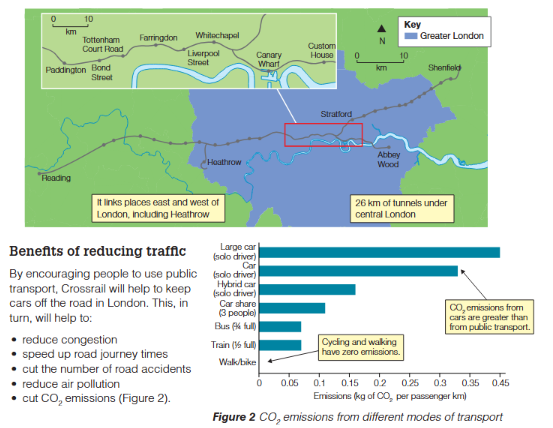
Crossrail is a new, high-speed rail route connecting east and west London. The project opened in 2019 and represents a major investment in London's transport infrastructure. The route creates a direct link between areas such as Heathrow Airport in the west and destinations in east London including Stratford and Abbey Wood.
Note
Why Crossrail matters: Before Crossrail, traveling east-west across London often required multiple changes and could take over an hour. Crossrail creates a single, fast connection that transforms how people move across the capital.
Route and infrastructure
The Crossrail route includes 26 kilometres of tunnels beneath central London, allowing trains to pass through the busiest parts of the city without adding to surface congestion. The line connects major stations including Paddington, Bond Street, Liverpool Street, Canary Wharf and Stratford.
Benefits of Crossrail
Crossrail delivers multiple benefits to London and its residents:
Increased capacity: The network can accommodate significantly more passengers, helping to relieve pressure on existing routes.
Faster journey times: East-west journeys across London are reduced by half compared to previous travel times, making commuting quicker and more efficient.
Additional commuters: Crossrail brings an extra 1.5 million commuters into London each day, supporting economic growth and employment.
Economic benefits: Property values increase around stations along the route, and new jobs are created at stations and in surrounding areas.
Important
Key Impact: By halving journey times and adding capacity for 1.5 million daily commuters, Crossrail fundamentally changes London's ability to support economic growth and handle population increases.
Benefits of reducing traffic
Encouraging public transport use
By encouraging more people to use public transport instead of private cars, Crossrail helps to reduce the number of vehicles on London's roads. This shift from cars to trains produces several important benefits:
- Reduced congestion - Fewer cars mean less traffic congestion on roads
- Faster road journeys - Those who must travel by road experience quicker journey times
- Fewer road accidents - Less traffic reduces the number of collisions
- Cleaner air - Lower levels of air pollution improve public health
- Lower CO2 emissions - Reduced carbon dioxide emissions help tackle climate change
Note
The multiplier effect: When one person switches from driving to using Crossrail, it doesn't just remove one car from the road - it makes every journey faster and safer for everyone else still using the roads.
CO2 emissions comparison
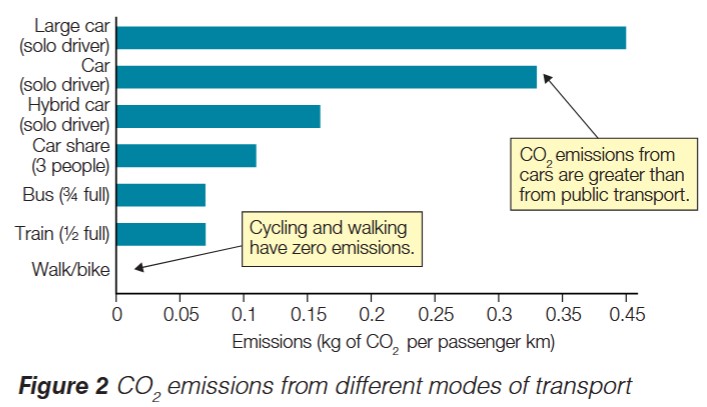
Different modes of transport produce vastly different amounts of carbon dioxide emissions. The data shows clear environmental benefits of choosing public transport or active travel:
Cars (solo driver): Both standard and large cars produce the highest emissions per passenger kilometre when driven by a single person. Even hybrid cars, while better than conventional vehicles, still produce significant emissions when used by one person alone.
Car sharing: When three people share a car, emissions per passenger drop substantially, demonstrating the benefit of reducing single-occupancy journeys.
Public transport: Buses (at three-quarters capacity) and trains (at half capacity) produce considerably lower emissions per passenger kilometre than cars.
Active travel: Walking and cycling produce zero emissions, making them the most environmentally friendly transport choices.
Important
Critical Environmental Insight: CO2 emissions from cars are significantly greater than from public transport. By shifting passengers from cars to trains, Crossrail helps London reduce its overall carbon footprint. Even a half-full train produces far less CO2 per passenger than a car with a single occupant.
Exam guidance
Important
Answering exam questions about sustainable transport improvements:
Describe questions require you to state features or characteristics (e.g. "Crossrail is a high-speed rail link connecting east and west London through 26km of central tunnels")
Explain questions need you to give reasons why something happens (e.g. "Crossrail reduces CO2 emissions because trains produce less CO2 per passenger than cars, so when people switch from driving to using Crossrail, overall emissions decrease")
Assess or evaluate questions require you to weigh up positives and negatives, and may ask you to reach a judgement (e.g. consider both the benefits of Crossrail like reduced journey times and any potential drawbacks like construction disruption)
Always use specific facts, figures and place details from case studies to support your answers.
Remember!
Summary
Key Points to Remember:
- London's public transport network handles 75 million passengers per week and faces capacity challenges due to population growth
- Crossrail is a high-speed east-west rail route with 26km of tunnels under central London, opening in 2019
- Crossrail increases passenger capacity, halves east-west journey times, brings 1.5 million additional daily commuters, and creates jobs around stations
- Reducing traffic by encouraging public transport use cuts congestion, accidents, air pollution and CO2 emissions
- Public transport produces significantly less CO2 per passenger kilometre than private cars, while walking and cycling produce zero emissions