More Sustainable Cities (OCR GCSE Geography B (Geography for Enquiring Minds)): Revision Notes
📚Revision Notes
More sustainable cities
What makes cities more sustainable?
Cities can improve their sustainability by reducing the size of their ecological footprint. The ecological footprint measures the environmental impact a city has through its resource use and waste production.
Note
Understanding a city's ecological footprint is essential for measuring and improving sustainability. It provides a clear way to track environmental impact over time.
Cities can reduce their ecological footprint through four main approaches:
- Reducing the amount of resources they consume
- Recycling more materials and resources
- Using renewable energy sources instead of fossil fuels
- Producing less waste overall
These actions help cities use fewer natural resources and create less pollution, making them more environmentally sustainable for the future.
The Green City Index
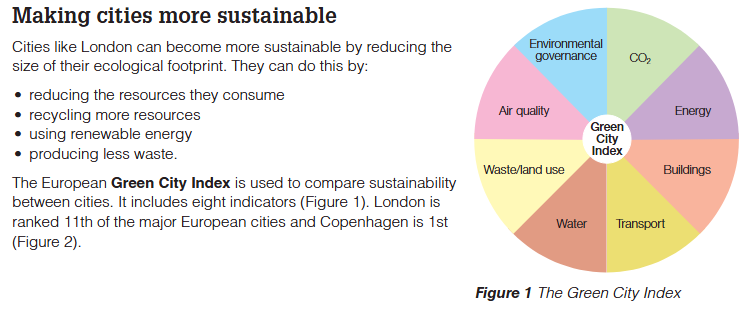
The Green City Index is a European measurement tool that compares how sustainable different cities are. It provides a standardised way to assess and rank cities based on their environmental performance.
The index measures sustainability using eight key indicators:
- CO2 emissions - the amount of carbon dioxide released into the atmosphere
- Energy - how energy is produced and consumed
- Buildings - the environmental efficiency of the built environment
- Transport - public and private transport systems and their environmental impact
- Water - water quality, supply and management
- Waste and land use - how waste is managed and land is used
- Air quality - levels of air pollution
- Environmental governance - policies and leadership on environmental issues
Note
The Green City Index allows cities to identify specific areas where they can improve their sustainability performance by comparing themselves against other European cities.
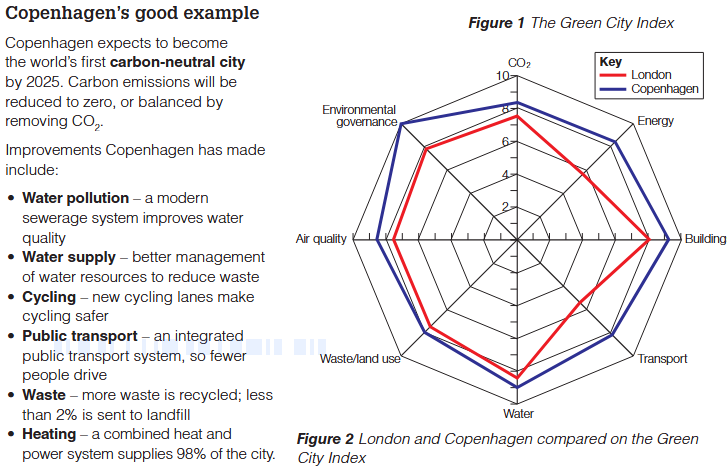
London compared with Copenhagen
Using the Green City Index, London ranks 11th among major European cities for sustainability. In contrast, Copenhagen ranks 1st, making it Europe's most sustainable major city.
The radar chart above shows how London and Copenhagen perform across all eight indicators. Copenhagen scores higher than London in most categories, particularly in transport, waste management and environmental governance. This comparison helps identify areas where London could improve to become more sustainable.
Important
The significant difference between London's 11th place and Copenhagen's 1st place ranking demonstrates that major improvements in urban sustainability are achievable through coordinated action and policy changes.
Case study: Copenhagen
Copenhagen provides an excellent example of urban sustainability in action. The city aims to become the world's first carbon-neutral city by 2025. A carbon-neutral city is one where carbon dioxide emissions are reduced to zero, or any remaining emissions are balanced by removing an equivalent amount of CO₂ from the atmosphere.
Improvements Copenhagen has made
Copenhagen has implemented several major sustainability improvements:
Water pollution - A modern sewerage system has been installed that significantly improves water quality throughout the city. This reduces harmful pollutants entering waterways and protects aquatic ecosystems.
Water supply - Better management of water resources helps reduce waste. The city has implemented systems to use water more efficiently and prevent unnecessary consumption.
Example
Practical Application: Cycling Infrastructure
Copenhagen transformed its transport system by building dedicated cycling lanes across the city. This infrastructure investment made cycling much safer and more attractive, encouraging people to choose bicycles over cars for daily commutes. The result? Reduced vehicle emissions, improved air quality, and healthier residents.
Public transport - An integrated public transport system has been developed that makes it easy for people to travel without using private cars. The system connects different transport modes seamlessly, reducing the need for people to drive.
Waste - Copenhagen has dramatically increased its recycling rates. Now less than 2% of the city's waste is sent to landfill, with the vast majority being recycled or used for energy generation. This reduces environmental damage from landfill sites and recovers valuable materials.
Note
Copenhagen's waste management success demonstrates that cities can achieve recycling rates above 98% through effective policies and infrastructure investment.
Heating - A combined heat and power system now supplies 98% of the city with heating. This highly efficient system generates both electricity and heat simultaneously, reducing energy waste and carbon emissions compared to traditional heating methods.
These improvements demonstrate that cities can make significant progress towards sustainability through coordinated policies targeting multiple environmental challenges. Copenhagen's approach shows how infrastructure improvements, policy changes and technology can work together to reduce a city's ecological footprint.
Summary
Key Points to Remember:
- Cities reduce their ecological footprint by reducing resource consumption, recycling more, using renewable energy and producing less waste
- The Green City Index measures sustainability using eight indicators: CO₂, energy, buildings, transport, water, waste/land use, air quality and environmental governance
- London ranks 11th among major European cities for sustainability, while Copenhagen ranks 1st
- Copenhagen aims to be carbon-neutral by 2025 through improvements in water systems, cycling infrastructure, public transport, waste recycling and heating
- Copenhagen's success shows that cities can achieve major sustainability improvements through coordinated action across multiple areas