Earth’s Changing Climate (OCR GCSE Geography B (Geography for Enquiring Minds)): Revision Notes
📚Revision Notes
Earth's Changing Climate
The Quaternary ice age
We are currently living in the Quaternary period, which spans the last 2.6 million years of Earth's history. This period is classified as an ice age, which means Earth has permanent ice sheets covering parts of its surface.
Note
An ice age is defined as any extended time period when Earth maintains permanent ice sheets. Within ice ages, there are distinct climate phases that alternate between extremely cold and relatively warmer conditions.
Glacial periods are the coldest phases within an ice age. These typically last for approximately 100,000 years and are characterised by extensive ice sheet coverage.
Interglacial periods are the warmer phases that occur between glacial periods. These warmer intervals last for roughly 10,000 years. We are currently in an interglacial period, which explains why we have ice sheets at the poles but not covering large areas of land like Europe or North America.
Important
Understanding the difference between glacial and interglacial periods is crucial:
- Glacial periods: Very cold, last ~100,000 years
- Interglacial periods: Warmer, last ~10,000 years
- We are currently in an interglacial period
Evidence of climate change during the Quaternary period
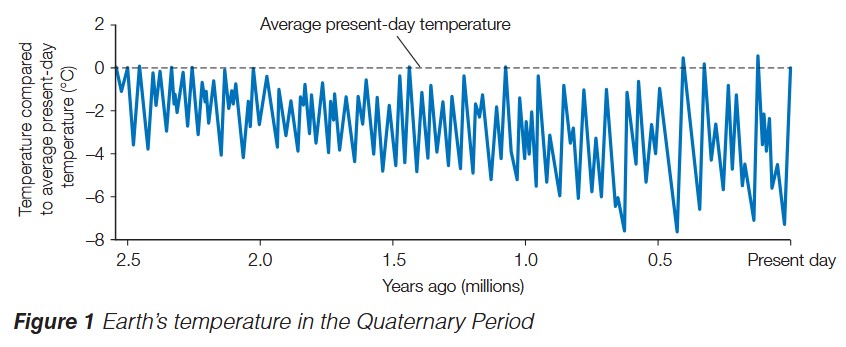
Throughout the Quaternary period, Earth's temperature has not remained constant. Instead, it has fluctuated considerably, rising and falling many times over the past 2.6 million years.
The evidence shows that for most of the Quaternary period, Earth's temperature has been colder than it is today. However, these temperatures have not stayed at one level – they have varied significantly, demonstrating that climate change is a natural process that has occurred throughout Earth's history.
Note
Reading the Temperature Graph:
The first graph displays temperature variations across the entire Quaternary period. The blue line shows how temperatures have risen and fallen repeatedly compared to today's average temperature. Notice the regular pattern of cold glacial periods alternating with warmer interglacial periods. The temperature has spent more time below today's average than above it.
Recent climate change: the last 1500 years
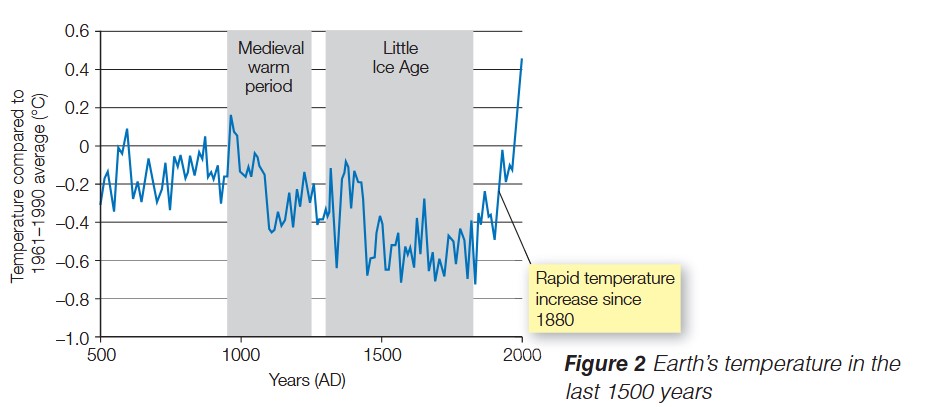
When we examine more recent climate history, covering the last 1500 years, a clearer picture of temperature changes emerges. This timeframe reveals several important climate events.
The Medieval Warm Period occurred roughly between 900-1300 AD. During this time, temperatures were warmer than the preceding centuries, though not as warm as today.
Following this warmer phase, the Little Ice Age took place approximately between 1300-1850 AD. This period brought notably colder temperatures across many regions, with temperatures dropping significantly below the long-term average.
Important
Rapid Modern Warming
The most significant observation from recent climate data is the rapid temperature increase since 1880. This warming has been both dramatic and swift compared to earlier natural fluctuations. The rate and magnitude of this temperature rise is considerably greater than previous changes observed in the historical record.
This recent rapid warming is particularly significant because the overwhelming majority of climate scientists attribute this increase to human activities rather than natural processes. Human actions, such as burning fossil fuels and deforestation, have released large quantities of greenhouse gases into the atmosphere, intensifying the natural greenhouse effect and causing global temperatures to rise.
Exam guidance
Note
Answering Climate Change Questions:
When answering questions about climate change evidence:
- Describe: State what the graphs show (e.g., "temperatures have fluctuated throughout the Quaternary period" or "there has been rapid warming since 1880")
- Explain: Give reasons for patterns (e.g., "the rapid warming since 1880 is linked to human activities releasing greenhouse gases")
- Use specific time periods from the data (Quaternary = 2.6 million years; glacial = 100,000 years; interglacial = 10,000 years)
- Reference named periods like the Medieval Warm Period and Little Ice Age to demonstrate detailed knowledge
- Distinguish between natural climate change (long-term fluctuations) and human-caused change (rapid warming since 1880)
Remember!
Summary
Key Points to Remember:
- The Quaternary period covers the last 2.6 million years and is classified as an ice age
- Glacial periods (very cold, ~100,000 years) alternate with interglacial periods (warmer, ~10,000 years)
- Earth's temperature has fluctuated throughout the Quaternary period and has mostly been colder than today
- The Medieval Warm Period and Little Ice Age demonstrate natural climate variations in recent history
- Since 1880, there has been exceptionally rapid warming that scientists link to human activities
- Climate change is both a natural process (occurring over geological time) and influenced by human activities (recent rapid warming)