Natural Causes of Climate Change (OCR GCSE Geography B (Geography for Enquiring Minds)): Revision Notes
📚Revision Notes
Natural Causes of Climate Change
Introduction
Note
Climate change is not a new phenomenon. Throughout Earth's history, the climate has changed many times, even before human activity had any influence.
Understanding these natural climate variations helps us distinguish between natural climate variations and human-induced changes. There are three main natural mechanisms that have driven climate change over geological time: Milankovitch cycles, sun spot activity, and volcanic eruptions.
Milankovitch cycles
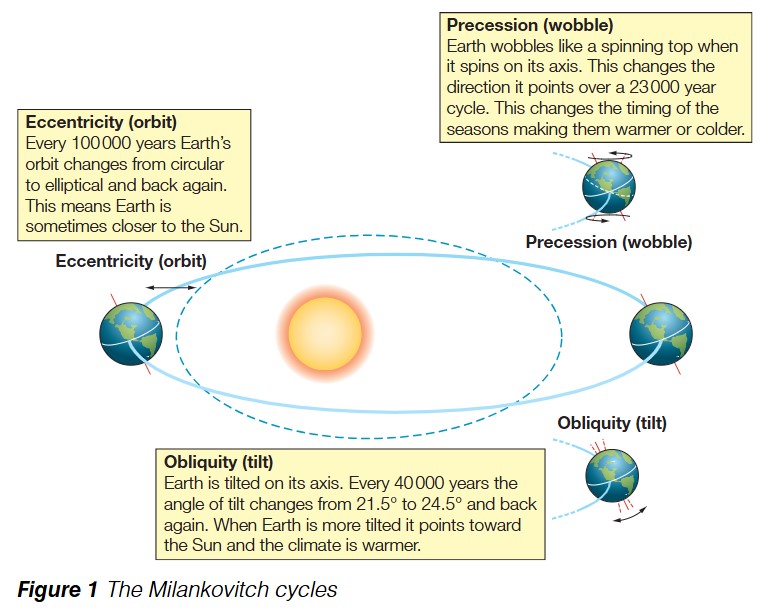
Milankovitch cycles are changes in Earth's movement and position relative to the Sun. These astronomical variations occur over thousands of years and significantly influence the amount of solar energy Earth receives. There are three distinct cycles, each operating on different timescales.
Eccentricity (orbital shape)
Earth's orbit around the Sun is not always the same shape. Over approximately 100,000 years, the orbit gradually changes from being nearly circular to more elliptical (oval-shaped), and then back again. This cycle is called eccentricity.
When the orbit is more elliptical, Earth's distance from the Sun varies more throughout the year. This means that at certain times, Earth moves closer to the Sun and receives more solar radiation, leading to warmer conditions. When the orbit is more circular, the distance remains more constant, resulting in less variation in the amount of solar energy received.
Important
Exam tip: When describing eccentricity, make sure you mention both the time period (100,000 years) and explain how it affects Earth's distance from the Sun.
Precession (axial wobble)
Earth does not spin in a perfectly stable way. Instead, it wobbles on its axis, rather like a spinning top that is slowing down. This wobble is called precession and follows a cycle of approximately 23,000 years.
Note
The spinning top analogy is helpful for visualizing precession - just as a slowing top wobbles, Earth's rotational axis traces a circular path through space over thousands of years.
As Earth wobbles, the direction its axis points gradually changes. This affects the timing and intensity of the seasons. For example, when the Northern Hemisphere points more directly toward the Sun during its summer, that summer will be warmer. When it points away, summers become cooler. This wobble therefore influences whether seasons are more extreme or more moderate in their temperatures.
Obliquity (axial tilt)
Earth is tilted on its axis, which is why we have seasons. However, the angle of this tilt is not fixed. Over a cycle of about 40,000 years, Earth's axial tilt varies between 21.5° and 24.5°.
When Earth has a greater tilt (closer to ), it points more directly toward the Sun, resulting in warmer global temperatures and more extreme seasonal differences. When the tilt is smaller (closer to ), temperatures are generally cooler and seasons are less extreme. The current axial tilt is approximately 23.5°.
Important
Exam tip: Remember that all three Milankovitch cycles work together to influence climate. Exam questions may ask you to explain how these cycles cause long-term climate change, such as ice ages.
Sun spots
The Sun is not a constant source of energy. Its activity varies over time due to magnetic storms on its surface. These magnetic disturbances create temporary dark patches called sun spots.
Sun spots appear dark because they are cooler than the surrounding surface of the Sun. However, they actually indicate increased solar activity. When more sun spots are present, the Sun releases more energy overall, which means Earth receives more solar radiation. This additional energy warms Earth's climate.
Note
This is counterintuitive - despite appearing as dark spots, sun spots actually signal that the Sun is releasing MORE energy, not less. Think of them as indicators of heightened solar activity rather than cooler areas.
Sun spot activity follows an 11-year cycle. During periods of high sun spot activity, Earth receives more energy and temperatures tend to rise. When sun spot numbers are low, Earth receives less energy and temperatures may fall slightly. This relatively short cycle can cause small fluctuations in Earth's temperature over decades.
Important
Exam tip: Make sure you understand that although sun spots look dark, they actually indicate the Sun is giving out MORE energy, not less.
Volcanic eruptions
Large volcanic eruptions are powerful natural events that can have significant short-term effects on global climate. When a volcano erupts explosively, it releases enormous quantities of dust, ash, and gases into the atmosphere, including sulphur dioxide.
If a volcanic eruption is powerful enough, these materials can reach high into the atmosphere, where they spread around the globe. The dust and ash particles remain suspended in the atmosphere and act like a barrier, blocking some of the Sun's incoming energy from reaching Earth's surface. This reduction in solar radiation causes global temperatures to drop.
The cooling effect of a major volcanic eruption can last for several years, until the volcanic material gradually settles out of the atmosphere.
Example
Worked Example: Mount Pinatubo Eruption (1991)
When Mount Pinatubo erupted in the Philippines in 1991, it was one of the largest volcanic eruptions of the 20th century.
What happened:
- The eruption ejected massive amounts of ash and sulphur dioxide into the stratosphere
- These materials spread globally, forming a layer that reflected sunlight back into space
Climate impact:
- Global temperatures dropped by approximately
- The cooling effect lasted for about two years
- This provided clear evidence of how volcanic eruptions can influence global climate
Key lesson: This demonstrates that even a single volcanic event can have measurable global effects, though temporary compared to long-term natural cycles.
Important
Exam tip: Volcanic eruptions cause SHORT-TERM cooling, whereas the other natural causes operate over much longer timescales. This is an important distinction in exam answers.
Remember!
Summary
Key Points to Remember:
- Earth's climate has changed naturally throughout history, long before human influence
- Milankovitch cycles (eccentricity, precession, and obliquity) operate over thousands of years and affect Earth's position relative to the Sun
- Sun spots follow an 11-year cycle and increase the amount of solar energy Earth receives
- Large volcanic eruptions can cool the climate for several years by blocking solar radiation
- These natural processes help explain past climate changes, such as ice ages
Key Terms:
- Milankovitch cycles – long-term changes in Earth's orbit and tilt that affect climate
- Eccentricity – changes in the shape of Earth's orbit (100,000-year cycle)
- Precession – wobbling of Earth's axis (23,000-year cycle)
- Obliquity – changes in Earth's axial tilt (40,000-year cycle)
- Sun spots – dark patches on the Sun indicating increased energy output
- Volcanic eruptions – explosive events releasing ash and gases that can block solar radiation
Critical Processes:
- Natural climate change occurs due to variations in solar energy received by Earth
- Milankovitch cycles alter Earth's distance from and angle to the Sun
- Sun spot activity changes the amount of energy the Sun produces
- Volcanic dust blocks incoming solar radiation, causing cooling