Coastline Management (OCR GCSE Geography B (Geography for Enquiring Minds)): Revision Notes
📚Revision Notes
Coastline management
Introduction
Coastlines require careful management to balance the forces of nature against the needs of human communities. Natural processes such as erosion, weathering, and mass movement continuously reshape the coast, but people need protection for their homes, businesses, and infrastructure. Coastal management aims to strike this balance through various strategies.
Note
The challenge of coastal management lies in finding the right balance between allowing natural processes to occur and protecting human interests. This balance varies depending on location, with some areas requiring strong protection while others can be left to natural forces.
Coastal management strategies
There are two main approaches to managing coastlines, each with distinct characteristics and purposes:
Hard engineering involves building solid structures that directly oppose natural coastal processes. These methods actively fight against the power of waves and erosion.
Soft engineering takes a different approach by working alongside natural coastal processes rather than against them. These methods are designed to complement how the coast naturally functions.
Note
The key difference between these approaches is their relationship with nature: hard engineering works against natural processes, while soft engineering works with them. Understanding this distinction is crucial when evaluating which strategy is appropriate for a particular location.
Shoreline management plans (SMPs)
Important
Local councils have a legal responsibility to develop Shoreline Management Plans for their coastal areas. These plans assess the coastline and decide on the most appropriate management approach.
There are four main options available:
- Do nothing – allow natural processes to continue without intervention
- Hold the line – maintain the current coastline position by building or maintaining defences
- Retreat the line – allow the sea to advance inland in a controlled manner
- Advance the line – build new land or defences extending seaward from the current coastline
The choice depends on factors such as cost, the value of land and property, environmental considerations, and community needs.
Hard engineering strategies
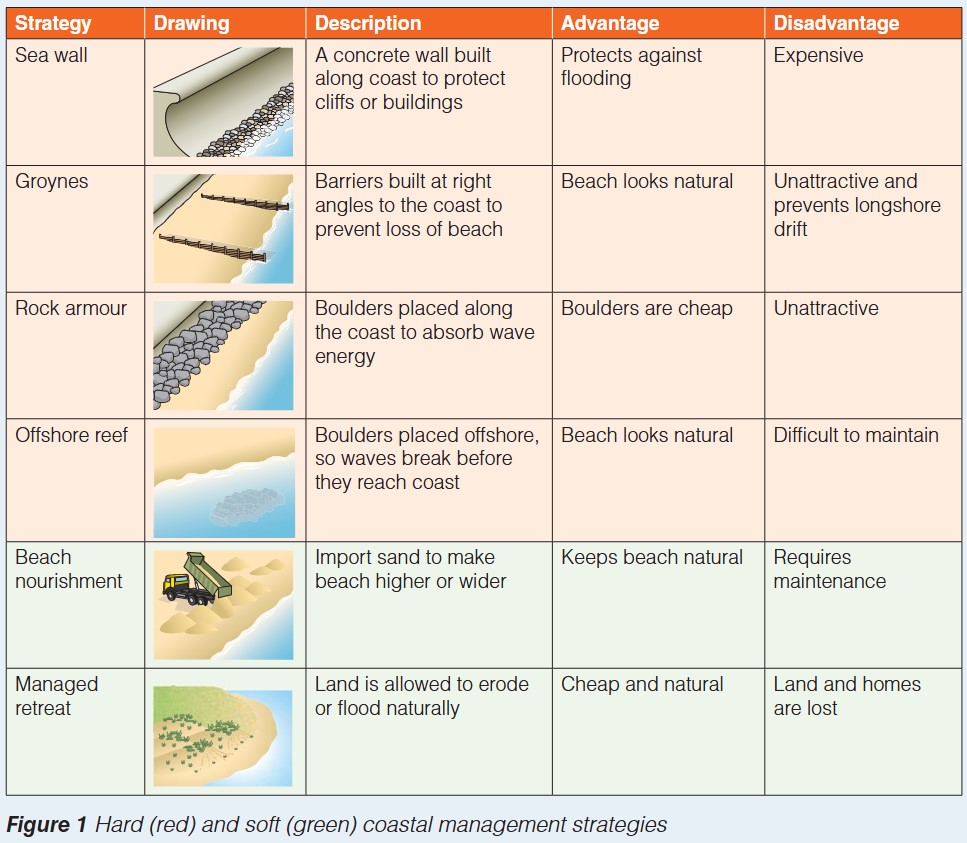
Sea walls
Sea walls are substantial concrete barriers constructed along the coastline to provide direct protection for cliffs or buildings situated behind them. They act as a solid defence against wave attack and flooding.
Advantages: Sea walls offer strong, reliable protection against flooding and wave damage, making them highly effective in high-risk areas.
Disadvantages: They are extremely expensive to construct and maintain, making them one of the most costly coastal management options.
Note
Sea walls reflect wave energy back out to sea rather than absorbing it. While this protects the land behind them, the constant bombardment of reflected waves can eventually undermine the wall's foundation or cause scouring at its base, requiring ongoing maintenance.
Groynes
Groynes are wooden or concrete barriers built at right angles to the shoreline, extending from the beach into the sea. Their purpose is to trap sand and shingle moving along the coast through longshore drift, building up the beach on one side.
Advantages: Groynes help beaches maintain a natural appearance, which is important for tourism and recreation.
Disadvantages: While they build up material on one side, they prevent longshore drift from continuing down the coast, starving beaches further along of sediment. They can also be considered visually unattractive.
Important
Common pitfall: Groynes create a "knock-on effect" down the coast. The beach that gains sediment (updrift side) benefits, but beaches further along (downdrift side) lose their natural sediment supply, potentially requiring their own coastal defences. This can create a domino effect of coastal management problems.
Rock armour (rip rap)
Rock armour consists of large boulders placed along the base of cliffs or sea walls. These boulders absorb and dissipate the energy of incoming waves, reducing their erosive power.
Advantages: The boulders are relatively inexpensive compared to other hard engineering methods.
Disadvantages: Many people consider rock armour unsightly and unnatural-looking in coastal settings.
Soft engineering strategies
Offshore reefs
Offshore reefs (also called breakwaters) are barriers made from boulders positioned in the sea, parallel to the coastline but at some distance from the shore. Waves break against these reefs before reaching the beach, reducing their energy.
Advantages: This approach maintains a natural beach appearance, as the reef is not visible from the shore.
Disadvantages: The underwater structures are difficult and costly to maintain, requiring regular inspection and repair.
Note
Offshore reefs work by causing waves to break offshore rather than on the beach itself. This reduces wave energy before it reaches the shore, allowing sediment to accumulate naturally behind the reef and building up the beach over time.
Beach nourishment
Beach nourishment involves importing sand and shingle from elsewhere to artificially increase the height or width of a beach. A wider, higher beach provides better natural protection against wave attack and flooding.
Advantages: This method keeps the beach looking natural and can actually enhance its appearance and usefulness for recreation.
Disadvantages: The added material gradually gets eroded and transported away by natural processes, requiring repeated applications and ongoing maintenance costs.
Example
Practical Application: Beach Nourishment
A coastal town decides to use beach nourishment to protect its seafront properties:
- Year 1: 50,000 cubic metres of sand imported at a cost of $500,000
- Year 5: Natural erosion has removed 60% of the added sand
- Action required: Another replenishment cycle needed to maintain protection
- Result: Ongoing costs every 5-7 years, but the beach remains accessible and attractive for tourists
Managed retreat
Managed retreat represents a fundamentally different approach – rather than defending against the sea, certain areas of low-value land are deliberately allowed to erode or flood naturally. This might involve removing existing defences or simply not replacing them when they fail.
Advantages: This is the cheapest option as it requires no construction or maintenance of defences. It also creates natural habitats such as salt marshes and mudflats.
Disadvantages: Land is permanently lost to the sea, along with any homes, farms, or businesses located there, which can be controversial and distressing for affected communities.
Important
Controversial approach: Managed retreat is often the most sustainable and environmentally beneficial option, but it is also the most controversial because it involves deliberately abandoning land to the sea. Communities affected by managed retreat decisions may face property loss and relocation, making this option politically and socially challenging despite its environmental and economic benefits.
Choosing the right strategy
The selection of coastal management strategy depends on several factors:
- Cost – some methods require substantial initial investment and ongoing maintenance
- Value of land – protecting cities and valuable infrastructure may justify expensive hard engineering
- Environmental impact – soft engineering often has less environmental damage
- Aesthetics – tourist areas may prefer methods that look natural
- Sustainability – soft engineering is generally more sustainable long-term
- Knock-on effects – some methods (like groynes) can cause problems elsewhere along the coast
Decision-makers must weigh these factors carefully when developing Shoreline Management Plans.
Note
Decision-making process: Coastal managers use cost-benefit analysis to evaluate different strategies. This involves calculating the cost of defences versus the value of what is being protected. For example, building a $10 million sea wall might be justified to protect a town worth $500 million, but not to protect farmland worth $2 million.
Summary
Key Points to Remember:
- Coastal management balances natural processes (erosion) against the need to protect people, property, and infrastructure
- Hard engineering works against nature using solid structures (sea walls, groynes, rock armour), but can be expensive and visually unattractive
- Soft engineering works with nature (offshore reefs, beach nourishment, managed retreat) and is often more sustainable, though may require ongoing maintenance
- Shoreline Management Plans (SMPs) give local councils four options: do nothing, hold the line, retreat the line, or advance the line
- Each strategy has distinct advantages and disadvantages related to cost, effectiveness, appearance, and environmental impact – no single solution works everywhere