Destructive and Collision Plate Boundaries (OCR GCSE Geography B (Geography for Enquiring Minds)): Revision Notes
📚Revision Notes
Destructive and Collision Plate Boundaries
Introduction
At convergent plate boundaries, tectonic plates move towards each other. The type of boundary and features that form depend on whether the plates involved are oceanic or continental. Two main types exist: destructive plate boundaries and collision plate boundaries.
Destructive plate boundaries
What happens at a destructive boundary?
A destructive plate boundary forms where an oceanic plate meets a continental plate. The oceanic plate is denser than the continental plate, so it is pushed beneath the continental plate in a process called subduction.
Note
The key to understanding destructive boundaries is remembering that oceanic plates are always denser than continental plates. This density difference drives the entire process of subduction and determines which plate will be forced downwards.
The movement of plates during subduction is not smooth. Plates drag against each other and often stick together. When the pressure becomes too great, the plates suddenly move, releasing built-up energy as an earthquake.
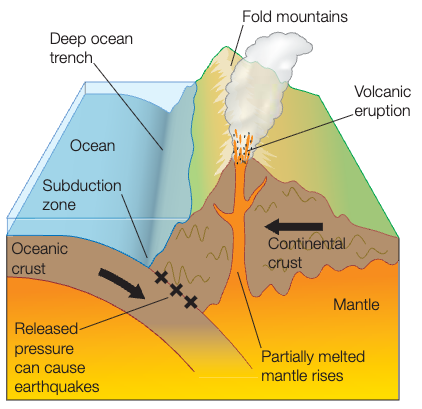
Features formed at destructive boundaries
Several distinctive features develop at destructive plate boundaries:
Deep ocean trench: Where the oceanic plate bends downwards and begins to subduct, a deep depression forms in the ocean floor. These trenches are the deepest parts of the ocean.
Volcanoes: As the oceanic plate descends into the mantle, water from the ocean trapped in the rocks reduces the melting point of the plate material. This partially melted rock (magma) is less dense than the surrounding material, so it rises through cracks in the overlying continental plate. When it reaches the surface, volcanoes erupt.
Important
The role of water is crucial for volcanic formation at destructive boundaries. Without seawater being carried down with the subducting oceanic plate, there would be no reduction in melting point and therefore no magma formation. This is why collision boundaries (where there is no oceanic plate and no subduction) have no volcanoes.
Fold mountains: The immense pressure from the converging plates causes the edge of the continental plate and sediments on the ocean floor to crumple and fold upwards, forming mountain ranges. The Andes mountain range in South America is an example of fold mountains created at a destructive boundary.
Earthquakes: These occur when pressure builds up between the plates and is suddenly released as they jolt past each other.
Oceanic-oceanic destructive boundaries
When two oceanic plates converge, the denser of the two plates subducts beneath the other. This process creates an extremely deep ocean trench. The Mariana Trench in the Western Pacific, the deepest point on Earth, formed in this way.
Collision plate boundaries
What happens at a collision boundary?
When two continental plates move towards each other, they collide but do not subduct. This is because both plates have similar low densities compared to the mantle beneath them. Instead of one plate sliding under the other, both plates crumple and push upwards.
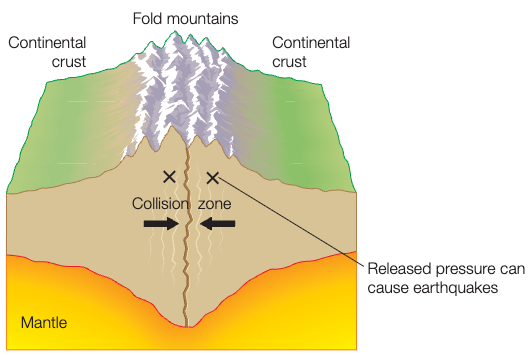
Features formed at collision boundaries
Fold mountains: The collision causes the continental crust to become thicker and buckle upwards, creating massive mountain ranges. The Himalayas, formed by the collision of the Indian and Eurasian plates, are the world's highest mountain range. These mountains continue to rise by approximately 10 mm each year as the collision continues.
Earthquakes: Although there is no subduction, the intense pressure from the converging plates causes the crust to fracture and fault. Movement along these faults releases energy as earthquakes. The devastating Nepal earthquake of 2015 resulted from pressure release at the collision boundary forming the Himalayas.
No volcanoes: Unlike destructive boundaries, collision boundaries do not produce volcanoes. This is because there is no subduction to carry water-rich oceanic crust down into the mantle. Without subduction, there is no mechanism to generate magma, so volcanic activity cannot occur.
Important
Common Mistake Alert: Many students confuse why there are no volcanoes at collision boundaries. Remember: No subduction = No water carried down = No reduction in melting point = No magma = No volcanoes. The absence of an oceanic plate is the key difference.
Key differences between destructive and collision boundaries
| Feature | Destructive Boundary | Collision Boundary |
|---|---|---|
| Plate types | Oceanic and continental | Two continental |
| Subduction | Yes (oceanic plate subducts) | No (similar densities) |
| Ocean trenches | Yes | No |
| Volcanoes | Yes | No |
| Fold mountains | Yes | Yes |
| Earthquakes | Yes | Yes |
Case studies summary
Example
Case Study Examples: Global Plate Boundaries
Andes Mountains (South America): Fold mountains formed at a destructive boundary where the oceanic Nazca plate subducts beneath the continental South American plate. Active volcanoes are present along this mountain range.
Mariana Trench (Western Pacific): The deepest ocean trench on Earth, formed where one oceanic plate subducts beneath another oceanic plate.
Himalayas (Asia): The world's highest mountain range, formed by the collision of the Indian and Eurasian continental plates. Rising at 10 mm per year with no volcanic activity.
Nepal Earthquake (2015): A major earthquake caused by pressure release along faults in the collision zone forming the Himalayas.
Exam guidance
Note
Describe questions: Focus on the sequence of processes and features you can observe. For destructive boundaries, mention the ocean trench, subduction, volcanoes and fold mountains. For collision boundaries, mention fold mountains and earthquakes but state there are no volcanoes.
Explain questions: You must give reasons. For example, explain that volcanoes form at destructive boundaries because water from the subducting oceanic plate lowers the melting point, allowing magma to form. Explain that collision boundaries have no volcanoes because there is no subduction to generate magma.
Command word tip: "Assess" or "evaluate" questions require you to consider both positive and negative impacts or compare different scenarios. You might need to compare the hazards at destructive versus collision boundaries.
Remember!
Summary
Key Points to Remember:
-
Destructive plate boundaries occur where an oceanic plate meets a continental plate. The denser oceanic plate subducts beneath the continental plate.
-
Key features at destructive boundaries include ocean trenches, volcanoes, fold mountains and earthquakes. Water plays a crucial role in generating magma for volcanic eruptions.
-
Collision plate boundaries occur where two continental plates meet. Neither plate subducts because they have similar low densities.
-
Key features at collision boundaries include fold mountains and earthquakes, but no volcanoes because there is no subduction to generate magma.
-
Important case studies: Andes (destructive boundary with volcanoes), Mariana Trench (oceanic-oceanic subduction), Himalayas (collision boundary, rising 10 mm/year), Nepal earthquake 2015 (collision boundary hazard).