Drought in the UK (OCR GCSE Geography B (Geography for Enquiring Minds)): Revision Notes
📚Revision Notes
Drought in the UK
What is a drought?
A drought occurs when water reserves in soils, lakes, and rivers become depleted faster than natural replenishment can occur. This creates a water deficit that impacts both the natural environment and human activities. In the UK, droughts are relatively uncommon but can have severe consequences when they do occur, as demonstrated by the 2012 drought event.
Note
Droughts develop through a combination of natural meteorological conditions and human water usage patterns. Understanding both aspects is crucial for effective drought management and response.
Causes of the 2012 drought
The 2012 UK drought developed over a two-year period between April 2010 and March 2012. Multiple factors combined to create these prolonged drought conditions:
Meteorological factors
Reduced precipitation: The UK experienced significantly below-average rainfall between April 2010 and May 2012. This extended period of low rainfall meant that water reserves could not be naturally replenished through precipitation.
Continental air masses: Dry winds originating from mainland Europe dominated weather patterns. These continental air masses brought warm, dry conditions rather than the moist Atlantic air that typically brings rainfall to the UK.
Note
The shift from typical Atlantic weather systems to continental air masses was a key meteorological driver of the drought. Atlantic air typically brings moisture and rainfall to the UK, while continental air from Europe tends to be warmer and drier.
Physical and environmental factors
Elevated temperatures: Warmer than average temperatures during this period caused increased water loss through evaporation. Higher evaporation rates meant that existing water reserves depleted more rapidly from soils, lakes, and rivers.
Reduced soil moisture: The combination of low rainfall and high evaporation created very dry soil conditions. Once soils became dry, their infiltration capacity decreased, making it harder for any rainfall that did occur to soak into the ground and recharge groundwater supplies.
Important
The reduced infiltration capacity of dry soils created a feedback loop - even when rainfall did occur, the water could not effectively replenish groundwater supplies because it ran off the surface rather than soaking in.
Human factors
Water infrastructure losses: High levels of water usage and significant waste from leaking pipes meant that demand on water supplies remained high even during the drought. This human pressure on water resources exacerbated the natural water deficit.
Consequences of the 2012 drought
The drought had wide-ranging impacts across multiple sectors:
Agricultural impacts
Farmers faced severe difficulties in finding adequate water supplies for both crop irrigation and livestock. The lack of water threatened crop yields and animal welfare, putting pressure on food production. Agricultural businesses faced economic losses as they struggled to maintain productivity during the extended dry period.
Environmental damage
The natural environment suffered significant harm during the drought. Wildfires became more frequent and severe due to the extremely dry conditions, damaging habitats and threatening wildlife. Rivers experienced reduced flow rates and in some cases very low water levels, which harmed aquatic ecosystems. The extraction of water from rivers to maintain supplies further stressed these ecosystems.
Important
Environmental Trade-off: Extracting water from already depleted rivers to maintain public supplies created a difficult choice between meeting human needs and protecting aquatic ecosystems. This highlights the complex challenges of drought management.
Social and domestic impacts
Hosepipe bans were implemented across affected regions, making it more difficult for households to wash cars and water gardens. This represented a noticeable change to daily routines and lifestyles. The restrictions highlighted the vulnerability of water supplies and the need for conservation during extreme conditions.
Responses to the 2012 drought
Various management strategies were employed to address the water shortage:
Supply-side management
Water companies were granted permission to extract additional water from rivers to maintain public water supplies. While this helped meet demand, it placed further stress on already depleted river ecosystems. This approach represented a short-term solution focused on maintaining supply rather than reducing demand.
Note
Supply-side management focuses on increasing water availability through extraction, storage, and distribution infrastructure. While effective in the short term, these approaches can have negative environmental consequences and don't address the root cause of high demand.
Demand-side management
Hosepipe bans: Temporary use bans (commonly known as hosepipe bans) were issued across many regions. These restrictions prohibited certain non-essential water uses, particularly outdoor uses like car washing and garden watering. The bans aimed to reduce overall water consumption during the critical shortage period.
Conservation campaigns: Water companies and government authorities launched campaigns to encourage the public to reduce water consumption in their homes. These initiatives promoted behavioral changes such as taking shorter showers, turning off taps when not needed, and fixing leaks promptly.
Note
Demand-side management focuses on reducing water consumption through behavioral changes, restrictions, and efficiency improvements. These approaches are often more sustainable long-term as they address consumption patterns rather than simply increasing supply.
Spatial distribution of the drought
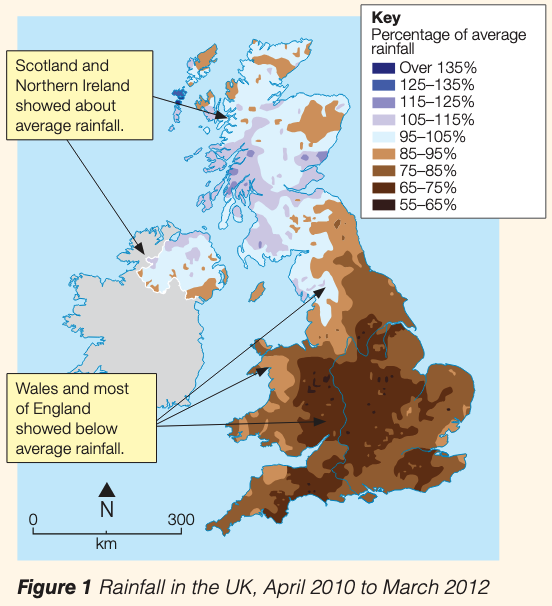
The drought did not affect the UK uniformly. Figure 1 shows clear regional variations in rainfall patterns:
Most affected regions
Wales and most of England experienced rainfall significantly below average, with many areas receiving only 55-80% of their typical rainfall. Some regions recorded even lower percentages, creating severe drought conditions. These areas faced the most serious water shortages and were subject to the strictest conservation measures.
Less affected regions
Scotland and Northern Ireland received rainfall close to or above average levels. These regions did not experience drought conditions and maintained more normal water availability throughout the 2010-2012 period.
Note
This spatial variation demonstrates how drought hazards can affect different parts of the UK very differently, depending on weather patterns and the movement of air masses. The north-south divide in rainfall reflected the dominance of continental air masses affecting southern regions while Atlantic influences remained stronger in the north.
Domestic water consumption patterns
Understanding how households use water helps identify potential areas for conservation during droughts. Data from the 2012 period shows the following breakdown of domestic water usage:
| Water use | Percentage of total |
|---|---|
| Toilet | 26.8% |
| Washing machine | 21.7% |
| Shower | 16.7% |
| Taps | 15.7% |
| Leaks | 13.7% |
| Bath | 3.7% |
| Dishwasher | 1.4% |
| Other | 2.3% |
Key observations:
- Toilets represent the single largest use of water in UK homes, accounting for over a quarter of consumption.
- The washing machine and shower combined represent over 38% of household water use.
- Water leaks account for nearly 14% of domestic water usage, highlighting the importance of fixing leaks to reduce waste.
- Taps and showers offer significant opportunities for water savings through behavioral changes, such as shorter showers and turning off running taps.
Important
The Hidden Cost of Leaks: Nearly 14% of domestic water - equivalent to 1 in every 7 liters - is lost through leaks before it can be used. This represents a significant opportunity for water conservation through infrastructure improvements and household repairs.
During drought periods, targeting these high-consumption areas through conservation campaigns can significantly reduce overall demand and help maintain water supplies.
Exam guidance
Note
Command word: Describe – When asked to describe the causes or consequences of the 2012 drought, provide specific details about what happened, using evidence from the case study. Include figures, locations, and clear statements about patterns.
Command word: Explain – When explaining drought responses, make clear links between causes and effects. For example, explain why hosepipe bans were necessary (linking low rainfall → depleted reservoirs → need to reduce demand).
Command word: Assess/Evaluate – Consider both the benefits and drawbacks of different responses. For instance, extracting water from rivers maintained supplies but damaged ecosystems. Judge which approaches were most effective and why.
Important
Case study details: Remember to include the specific time period (April 2010 to March 2012), affected regions (Wales and England particularly), and quantifiable data (e.g., rainfall percentages, water usage figures).
Remember!
Summary
Key points to remember:
-
The 2012 UK drought lasted from April 2010 to March 2012, caused by low rainfall, warm temperatures, dry continental air masses, and reduced soil infiltration.
-
Major consequences included agricultural water shortages, environmental damage through wildfires and low river levels, and the implementation of hosepipe bans.
-
Responses combined supply-side measures (extracting water from rivers) with demand-side measures (hosepipe bans and conservation campaigns).
-
The drought affected different UK regions variably, with Wales and England most severely impacted, while Scotland and Northern Ireland maintained near-normal rainfall.
-
Domestic water usage data shows toilets, washing machines, and showers as the highest consumers, with leaks accounting for nearly 14% of household water waste.
Key terms: Drought, evaporation rates, water reserves, hosepipe ban, water extraction, continental air masses, infiltration capacity, conservation, supply-side management, demand-side management.