Ecosystems (OCR GCSE Geography B (Geography for Enquiring Minds)): Revision Notes
📚Revision Notes
Ecosystems
What is an ecosystem?
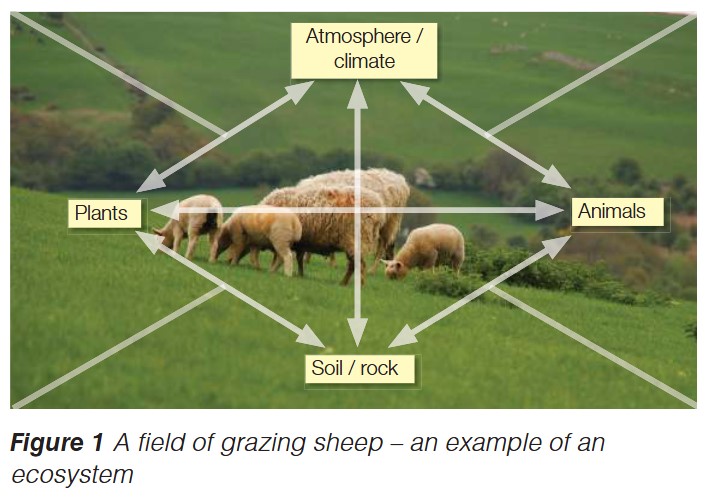
An ecosystem is a natural system made up of living organisms (plants and animals) and the non-living environment they inhabit. All parts of an ecosystem work together and depend on each other – this is called being interdependent.
Ecosystems contain two types of components:
- Living components – all plants and animals
- Non-living components – climate, atmosphere, soil, and rock
Important
Exam Tip: When describing ecosystems, remember to include both the living organisms AND the physical environment. Examiners look for you to explain how these components interact and depend on each other.
How ecosystems function
Ecosystems work through the storage and transfer of three key resources: nutrients, water, and energy. Understanding how these move through an ecosystem is essential.
Nutrient storage and cycling
Nutrients are chemical elements that organisms need to survive and grow. In ecosystems, nutrients are stored in three main locations:
- Biomass – the total amount of living plant and animal matter
- Litter – dead organic material such as fallen leaves and dead plants
- Soil – a mixture of weathered rock and decomposed organic matter
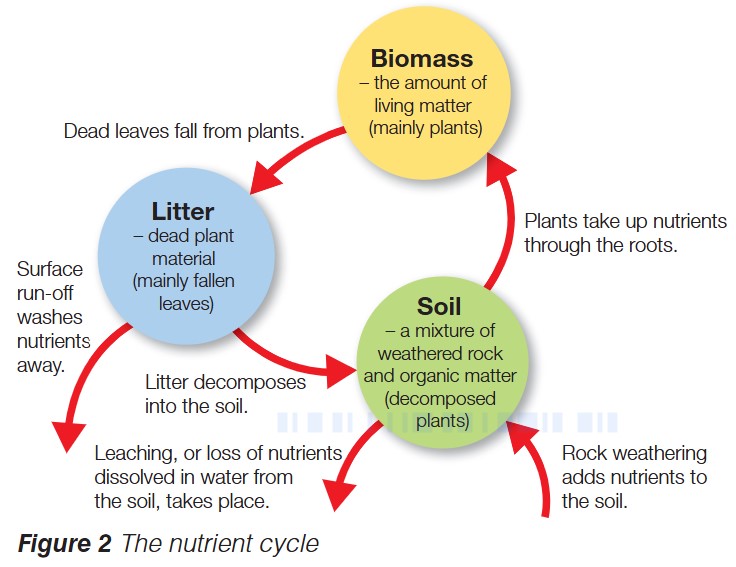
The nutrient cycle shows how nutrients move continuously between these stores:
- Dead leaves and plant material fall from living plants to create litter
- Litter decomposes and breaks down into the soil
- Plants absorb nutrients from the soil through their roots
- Rock weathering releases additional nutrients into the soil
- Some nutrients are lost through surface runoff (water washing nutrients away) and leaching (nutrients dissolving in water and moving down through the soil)
Note
Key Term: The nutrient cycle describes the continuous movement of nutrients between biomass, litter, and soil in an ecosystem. Unlike energy, nutrients are recycled continuously through the ecosystem.
Water storage
Water is stored in three main places within an ecosystem:
- The atmosphere (as water vapour and in clouds)
- The soil (held in spaces between soil particles)
- Biomass (inside living organisms)
Energy flow
Energy flows through ecosystems in a specific direction, moving from the Sun through different levels of organisms:
- Energy capture: Solar energy from the Sun is captured by producers (plants) through a process called photosynthesis
- Energy transfer: This energy passes up the food chain to consumers (animals) when they eat plants or other animals
- Energy loss: At each level of the food chain, only a small amount of energy reaches the next level. Most energy is lost through:
- Heat production
- Body functions like breathing and movement
- Excretion (waste products)
- Uneaten parts of food
Note
Key Terms:
- Producers – organisms (usually plants) that make their own food using sunlight
- Photosynthesis – the process by which plants convert sunlight into energy
- Food chain – the sequence showing how energy passes from one organism to another
- Consumers – organisms (animals) that get energy by eating other organisms
Important
Exam Tip: When explaining energy flow, remember that energy is NOT recycled like nutrients – it flows in one direction and is gradually lost from the system. This is a common exam question, so make sure you can explain the difference between nutrient cycling and energy flow.
Ecosystem interdependence
All components of an ecosystem are interdependent, meaning they rely on each other to survive. Changes to one part of the ecosystem affect all other parts.
Example
Understanding Interdependence in Action:
Consider how different components rely on each other:
- Plants need nutrients from the soil to grow
- Animals depend on plants for food and oxygen
- Decomposers in the soil break down dead matter, returning nutrients that plants need
- The atmosphere provides carbon dioxide for photosynthesis and receives oxygen from plants
This shows how a change to any one component affects the entire ecosystem.
Summary
Key Points to Remember:
Core Concepts:
- An ecosystem includes both living organisms and their non-living environment
- All ecosystem components are interdependent – they rely on each other
- Nutrients are stored in biomass, litter, and soil, and cycle continuously between these stores
- Water is stored in the atmosphere, soil, and biomass
- Energy flows from the Sun through producers (plants) to consumers (animals) via food chains
- Energy is lost at each level of the food chain and cannot be recycled
Critical Processes to Understand:
- The nutrient cycle: Continuous movement between biomass → litter → soil → biomass
- Energy flow: Sun → producers (photosynthesis) → consumers (food chain)
- Key difference: Energy is lost at each level; nutrients are recycled
Key Terms to Memorize: Ecosystem, interdependent, biomass, litter, producers, consumers, photosynthesis, food chain, nutrient cycle