Global Ecosystems (OCR GCSE Geography B (Geography for Enquiring Minds)): Revision Notes
📚Revision Notes
Global Ecosystems
Introduction to ecosystems
Ecosystems exist in every region of our planet, from the frozen poles to the tropical equator. When we examine these ecosystems at a global scale, we classify them into large-scale systems called biomes.
Note
Natural ecosystems vary dramatically across the globe, shaped by local climate conditions and geographic factors. Understanding these patterns helps us predict where different types of ecosystems will develop.
What are biomes?
Biomes are large-scale natural ecosystems found across the world. Each biome contains characteristic plant life (flora) and animal life (fauna) that you would typically find in that environment without human interference.
Important
Biomes represent ecosystems in their natural state - the plants and animals you would expect to find if there was no human intervention. This means they show us what nature would look like without cities, farms, or other human development.
In many areas, natural ecosystems have been replaced by human development such as cities and farmland, but biomes still exist in regions where natural conditions dominate.
Climate influences on biome distribution
The global distribution of biomes is controlled by climate patterns, particularly two key factors:
- Temperature: determines which plants and animals can survive in different regions
- Rainfall: controls the amount of water available for plant growth
These climate factors work together to determine which type of biome develops in any location. Areas with similar temperature and rainfall patterns will typically develop similar biomes, even if they are on different continents.
Important
Critical Climate Factors:
Temperature and rainfall are the most important factors that determine plant growth in any part of the world. The distribution of biomes reflects the world's climate pattern - areas with similar climates will have similar biomes regardless of their location on Earth.
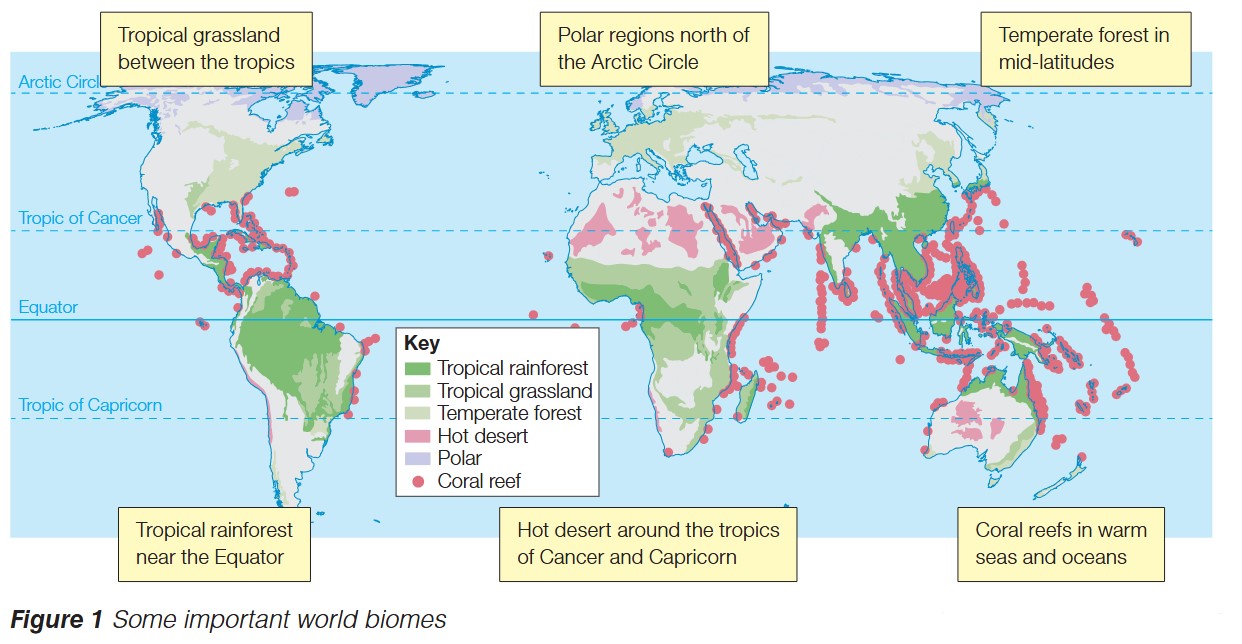
Major world biomes and their locations
Different biomes occupy distinct geographic zones around the world:
Tropical rainforest
- Located near the Equator
- Hot and wet climate throughout the year
- Found in South America (Amazon), Central Africa, and Southeast Asia
Tropical grassland
- Positioned between the tropics
- Seasonal rainfall with distinct wet and dry periods
- Found in African savanna, South American cerrado, and northern Australia
Hot desert
- Located around the tropics of Cancer and Capricorn
- Very low rainfall and high temperatures
- Examples include the Sahara, Arabian, and Australian deserts
Temperate forest
- Found at mid-latitudes (between 30° and 60° from the equator)
- Moderate temperatures with distinct seasons
- Located in Europe, eastern North America, and eastern Asia
Polar regions
- Found north of the Arctic Circle and in Antarctica
- Extremely cold temperatures year-round
- Very low precipitation
Coral reef
- Located in warm seas and oceans
- Require clear, shallow, warm tropical waters
- Found in the Caribbean, Great Barrier Reef, and Southeast Asian waters
Note
Notice the pattern: biomes with similar characteristics appear in different locations around the world where climate conditions are comparable. For example, tropical rainforests develop near the Equator in South America, Africa, and Southeast Asia because all these regions experience hot, wet conditions year-round.
Productivity of biomes
Different biomes produce varying amounts of living material (biomass). Productivity is measured in grams of biomass per square metre per year (g/m²/year).
The most productive biomes generally grow in hot, wet climates where conditions are ideal for plant growth. These ecosystems can support large amounts of plant and animal life.
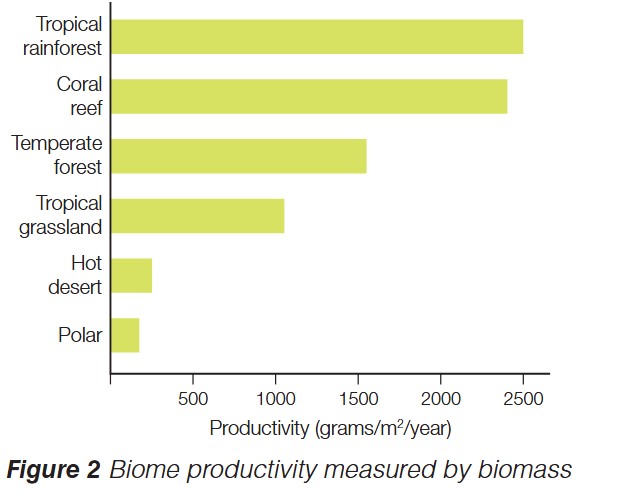
Productivity ranking from highest to lowest:
- Tropical rainforest: approximately 2,500 g/m²/year
- Highest productivity due to year-round warmth and heavy rainfall
- Coral reef: approximately 2,400 g/m²/year
- Very high productivity in warm, nutrient-rich waters
- Temperate forest: approximately 1,500 g/m²/year
- Moderate productivity with seasonal growth patterns
- Tropical grassland: approximately 1,000 g/m²/year
- Lower productivity due to seasonal drought periods
- Hot desert: approximately 200 g/m²/year
- Very low productivity due to lack of water
- Polar: approximately 100 g/m²/year
- Lowest productivity due to extreme cold and lack of sunlight for much of the year
Important
The Climate-Productivity Pattern:
The clear pattern shows that biomes in hot, wet environments are far more productive than those in cold or dry conditions. Tropical rainforests produce 25 times more biomass than polar regions! This demonstrates how critical warmth and water availability are for plant growth.
Exam guidance
Command word focus:
- Describe: When asked to describe biome distribution, state where different biomes are located using compass directions and named examples (e.g., "Tropical rainforests are found near the Equator in regions such as the Amazon Basin").
- Explain: When explaining why biomes occur in certain locations, link to climate factors (e.g., "Tropical rainforests develop near the Equator because high temperatures and heavy rainfall create ideal conditions for plant growth").
- Assess/Evaluate: Consider the importance of different factors. While temperature and rainfall are most important for biome distribution, other factors like altitude and ocean currents can also play a role.
Note
Exam Success Tips:
Always support your descriptions with specific examples - name actual locations and biomes. When explaining, make clear connections between cause (climate conditions) and effect (biome type). Remember that the examiners want to see you understand the relationship between climate and ecosystem distribution.
Remember!
Summary
Key Points to Remember:
-
Biomes are large-scale natural ecosystems containing characteristic plants (flora) and animals (fauna) that exist without human intervention.
-
Climate patterns control biome distribution, with temperature and rainfall being the two most important factors determining where different biomes develop.
-
Productivity varies dramatically between biomes, measured by biomass production, with tropical rainforests and coral reefs being the most productive ecosystems.
-
Hot, wet climates produce the most productive biomes because plants can grow year-round with abundant warmth and water.
-
The world's major biomes include tropical rainforest, tropical grassland, hot desert, temperate forest, polar regions, and coral reefs, each occupying specific climate zones.