Human Impacts on Rainforests (OCR GCSE Geography B (Geography for Enquiring Minds)): Revision Notes
📚Revision Notes
Human Impacts on Rainforests
Why rainforests matter to us
Tropical rainforests are vital ecosystems that provide numerous benefits to both local communities and the wider world. Understanding how human activities affect these forests is essential, particularly as many rainforests are located in countries seeking economic development. The challenge lies in balancing economic needs with sustainable management of these irreplaceable natural resources.
Note
The key challenge is finding a balance between meeting the economic needs of developing countries and protecting these vital ecosystems for future generations.
Rainforests and economic development
Location of the world's rainforests
The majority of the world's tropical rainforests are found in low-income developing countries (LIDCs) and emerging and developing countries (EDCs). These nations often face significant economic challenges and view their rainforests as valuable resources that can be used to generate income and support development.
The Amazon rainforest case study
The largest area of tropical rainforest on Earth is the Amazon rainforest, located in South America. This vast ecosystem covers an area approximately half the size of Europe, spanning across multiple countries including Brazil, Peru, Colombia, Venezuela, Bolivia, Ecuador, French Guiana, Guyana, and Suriname.
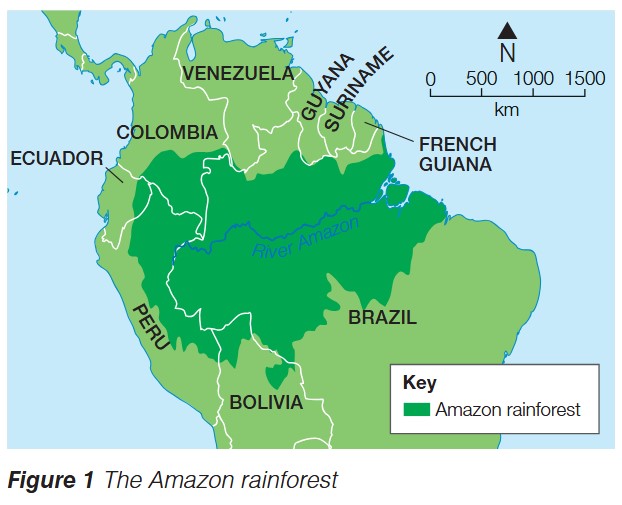
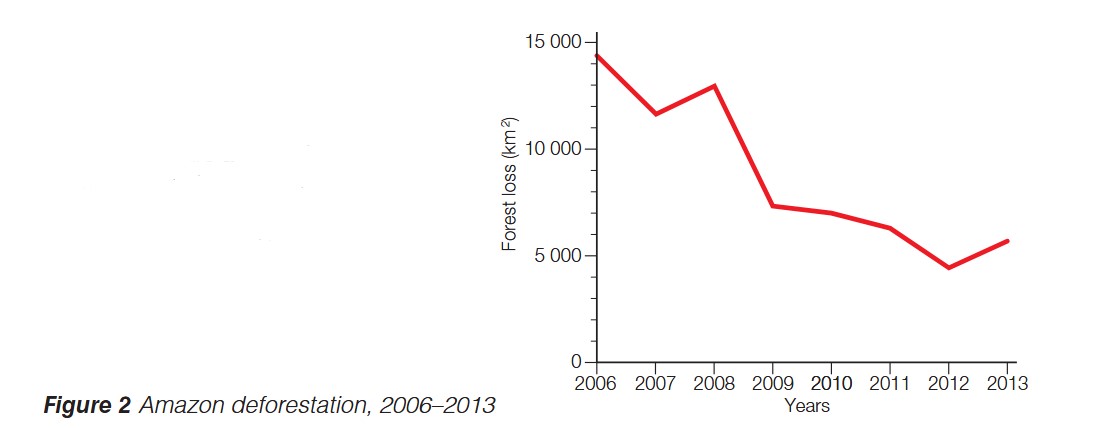
The map above shows the extensive distribution of the Amazon rainforest across northern South America. The accompanying graph illustrates an important trend: deforestation rates in the Amazon have been declining since 2006, though forest loss still continues.
Note
The declining deforestation rate in the Amazon shows that conservation efforts can be effective, even while economic development continues. This demonstrates that these goals don't have to be mutually exclusive.
Exploitation for economic development
Rainforests are being exploited - meaning they are used and developed for economic purposes. For LIDCs and EDCs, rainforests represent an opportunity to generate income, create jobs, and boost national economies. However, this exploitation has led to significant environmental concerns, particularly large-scale deforestation in certain countries.
Important
When explaining why rainforests are exploited in exams, always link your answer to the economic needs of developing countries. Use specific examples of how exploitation generates income to strengthen your response.
Ways of exploiting rainforests
Rainforest exploitation takes several different forms, each with distinct impacts on the forest ecosystem:
Logging
Logging involves felling large trees to harvest timber, which is then sold commercially. This activity can occur over extensive areas of rainforest. Timber from tropical rainforests is valuable in international markets, making logging a significant source of income for developing countries. However, large-scale logging removes vital tree cover and disrupts forest ecosystems.
Mineral extraction
Mineral extraction uses two main approaches to access valuable resources beneath the rainforest:
- Open-cast mining removes trees and strips away topsoil from the surface rock to access minerals underneath. This method leaves large scars on the landscape and destroys forest habitat completely in the mined areas.
- Drilling operations obtain oil and natural gas from deep underground. While drilling has a smaller surface footprint than open-cast mining, it still requires forest clearance for equipment and infrastructure, and poses risks of pollution.
Agriculture
Forests are cleared and removed to create farmland for both small-scale subsistence farming and large-scale commercial agriculture. While this provides land for food production and cash crops, there is a critical problem: rainforest soil quickly loses fertility once the forest cover is removed. The trees and vegetation normally protect the soil and recycle nutrients, so without them, the soil becomes degraded within a few years.
Important
Critical Concept: Soil Fertility Decline
When describing agricultural impacts in exams, always mention that soil fertility rapidly declines after forest clearance - this is a key point about why rainforest agriculture is often unsustainable. This happens because the forest trees and vegetation normally protect the soil and recycle nutrients back into the ecosystem.
Tourism
Unlike the other forms of exploitation, tourism can actually help prevent deforestation. When tourists pay to visit rainforests, this generates income for local communities without requiring forest clearance. This alternative source of revenue can reduce pressure to exploit forests in more destructive ways. Tourism therefore represents a more sustainable approach to gaining economic benefit from rainforests, supporting the local economy while maintaining the forest ecosystem.
Example
Example: Tourism as Sustainable Income
In many rainforest regions, ecotourism provides a viable alternative to destructive exploitation:
- Tourist visits generate direct income for local communities
- No forest clearance is required
- The forest remains intact while still providing economic benefits
- Reduces pressure to engage in logging, mining, or agriculture
- Creates long-term sustainable employment opportunities
This demonstrates how economic development and conservation can work together.
Rainforests as 'natural capital'
Understanding natural capital
Tropical rainforests can be viewed as a form of natural capital - a resource that, when managed wisely, can provide income for many years into the future. This concept represents a shift in how governments and communities value their forests.
Note
Definition: Natural Capital
Natural capital is a resource that, if used wisely, can provide an income for many years. This long-term perspective contrasts with short-term exploitation that depletes resources quickly.
The value of rainforests
Governments are increasingly recognizing that rainforests offer valuable goods and services that benefit both their economies and their populations. Rather than seeing forests simply as obstacles to development, this perspective acknowledges the long-term benefits of maintaining healthy forest ecosystems. These goods and services include timber products, medicinal plants, climate regulation, water cycle maintenance, and biodiversity conservation.
Slowing deforestation in the Amazon
There is encouraging evidence that conservation efforts are having some positive impact. As shown in the graph earlier, the rate of deforestation in the Amazon rainforest has slowed down significantly since 2006. While forest loss continues, the declining trend suggests that policies aimed at forest protection and sustainable management may be working. This demonstrates that economic development and forest conservation are not necessarily incompatible goals.
Note
Exam Strategy: Using Evidence
When asked to evaluate management strategies, refer to the Amazon deforestation data as evidence that conservation measures can be effective, though challenges remain. This shows you can support your arguments with specific examples and data.
Remember!
Summary
Key Points to Remember:
- Most tropical rainforests are located in LIDCs and EDCs, with the Amazon being the largest example
- Rainforests are exploited for economic development through four main methods: logging, mineral extraction, agriculture, and tourism
- Agriculture causes particular problems because rainforest soil rapidly loses fertility after trees are removed
- Tourism offers a more sustainable alternative that generates income without destroying the forest
- Rainforests are increasingly recognized as 'natural capital' - valuable long-term resources
- Deforestation rates in the Amazon have been declining since 2006, showing that conservation efforts can succeed
Key Terms:
- LIDCs (Low-Income Developing Countries) and EDCs (Emerging and Developing Countries) - where most rainforests are located
- Deforestation - large-scale removal of forest trees
- Exploitation - using resources for economic benefit
- Natural capital - resources that can provide long-term income if managed sustainably
- Open-cast mining - surface mining that removes topsoil and trees
Critical Processes:
- Rainforest exploitation for economic development in developing countries
- Soil fertility decline following forest clearance
- Trend towards viewing rainforests as natural capital requiring sustainable management