Life in the Arctic (OCR GCSE Geography B (Geography for Enquiring Minds)): Revision Notes
📚Revision Notes
Life in the Arctic
Introduction to Arctic environments
The Arctic is a unique region characterized by extremely cold conditions and limited biodiversity. This polar environment contains two distinct types of ecosystems: the marine ecosystem in the ocean waters and the tundra ecosystem on land. Both ecosystems are interconnected and have adapted to survive in harsh conditions where temperatures remain very low for most of the year.
Note
The marine and tundra ecosystems are not isolated—they interact through migratory animals, birds, and nutrient cycles that connect ocean and land environments.
Arctic ecosystems
Marine ecosystem
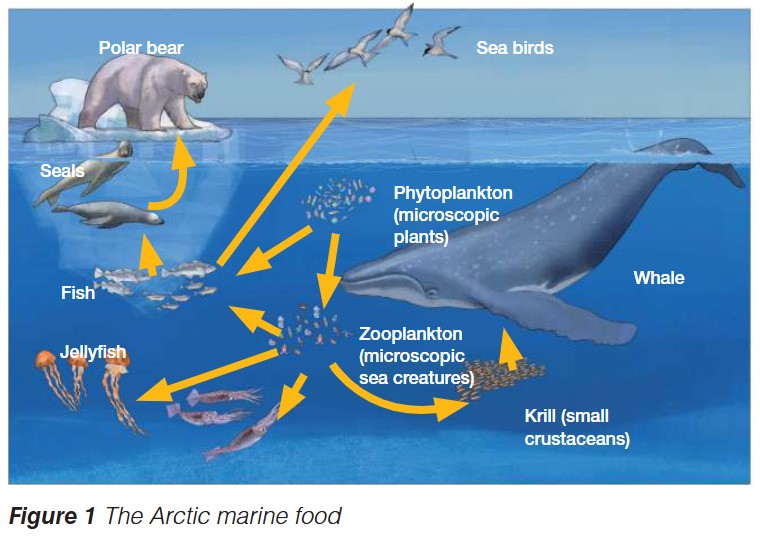
The Arctic Ocean supports a complex marine ecosystem built around an intricate food web. Unlike simple food chains, this web shows how multiple species depend on each other for survival.
The foundation of this marine ecosystem consists of tiny organisms called phytoplankton. These microscopic plants float in the ocean and use sunlight to produce their own food through photosynthesis, making them the primary producers. They form the base of the entire food web.
Energy then flows upward through the ecosystem. Zooplankton (tiny animal-like creatures including small crustaceans called krill) feed on the phytoplankton. These zooplankton are then consumed by fish, which in turn become food for larger predators. At the top of this food web sit the apex consumers: polar bears and whales. These large mammals have no natural predators in the Arctic Ocean.
Example
Energy Flow in the Arctic Marine Food Web
The complete energy transfer pathway looks like this:
- Phytoplankton (producers) → use sunlight to create energy
- Zooplankton (primary consumers) → feed on phytoplankton
- Fish (secondary consumers) → consume zooplankton
- Polar bears and whales (apex consumers) → feed on fish and have no predators
Each step transfers energy upward through the ecosystem, with organisms at each level depending on the level below for survival.
Birds also play an important role in this ecosystem, feeding on fish and connecting the marine and terrestrial environments. The interdependence between all these species means that changes to one population can affect the entire ecosystem.
Tundra ecosystem
On land, the Arctic tundra represents a very different environment. The word "tundra" refers to vast, treeless plains where only specially adapted organisms can survive.
The producers in the tundra are quite different from those in the ocean. Instead of phytoplankton, the tundra supports small, low-growing plants. These plants have adapted to survive the extreme cold and grow close to the ground to avoid harsh winds. Importantly, these plants can only grow during the brief summer months when conditions are slightly warmer and the soil thaws.
The consumers in the tundra ecosystem are primarily migratory animals. These include large herbivores such as caribou (reindeer) and birds like geese and ducks. These animals migrate to the Arctic during summer to feed on the available vegetation, then travel south before winter returns. This seasonal movement is essential for their survival, as the tundra cannot support animal life year-round due to the lack of available food in winter.
Note
The tundra's extreme seasonality means that most animal life must be mobile, arriving to take advantage of the brief productive summer period and leaving before the harsh winter makes survival impossible.
Arctic soils
Characteristics of Arctic soils
Arctic soils present significant challenges for both plants and human development. Generally, these soils are thin and of poor quality, which severely limits plant growth. The shallow depth means there is little room for root systems to develop, and the nutrient content is low because decomposition of organic matter occurs very slowly in cold conditions.
The underlying rock layer weathers extremely slowly due to the persistently low temperatures. Weathering is the process by which rock breaks down into smaller particles to form soil, but this process requires water movement and temperature fluctuations, both of which are limited in the Arctic.
Important
The slow weathering rate in the Arctic means soil formation takes much longer than in warmer climates. This is a key reason why Arctic soils remain thin and nutrient-poor despite being ancient landscapes.
Permafrost
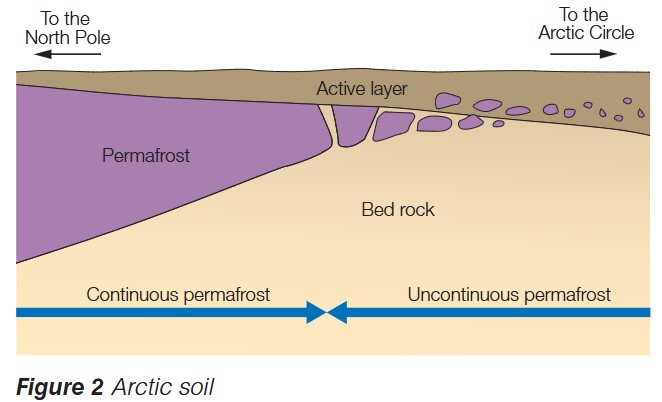
One of the most distinctive features of Arctic soils is permafrost. This is the portion of ground that stays frozen throughout the entire year, even when air temperatures rise above 0°C during summer months. Permafrost can extend to great depths and represents a permanent frozen layer beneath the surface.
The distribution of permafrost varies across the Arctic region. Closer to the North Pole, continuous permafrost exists, meaning the frozen ground is present everywhere beneath the surface. As you move toward the Arctic Circle (the southern boundary of the Arctic region), the permafrost becomes discontinuous or uncontinuous, meaning frozen ground exists in patches rather than as a continuous layer.
Active layer
Above the permafrost lies the active layer. This is the uppermost section of soil that undergoes seasonal thawing during summer months. When temperatures rise slightly, this surface layer melts, allowing some water movement and limited plant growth.
However, the active layer is typically quite thin, and it refreezes completely when winter returns. This annual freeze-thaw cycle creates challenging conditions for plants, as their roots must be able to survive both frozen and waterlogged conditions.
Note
Think of the active layer as a thin "breathing zone" above the permanently frozen permafrost. This narrow layer is the only part of the soil that plants can access during the growing season.
Building considerations in the Arctic
The presence of permafrost creates serious challenges for construction and development in Arctic regions. When buildings are constructed directly on the ground, the heat from the structure can warm the permafrost beneath it. This causes the frozen ground to melt, which leads to ground subsidence (sinking).
To prevent this problem, modern homes and buildings in the Arctic are constructed on stilts (raised supports). This design keeps the building elevated above the ground, allowing air to circulate beneath the structure. This circulation prevents heat transfer to the permafrost, maintaining the frozen ground in its solid state and preventing the building from collapsing due to ground movement.
Important
Why Stilts Are Essential
Without stilts, building heat would melt the permafrost, causing the ground to become unstable. This would lead to:
- Ground subsidence and sinking
- Structural damage to buildings
- Potential collapse of the structure
- Costly repairs and safety hazards
Stilts solve this by keeping buildings elevated, maintaining air circulation that preserves the frozen ground.
This engineering solution demonstrates how human activities in the Arctic must be carefully adapted to work with, rather than against, the unique environmental conditions.
Remember!
Summary
Key Points to Remember:
-
The Arctic contains two main ecosystem types: marine (in the ocean) and tundra (on land), both supporting interconnected species adapted to extreme cold.
-
The marine food web flows from phytoplankton → zooplankton → fish → top consumers (polar bears and whales), showing clear energy transfer through the ecosystem.
-
Permafrost is permanently frozen ground found beneath the surface that remains solid even in summer, while the active layer above it thaws seasonally.
-
Arctic soils are generally thin, nutrient-poor, and challenging for plant growth due to permafrost, slow weathering, and low temperatures.
-
Buildings in the Arctic must be constructed on stilts to prevent the heat from structures melting the permafrost, which would cause ground collapse and building damage.