Towards an Arctic Treaty (OCR GCSE Geography B (Geography for Enquiring Minds)): Revision Notes
📚Revision Notes
Towards an Arctic Treaty
Why an Arctic treaty is needed
The Arctic region faces growing environmental challenges that threaten its fragile ecosystem. The success of the Antarctic Treaty, established in 1961, demonstrates how international cooperation can effectively protect polar environments. This has led to discussions about whether the Arctic needs similar protection.
Note
The Antarctic Treaty has become one of the most successful international environmental agreements in history, proving that countries can work together to protect vulnerable polar regions.
Environmental threats to the Arctic
The Arctic is under pressure from several major environmental threats:
- Global warming and melting sea ice: Rising temperatures are causing Arctic sea ice to melt at an accelerating rate, disrupting ecosystems and contributing to sea level rise.
- Resource exploitation: Countries and companies are increasingly interested in extracting Arctic resources, particularly drilling for oil and gas. As sea ice retreats, previously inaccessible areas become available for exploitation.
- Pollution: The Arctic receives pollution transported from other parts of the world through atmospheric and ocean currents, despite being far from major population centres.
- Declining Arctic species: Populations of species adapted to Arctic conditions, such as polar bears, Arctic foxes, and various marine mammals, are experiencing significant decline due to habitat loss and changing conditions.
These threats have prompted environmental groups and some governments to consider whether an international Arctic treaty could provide better protection for this vulnerable region.
The Antarctic Treaty and Environmental Protocol
The Antarctic Treaty, signed in 1961, has become one of the world's most successful international environmental agreements. It established Antarctica as a protected region dedicated to peace and scientific research.
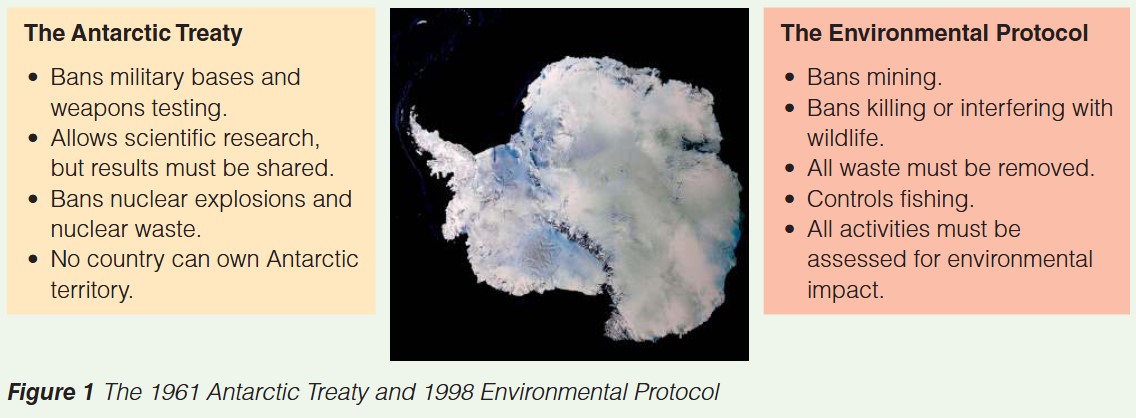
Main features of the Antarctic Treaty (1961)
The original treaty introduced several groundbreaking provisions:
- Military prohibition: All military bases and weapons testing are banned, ensuring Antarctica remains a zone of peace.
- Scientific cooperation: Scientific research is encouraged, but all findings must be shared internationally, promoting collaboration rather than competition.
- Nuclear ban: Nuclear explosions and disposal of nuclear waste are strictly prohibited, protecting the pristine environment.
- Territorial freeze: No country can claim ownership of Antarctic territory, preventing disputes over sovereignty.
Important
The Antarctic Treaty's most revolutionary principle is that no country can own Antarctic territory. This territorial freeze has prevented conflicts and ensured the continent remains dedicated to peaceful scientific research and environmental protection.
The Environmental Protocol (1998)
The treaty was significantly strengthened in 1998 when the Environmental Protocol was added, introducing stricter environmental protections:
- Mining prohibition: All mineral extraction activities are banned, preserving Antarctica's resources.
- Wildlife protection: Killing or interfering with Antarctic wildlife is forbidden, safeguarding unique species like penguins, seals, and whales.
- Waste management: All waste generated by human activities must be removed from the continent, maintaining its pristine condition.
- Fishing regulations: Fishing activities are controlled to prevent overexploitation of marine resources.
- Environmental impact assessments: Any proposed activity must undergo environmental impact assessment before proceeding.
Key differences between the Arctic and Antarctica
Understanding the differences between these two polar regions helps explain why creating an Arctic treaty presents unique challenges.
Geographic differences
The most fundamental difference is their basic geography. The Arctic is an ocean surrounded by land masses, including parts of Russia, Canada, Alaska, Greenland, Norway, Sweden, Finland, and Iceland. In contrast, Antarctica is a continent surrounded by ocean, isolated from other landmasses.
Note
This geographic distinction has profound implications for how each region can be governed and protected. The Arctic's land borders connect it to sovereign nations, while Antarctica's isolation made it easier to establish as international territory.
Population and settlement
The Arctic supports indigenous populations who have lived in the region for thousands of years, including the Inuit, Sami, and other groups. These communities have established rights to their traditional lands. Antarctica, however, has no permanent indigenous population. Only scientists and support staff temporarily occupy research stations on the continent.
Ice cover and terrain
Arctic regions include both sea ice and tundra landscapes, with varying degrees of ice cover depending on location and season. Antarctica is almost entirely covered by ice, with approximately 98% of the continent buried under thick ice sheets.
Ownership and sovereignty
Eight countries (Russia, Canada, United States, Denmark/Greenland, Norway, Sweden, Finland, and Iceland) have territory in the Arctic and exercise sovereignty over their own land and seabed. They control resource extraction and other activities within their borders. Antarctica has no national ownership – no country can claim any part of the continent as sovereign territory under the Antarctic Treaty.
Resource exploitation and military activity
The Arctic currently experiences significant resource exploitation, particularly oil and gas extraction, as well as some military activity by the countries with Arctic territory. Both resource exploitation and military activity are completely banned in Antarctica under the treaty system.
Challenges for an Arctic treaty
Creating an Arctic treaty similar to Antarctica's would face several obstacles:
- The eight Arctic nations have existing sovereignty over their territories and may be reluctant to give up control over resource exploitation.
- Indigenous peoples have established rights to Arctic lands, which must be respected in any agreement.
- Economic interests in Arctic oil, gas, and mineral resources create strong opposition to exploitation bans.
- Strategic military interests in the Arctic region make countries hesitant to accept military restrictions.
- The complexity of balancing environmental protection with the rights and needs of Arctic residents and nations makes reaching international agreement more difficult than it was for uninhabited Antarctica.
Important
Key Challenge: Unlike uninhabited Antarctica, the Arctic has permanent populations with established rights and eight nations with sovereign claims. Any Arctic treaty must balance environmental protection with indigenous rights, national sovereignty, and economic interests – making agreement far more complex than the Antarctic Treaty.
Summary
Key Points to Remember:
-
The 1961 Antarctic Treaty successfully protects Antarctica through bans on military activity, nuclear testing, and territorial claims, with strengthened environmental protections added in 1998.
-
The Arctic faces four main threats: global warming melting sea ice, resource exploitation (especially oil drilling), pollution, and declining species populations.
-
Key differences exist between the regions: the Arctic is an ocean surrounded by land with indigenous populations and national sovereignty, while Antarctica is an ice-covered continent with no permanent inhabitants or national ownership.
-
An Arctic treaty would be more difficult to establish than the Antarctic Treaty due to existing sovereignty claims, indigenous peoples' rights, economic interests in resources, and strategic military considerations.
-
Despite challenges, the success of Antarctic protection demonstrates that international cooperation can effectively preserve polar environments.