Jahangir, 1605–1627 (OCR GCSE History B (Schools History Project)): Revision Notes
📚Revision Notes
Jahangir's patronage of painting and the development of the Mughal miniature
Note
Largely influenced by Western painting, Jahangir ordered his painters to make reference to Western styles in his portraits. As a result, Mughal painters adapted finer strokes and lighter colours. Among the earlier Mughal emperors, Jahangir had direct contact with the English Crown. He received gifts of oil paintings, specifically portraits.
Jahangirnama
Babur, Jahangir's great grandfather wrote Baburnama which is regarded as the first true autobiography in the Islamic world.
Following his predecessor's initiative, Jahangir collected his personal memoirs including narratives and works of art.
Compared to all Mughal Emperors, Jahangir was the most visual and observant of the world around him. Compared to his father, Akbar, who initiated extensive public building projects, Jahangir focused on the beauty of architecture and illustrations.
In the Jahangir Nama, the emperor described the landscapes he witnessed in India, including gardens, trees, animals, and temples.
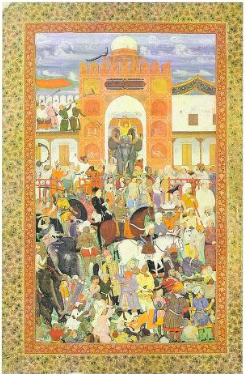
Painting depicting Jahangir's accession
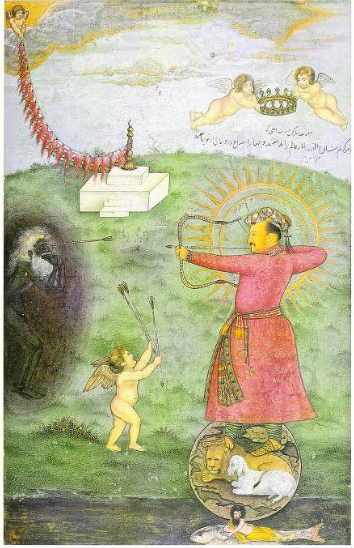
Painting depicting the emperor triumphing over poverty
Jahangir's patronage of painting and the development of the Mughal miniature
- Mughal miniature paintings covered a variety of subjects, including court scenes, battles, and portraiture. Most were painted with ornate borders and calligraphy.
- Compared to the regular form of paintings, as its name suggests, miniatures were quite small yet filled with detail.
- Usually, multiple artists worked on creating a single miniature painting.
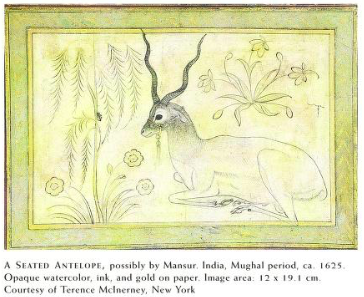
Painting depicting a seated antelope, 1625
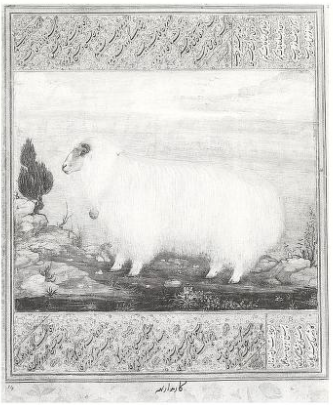
Painting depicting a mountain sheep, 1620
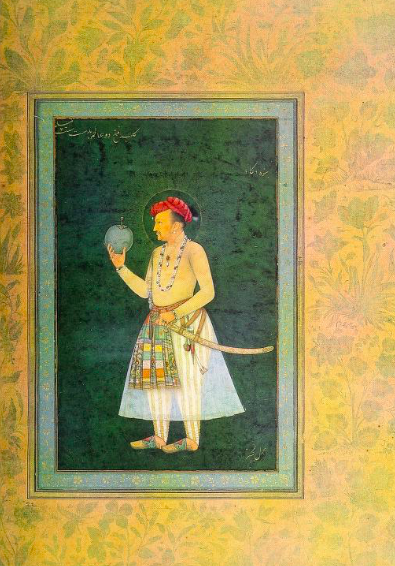
Painting of Jahangir holding a globe, 1620
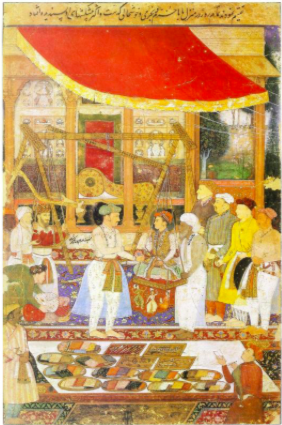
Painting depicting the weighing of Prince Khurram, 1625
Note
Art historians suggest that the height of Mughal painting was achieved during the rule of Jahangir. Abul Hasan, son of the Iranian artist Aqa Reza, became one of his most valued court artists. Jahangir commissioned paintings of rare birds from Goa and flowers in Kashmir, which reflected Naturalism.
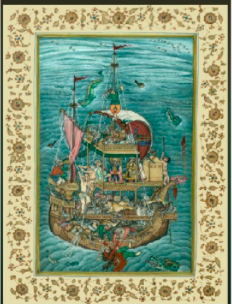
Painting of the Noah's Ark
In addition to India's marvellous landscape, most Mughal paintings during Jahangir's reign depicted battles and the presence of foreign emissaries who aimed to establish trade connections. The Mughal way of life was greatly told through their paintings.
In general, Mughal painting was a combination of Indian, Persian, and Muslim styles in which the major features included the following:
- Subjects were based on close observation of nature.
- Refined and intricate drawings along with calligraphic text descriptions, usually on the border.
- Primarily aristocratic in nature and mostly secular. Ustad Mansur, one of Jahangir's court artists was best known for his paintings of a Siberian crane and the dodo bird, both of which are now extinct.

Glossary of Terms
Jahangir
Son of Akbar, Prince Salim was later crowned as Jahangir was the 4th Mughal emperor.
Foreign Trade
The exchange of goods and capital across borders and territories.
Jahangirnama
Jahangir's collection of personal memoirs including narratives and work of art.
Nur Jahan
Jahangir's 20th wife who gained influence in her husband's court and administration in general.
Miniature Painting
A combination of Indian, Persian, and Muslim styles in which subjects are based on nature. It is usually bordered with intricate designs and calligraphy.
Farman
An adjoining legal document or order issued by Nur Jahan, which showed her political influence.

Source Analysis
Note
Critically read the source and answer the questions which follow: (1) How did Jahangir respond to English traders? and (2) What was the historical significance of this event on the Mughal Empire during Jahangir's reign?
Upon which assurance of your royal love I have given my general command to all the kingdoms and ports of my dominions to receive all the merchants of the English nation as the subjects of my friend; that in what place soever they choose to live, they may have free liberty without any restraint; and at what port soever they shall arrive, that neither Portugal nor any other shall dare to molest their quiet; and in what city soever they shall have residence, I have commanded all my governors and captains to give them freedom answerable to their own desires; to sell, buy, and to transport into their country at their pleasure.
For confirmation of our love and friendship, I desire your Majesty to command your merchants to bring in their ships of all sorts of rarities and rich goods fit for my palace; and that you be pleased to send me your royal letters by every opportunity, that I may rejoice in your health and prosperous affairs; that our friendship may be interchanged and eternal.
- Letter of Jahangir to the English king through Sir Thomas Roe

Source Analysis
"As regards myself, my liking for painting and my practice in judging it have arrived at such a point that when any work is brought before me, either of a deceased artists or of those of the present day, without the names being told to me, I can say at the spur of the moment that it is the work of such and such a man. And if there be a picture containing many portraits, and each face be the work of a different master, I can discover which face is the work of each of them. If any person has put in the eye and eyebrow of a face, I can perceive whose work the original face is, and who has painted the eye and the eyebrow."
- Jahangir as written in his biography, Tuzuk-i-Jahangiri
Note
Given the source, write a substantiated essay on Jahangir's patronage of the arts. Moreover, discuss how her characteristics facilitated the development of Mughal miniature painting.