Isotopes (OCR GCSE Physics A, Combined (Gateway Science Suite)): Revision Notes
📚Revision Notes
4.1.4 Isotopes
Note
Key Points:
- All atoms of the same element have the same number of protons.
- Neutral atoms have the same number of electrons and protons.
- Isotopes are atoms of the same element but with different masses, having the same number of protons but different numbers of neutrons.
Example
Example: Carbon-12, Carbon-13, and Carbon-14.
Note
Notation:
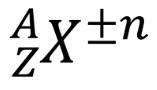
- : The letter of the element.
- : Mass number (number of neutrons and protons).
- : Proton number.
- : Charge.
- On a neutral atom: Electrons = Protons, so cancels out.
- If ( N ) more electrons than protons, then -( N ) charge.
- If ( N ) fewer electrons than protons, then +( N ) charge.
- The number of protons does not change for a certain element.
Isotopes and Nuclear Radiation
Isotopes
Note
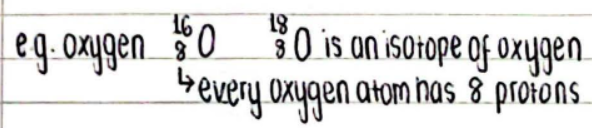
Definition: Isotopes are different forms of the same element. They have the same number of protons but a different number of neutrons.
Example
Example: Oxygen:
Note
General Information:
- All elements have different isotopes, but there are usually only one or two stable ones.
Radioactive Substances
- Ionising Radiation:
- Radioactive substances release ionising radiation from their nucleus.
- They can also release neutrons when they decay to rebalance the number of protons and neutrons.
- Ionising Power:
- How easily a source of radiation loses electrons to create positive ions.
Radioactivity
- Unstable Nucleus:
- Some isotopes have an unstable nucleus.
- To become stable, the nucleus gives out radiation.
- This process is called radioactive decay.
- It is a totally random process.
- Activity:
- The rate at which a source of unstable nuclei decay.
- Measured in becquerel (Bq).
- Measurement:
- A Geiger-Muller tube is used to measure the activity of a radioactive source.
- It is a detector.
- Count-rate:
- The number of decays recorded each second.
- It is not the same as activity.