Notation (Junior Cert Mathematics): Revision Notes
📚Revision Notes
Notation
Functions: Notation and Mapping Diagrams
In this section, we will look at the different ways to write functions and how to interpret mapping diagrams. We will also explain how to determine if a relation is a function.
Notation
There are different ways to write functions, but they all mean the same thing. Here are the common notations you might see:
- These notations all describe the same function: a rule that takes an input , performs some operations on it (like squaring it and adding times ), and gives an output.
It's important to understand that no matter how the function is written, the idea remains the same—you're transforming an input into an output following a specific rule.
Mapping Diagrams
A function connects inputs to outputs, and this relationship can be shown using mapping diagrams. In these diagrams, the arrows show how the function maps (or connects) each input to exactly one output.
For example, if you have a function where the input is mapped to the output , this would be shown with an arrow pointing from to . Each input will have one arrow pointing to its corresponding output.
Imagine you have a set of input numbers (these are your domain) and a set of output numbers (these are your range). The function connects each input to exactly one output.
For example, if you have the following inputs and outputs:
-
Inputs: (Domain)
-
Outputs: (Range) In this diagram, the arrows show how each input is connected to its output:
-
Input is mapped to output
-
Input is mapped to output
-
And so on…
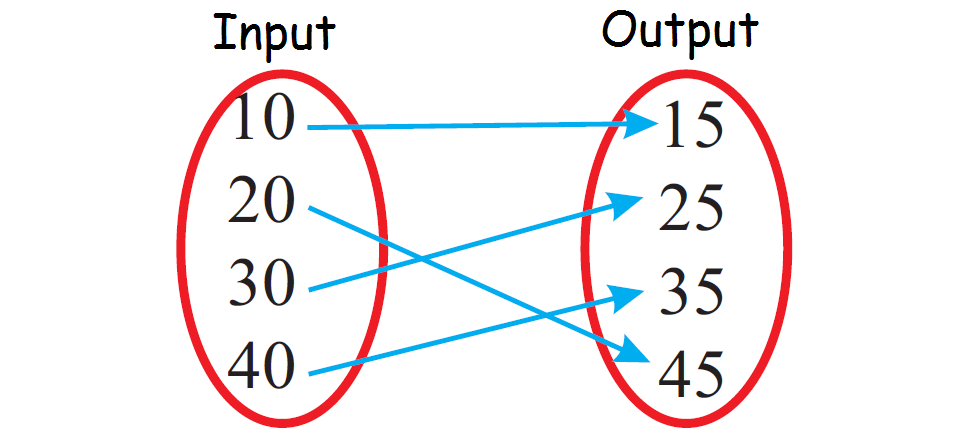
Mapping diagrams help us visualise how each input has a specific output.
Identifying if a Relation is a Function
Rule: For a relation to be a function, each input must be connected to only one output. This means that no input can be connected to more than one output.
Imagine you have a machine where you put in a number (the input) and it gives you a result (the output). If every time you put in the same number, you always get the same result, then this machine is working as a function. But if you put in a number and sometimes get one result and sometimes another, then it is not a function.
To explain further:
- One Output Per Input: For every input, there should only be one output. Think of it like a vending machine. If you press the button for a chocolate bar, you should only get one chocolate bar, not two different things!
- What to Look For: When looking at a mapping diagram, check to make sure each input has only one arrow pointing to an output. If an input has two arrows going to different outputs, then the relation is not a function. To help you understand this, let's look at two diagrams:
- (NOTE: Include a diagram that shows a function, where each input has exactly one output. For example, inputs mapped to outputs )
- (NOTE: Include a diagram that shows a relation that is not a function, where one input has multiple outputs. For example, inputs mapped to outputs , but with input also mapped to ) In the first diagram, each input has only one output, so it is a function. In the second diagram, input has two different outputs ( and ), so it is not a function. This is because a function must give you the same result every time you use the same input.
Important
Important Tip: If you're unsure whether a relation is a function, just ask yourself, "Does each input only have one output?" If the answer is yes, then it's a function!
Summary
- Functions can be written in different ways using function notation, but they all describe the same idea.
- Mapping diagrams show how each input in the domain is connected to an output in the range. The arrows in the diagram represent how the function maps each input to its output.
- A relation is a function if every input has only one output. You can spot this by checking that each input in the diagram only connects to one output. If an input has more than one output, it is not a function. Understanding these ideas will help you work confidently with functions in algebra. Keep practising with different examples and diagrams to strengthen your understanding!
Let me know if you need further explanations or examples!