Exponential: y=a^x (Junior Cert Mathematics): Revision Notes
📚Revision Notes
Exponential Functions
An exponential function is a special type of function in maths where the variable (usually ) appears as the exponent (or power). Don't worry if that sounds a bit tricky—let's break it down!
For example, look at the function:
Here:
- The number is called the base.
- The letter is the exponent or power. So, in this function, the base stays the same, but the exponent (which is ) can change. That's what makes exponential functions unique!
What Happens When You Change ?
When you change the value of , the output (or result) of the function changes too. Here are some examples:
- If , then (Remember, any number to the power of is !)
- If , then
- If , then
- If , then Notice how quickly the numbers get bigger as increases? That's what makes exponential functions grow so fast.
How to Draw the Graph of
To draw the graph of this function, let's make a table with some values of and the corresponding values of :
| -2 | 0.25 |
| -1 | 0.5 |
| 0 | 1 |
| 1 | 2 |
| 2 | 4 |
| 3 | 8 |
Now, plot these points on graph paper or using a grid:
- When , (very small)
- When ,
- When , (much bigger) Join the points with a smooth curve. You'll see that the graph starts out small on the left, rises through the point , and then curves upward more steeply as you move to the right.
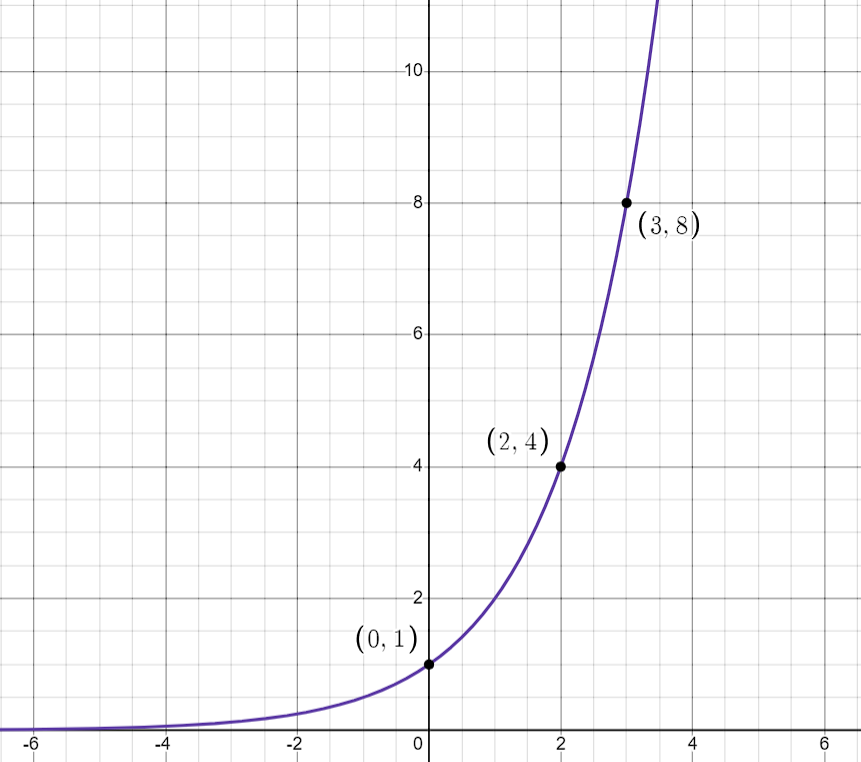
Key Features of Exponential Graphs:
- Starts Slowly, Then Grows Quickly: The graph starts out increasing slowly for smaller values of , but as increases, the graph shoots up quickly.
- Always Positive: The graph never dips below the -, which means the values of are always positive.
- Passes Through : All exponential functions of this type will cross the - at the point .