Practice Problems (Junior Cert Mathematics): Revision Notes
📚Revision Notes
Practice Problems
Problems:
Problem 1:
Note
In the given triangles, the marked angles are equal.
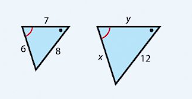
Question :
- (i) Explain why the two triangles are similar.
- (ii) Find the values of and .
Explanation:
This question is asking you to determine why two triangles are similar based on their angles, and then use that similarity to find the lengths of the sides and .
Problem 2:
Note
In the given diagram, the arrows indicate that the lines are parallel.
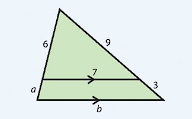
Question : Find the lengths of the line segments marked and .
Explanation:
This question involves finding the lengths of two segments in a triangle where parallel lines create proportional segments.
Problem 3:
Note
In the given triangle, is parallel to .
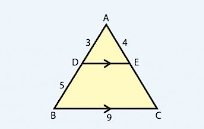
Question : Find the length of .
Explanation:
This question asks you to find the length of a segment in a triangle where two sides are parallel, using the proportionality of the segments.
Solutions:
Problem 1:
Note
In the given triangles, the marked angles are equal.
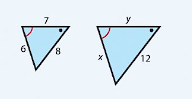
Question :
- (i) Explain why the two triangles are similar.
- (ii) Find the values of and .
- (i) Why the triangles are similar:
- The problem states that the marked angles in both triangles are equal. Since two angles in one triangle are equal to two angles in another triangle, the triangles are similar.
- Reason: According to the Angle-Angle (AA) Similarity Theorem, if two angles of one triangle are equal to two angles of another triangle, then the triangles are similar. This theorem is valid because similar triangles maintain the same shape, with corresponding angles equal and corresponding sides proportional.
- (ii) Finding and :
- Since the triangles are similar, their corresponding sides are proportional. This means the ratios of the sides in one triangle will be equal to the ratios of the corresponding sides in the other triangle.
- To solve for and , we first need to correctly match the corresponding sides between the two triangles.
- Step 1: Set up the proportions
- The side with length in the smaller triangle corresponds to the side with length in the larger triangle.
- The side with length in the smaller triangle corresponds to the side with length in the larger triangle.
- The side with length in the smaller triangle corresponds to the side with length in the larger triangle.
- Therefore, we set up the following proportions:
- Step 2: Solve for Reasoning: Cross-multiplying gives us: Explanation: We used the proportionality of corresponding sides in similar triangles to find the length of .
- Step 3: Solve for Cross-multiply: Explanation: Similarly, we used the proportionality to solve for , confirming the triangle's sides are consistent with their similarity.
- Final Answer: units, units.
Problem 2:
Note
In the given diagram, the arrows indicate that the lines are parallel.
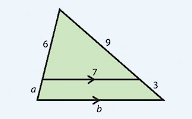
Question : Find the lengths of the line segments marked and .
Step 1: Identify the Relationship Between the Triangles
- The problem involves two triangles where one is smaller and inside the other, and the lines are parallel. The parallel lines imply that the triangles are similar because corresponding angles are equal.
- Reasoning: The Angle-Angle (AA) Similarity Theorem applies here because the corresponding angles are equal, making the triangles similar. This allows us to use the proportionality of corresponding sides.
Step 2: Solve for
- Since the triangles are similar, their corresponding sides are proportional. We use this property to find the length of side .
- Set up the proportion based on the given sides:
- Explanation: This proportion is valid because it directly compares corresponding sides of the similar triangles.
- Cross-multiply to solve for :
Step 3: Solve for Using the Similar Smaller Triangle Inside the Larger Triangle
- Now, we solve for by recognising that corresponds to the entire base of the smaller triangle. Since we know now, the ratio of the sides should hold:
- Substitute the value of into the equation:
- Cross-multiply to solve for :
- Explanation: We correctly set up the proportion based on similar triangles and solved for .
Final Answers:
- The length of units.
- The length of units.
Problem 3:
Note
In the given triangle, is parallel to .
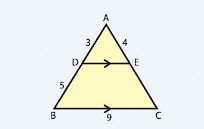
Question : Find the length of .
Step 1: Use the Triangle Proportionality Theorem
- The problem states that . This parallelism indicates that the segments and divide the triangle into similar triangles.
- Reasoning: The Triangle Proportionality Theorem tells us that if a line parallel to one side of a triangle intersects the other two sides, it divides those sides proportionally. We can use this theorem to set up a proportion involving and .
Step 2: Set up the Proportion and Solve for
- Set up the proportion using the given lengths:
- Substitute the known values:
- Cross-multiply to find :
- Explanation: By applying the Triangle Proportionality Theorem, we calculated the length of accurately using the relationship between the sides.
Final Answer:
- The length of units.