Introduction to Trigonometry (Junior Cert Mathematics): Revision Notes
📚Revision Notes
Introduction to Trigonometry
Welcome to trigonometry! This part of maths helps us understand the relationship between angles and sides in right-angled triangles. Although it might seem tricky at first, with practice, you'll get the hang of it. Here are some important things to remember before you start solving trigonometry problems.
1. Check Your Calculator!
Before you begin any calculations, make sure your calculator is set to degrees mode. You can tell if your calculator is in degrees mode by looking for "DEG" or "D" on the screen. If it's not in degrees mode, your answers might be wrong, so this is super important!
2. Always Draw a Diagram
Whenever you're faced with a trigonometry problem, the first thing you should do is draw a diagram. This doesn't have to be a perfect drawing, but it should clearly show the triangle and any angles or sides you know.
- Label your diagram: Write down the measurements of any angles or sides you are given.
- Identify what you need to find: This helps you decide which method to use.
3. Figure Out the Type of Problem
Once your diagram is ready, try to decide what type of problem it is. In trigonometry, there are two main types of problems you might encounter:
- Pythagoras' Theorem problems: These are used when you need to find the length of a side in a right-angled triangle, and you already know the other two sides.
- Right-Angled Triangle problems: These problems use trigonometric ratios to find unknown sides or angles in right-angled triangles. You might hear about SOH-CAH-TOA when working with these problems, which stands for the Sine, Cosine, and Tangent ratios. We'll explain these in detail later. You don't need to worry about using these methods just yet, but it's good to start thinking about what type of problem you're dealing with.
4. Angles of Elevation and Depression
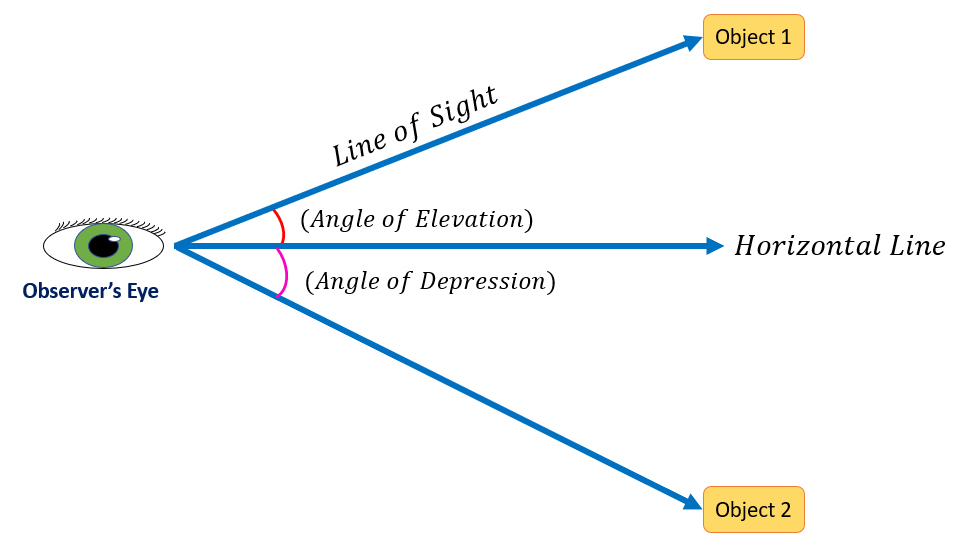
Now, let's talk about something called angles of elevation and angles of depression. These terms might sound complicated, but they're actually quite simple.
- Angle of Elevation: Imagine you're standing on the ground, looking up at the top of a tall tree. The angle between your line of sight (what you're looking at) and the flat ground is called the angle of elevation. It's like tilting your head up to look at something higher than you.
- Angle of Depression: Now imagine you're standing on a hill, looking down at a house below. The angle between your line of sight and the flat ground is called the angle of depression. It's like tilting your head down to look at something lower than you.
5. Area of a Triangle
In trigonometry, you might also need to calculate the area of a triangle. The formula for the area of a triangle is simple:
Here's how it works:
- The base is the length of one side of the triangle (usually the bottom side).
- The height is the perpendicular distance from the base to the opposite vertex (the highest point).
Note
Example:
Imagine you have a triangle with a base of 8 cm and a height of 5 cm. To find the area, you would use the formula:
So, the area of the triangle is 20 square centimetres.
Note
Exam Tip: Watch Your Units!
When calculating the area of a triangle (or any other measurement), always include the correct units in your final answer. For example, area should be in square units (e.g., cm², m²). You can lose marks in the exam if you forget to include units or if you use the wrong ones, so make sure to double-check!
Note
Final Tip
Trigonometry can seem tough at first, but remember: Take your time, draw diagrams, and practice, practice, practice! The more you practice, the easier it will become. Don't be afraid to make mistakes—that's how you learn!
In the next section, we'll dive into the details of Pythagoras' Theorem and how to solve Right-Angled Triangle problems using the Sine, Cosine, and Tangent ratios. Stay tuned, and you'll be solving trigonometry problems with confidence in no time!