Articulation Explored (Junior Cert Music): Revision Notes
📚Revision Notes
Articulation Explored
Note
Articulation indicates 'how' a note should be performed. Articulation changes how a note sounds, but it doesn't change the pitch or the overall duration of the note.
What is Articulation?
- Articulation describes how a note is played, affecting the expression and mood of the music.
- It affects the note's length, connection to other notes, and overall expression.
Key Articulation Markings Explored:
- Accents
- Legato
- Staccato
- Tenuto
- Fermata
Accents
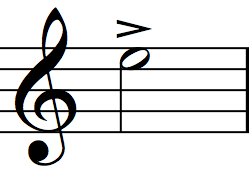
- An accent on a note tells the performer that they must emphasise that note.
- They are drawn above or below the note head, depending on the directing of the stem.
- Accent symbols never touch the note head or stem.
- When a note's stem points downwards, accent symbols are written above the note head.
- When a note's stem points upwards, the accent symbol is written below the note head.
Legato
- Legato markings on music mean that notes should be played smoothly.
- Legato is often indicated using a curved line called a slur.
- The slur is placed above or below two or more notes of different pitch.
- Notes within the curved line of the slur should be played smoothly and joined together.
- Drawing slurs:
- The slur symbol never touches a note head or stem.
- When the stem of the note points downwards, the slur symbol is written above the note heads.
- When the stem of the note points upwards, the slur symbol is written below the note heads.

Note
A slur is a curved line that connects two or more notes to indicate that they should be played smoothly.
Staccato
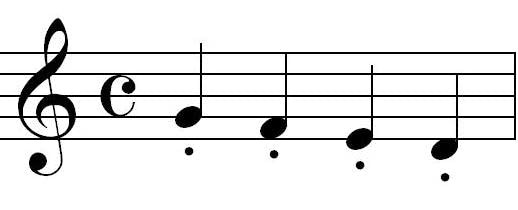
- Staccato markings mean that notes should be played short and detached.
- This symbol is a small dot placed above or below the note head.
- Drawing staccato marks:
- Staccato marks never touch the note head.
- When the stem of the note points downwards, the dot is placed above the note head.
- When the stem points upwards, the dot is placed below the notehead.
Tenuto
- A tenuto mark tells the performer to hold the note for its full value.
- It is a short horizontal line placed above or below the note, depending on the direction of the stem.
- Tenuto helps give the note a slight weight or emphasis, making it sound more deliberate or connected in the phrase.

Fermata
- A fermata (also called a pause) tells the performer to hold the note longer than its written value.
- It looks like a small arc with a dot underneath and is placed above or below the note.
- Fermatas often appear at the end of a phrase or section, allowing the music to pause for dramatic effect.
- In orchestral scores, fermatas are used so that all players keep playing their note until the conductor indicates that they should stop.

Why is Articulation Important?
- Articulation changes the way notes sound, making them short and crisp, smooth and connected, or strong and emphasised.
- Makes a melody more interesting.
- Helps express emotions in music.
- Used in listening tasks to describe music and in performance to shape sound.
- Examples
- 🎵 Coldplay – Viva La Vida uses staccato strings to create an energetic rhythm.
- 🎵 Ludwig van Beethoven – Symphony No. 5 uses accents for dramatic effect.
How to Describe Articulation in Listening Tasks
- Listen for how the notes are played.
- Are they short and detached (staccato) or smooth and connected (legato)?
- Do some notes sound stronger (accents) or held for their full length (tenuto)?
- Describe the articulation using the correct terms.
- Examples:
- The staccato strings in Viva La Vida make the rhythm lively and energetic.
- In Beethoven's Symphony No. 5, the accents ( > ) make the notes sound strong and dramatic.