Human Health (Junior Cert Science): Revision Notes
📚Revision Notes
Human Health
What is health?
Health is not simply the absence of disease or illness. It means something much broader - it is a state of complete wellbeing that includes three important aspects:
- Physical wellbeing - your body is functioning properly and you feel physically well
- Mental wellbeing - you are emotionally stable and your mind is healthy
- Social wellbeing - you have good relationships and connections with other people
Note
All three aspects work together to determine your overall health. You might be physically fit but struggling mentally, or you might have good friendships but be dealing with a physical illness. True health requires balance across all three areas.
Factors affecting health
Your health is influenced by two main categories of factors:
- Inherited factors - characteristics you are born with, controlled by your genes
- Environmental factors - everything around you that can affect your health
These two types of factors work together. This relationship can be shown as:
Your genotype is your genetic makeup (the genes you inherited from your parents). Your environment includes everything from the food you eat to the air you breathe. Your phenotype is your observable characteristics - what you actually look like and how your body functions.
Inherited factors
Understanding genetics and inheritance
Inherited factors are those aspects of your health that are controlled by DNA. Remember from Chapter 10 that DNA carries genetic information passed down from your parents. Some health conditions can be inherited through genes.
Note
Even if you have genes that might put you at risk for something, environmental factors can still influence whether that condition develops. For example, a person might have genes that could make them athletic and strong, but if they do not eat well and train hard, they will not reach their full potential.
Enzymes
Enzymes are special proteins that speed up chemical reactions in living cells. Think of them as helpers that make important processes in your body happen much faster.
There are two key enzymes:
- Amylase - breaks down starch into maltose (a simpler sugar)
- Maltase - breaks down maltose into glucose (which your body can use for energy)
Enzymes are important for health because they control many reactions in your body. If a person has a mutation (change) in the gene that controls a particular enzyme, that enzyme may not work properly. This can cause health problems.
Important
Some people lack the enzyme lactase, which digests the sugar in milk. When they drink milk, they cannot break down the lactose, which causes stomach cramps and discomfort. These people need to take lactase drops or avoid dairy products.
Inherited disorders
Inherited disorders are conditions caused by mutations in genes. These mutations are passed from parents to children through DNA.
| Inherited disorder | Mutated gene | Symptoms | Treatment |
|---|---|---|---|
| Cystic fibrosis | Gene that makes a protein to control salt in cells | Respiratory system can become clogged with mucus | Physiotherapy, Antibiotics, Lung transplant |
| Sickle cell anaemia | Gene for haemoglobin | Loss of red blood cells | Blood transfusions |
How cystic fibrosis is inherited
Cystic fibrosis follows a recessive inheritance pattern. Let's use:
- N = normal gene (dominant)
- n = cystic fibrosis gene (recessive)
Example
Worked Example: Inheritance of Cystic Fibrosis
If both parents are carriers (genotype Nn), they appear normal but carry one copy of the cystic fibrosis gene. Here's what can happen with their children:
| Parents' information | Mother | Father |
|---|---|---|
| Phenotype | Normal | Normal |
| Genotype | Nn | Nn |
| Gametes' genotypes | N, n | N, n |
| Children's possible genotype | Children's possible phenotype |
|---|---|
| NN | Normal |
| Nn | Normal (carrier) |
| Nn | Normal (carrier) |
| nn | Cystic fibrosis |
This shows that when both parents are carriers:
- There is a (25%) chance their child will have cystic fibrosis
- There is a (50%) chance their child will be a carrier
- There is a (25%) chance their child will not carry the gene at all
Environmental factors
Environmental factors include everything about your surroundings that can affect your health. These are factors you can often control or change, unlike your inherited characteristics.
Key environmental factors include:
- Where you live
- The air you breathe
- The food you eat
- Drinking water quality
- Alcohol intake
- Drug intake
- Radiation exposure
- Smoking
- Physical activity levels
- Stress and relaxation
We will look more closely at two particularly important environmental factors: nutrition and lifestyle choices.
Nutrition
What is a balanced diet?
Nutrition is concerned with the foods that are essential for life and good health. Your body needs various nutrients to function properly.
A balanced diet includes the correct amounts of:
- Protein - for growth and repair of cells
- Carbohydrates - for energy
- Fats - for energy storage and insulation
- Minerals - for various body functions (e.g. calcium for bones)
- Vitamins - for maintaining health
- Water - for all body processes
Note
The amounts you need depend on:
- Your age
- Your gender
- Your activity level
The food pyramid
The food pyramid is a useful visual guide that helps us understand how to eat a balanced diet. Foods at the bottom should be eaten most, while foods at the top should be eaten least.
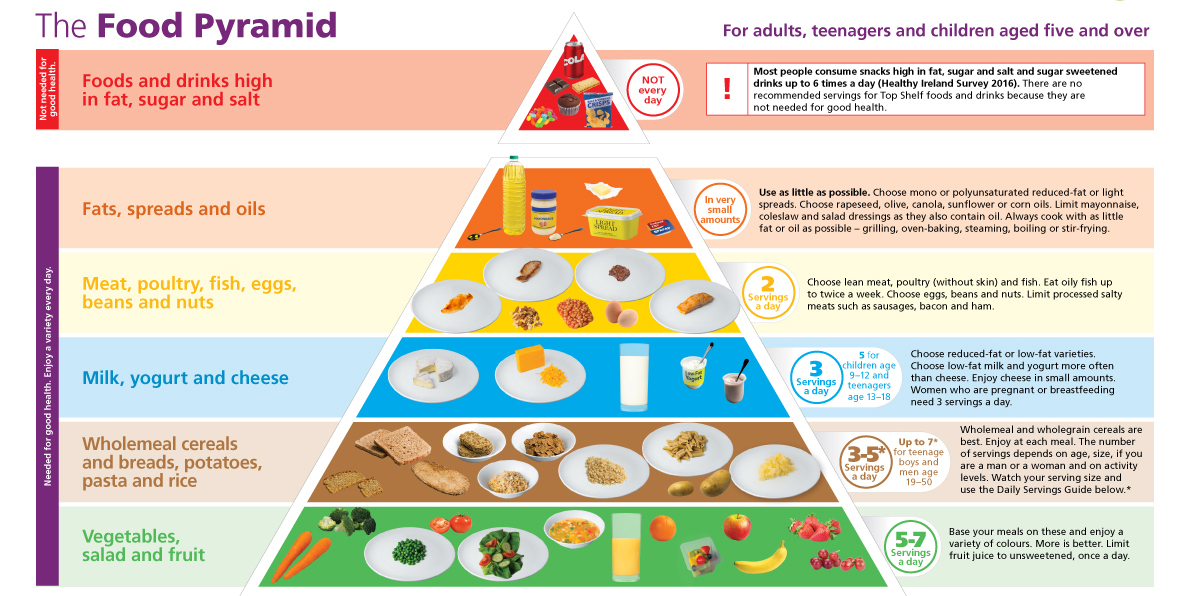
From bottom to top, the pyramid shows:
- Base (largest) - Vegetables, salad and fruit (eat most)
- Second level - Wholemeal cereals and breads, potatoes, pasta and rice
- Third level - Milk, yogurt and cheese
- Fourth level - Meat, poultry, fish, eggs, beans and nuts
- Fifth level - Fats, spreads and oils (eat small amounts)
- Top (smallest) - Foods and drinks high in fat, sugar and salt (maximum once or twice weekly)
The portion plate
Another helpful guide is the portion plate model, which shows the correct proportions of different food types on your plate for a balanced meal. A nutritionally balanced dinner plate should contain:
- plate of vegetables or salad
- plate of wholegrain foods like brown rice or wholemeal pasta
- plate of lean meat, chicken, fish, eggs or beans
Good eating tips
To maintain a balanced diet:
- Eat lots of different coloured fruit and vegetables - aim for at least five portions a day
- Choose lean meat, chicken, turkey, fish, peas and beans for protein
- Choose milk and yogurt more often than cheese (cheese can contain a lot of fat)
- Grill, bake, steam or boil food rather than frying
- Limit your salt intake
- Drink plenty of water
Water - the essential nutrient
Water is essential to human health for many reasons:
Your body composition:
- Brain is 90% water
- Blood is 82% water - water helps to flush out toxins and maintain body temperature at 37°C
- Lungs moisturise the air in our lungs
- Muscles are 73% water
- Bones are 22% water - water protects and moisturises our joints
Note
Water performs vital functions:
- Transports nutrients and oxygen to cells
- Helps convert food to energy
- Protects and moisturises joints
You should drink at least eight glasses (cups) of fluid per day - water is the best fluid to drink.
Energy from food
Different foods provide different amounts of energy. The amount of energy you get from a food is known as its energy value.
Energy value is measured in kilojoules (kJ) per of food (or per portion).
Example
Worked Example: Reading Energy Values
Looking at a nutrition label:
| Nutrient | Per 100g | Per portion |
|---|---|---|
| Energy | 657 kJ / 157 kcal | 1751 kJ / 419 kcal |
Most foods have their energy value written on the packaging label. Some packaging also gives the energy value of a single portion of the food, as well as the value per .
Understanding energy values helps you make informed choices about the foods you eat and ensures you are consuming the right amount of energy for your body's needs.
Reading food labels
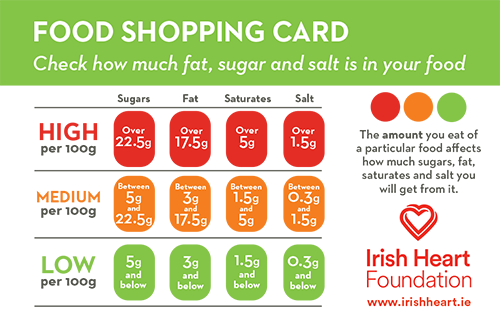
Food labels provide nutrition information that helps you make healthier choices. The Irish Heart Foundation has developed a traffic light system to make this easier:
- RED (HIGH) - consume occasionally
- AMBER (MEDIUM) - consume in moderation
- GREEN (LOW) - the healthier choice
This system helps you quickly identify levels of sugars, fat, saturates, and salt per of food.
Food tests
In the laboratory, we can test food samples to detect the presence of different nutrients.
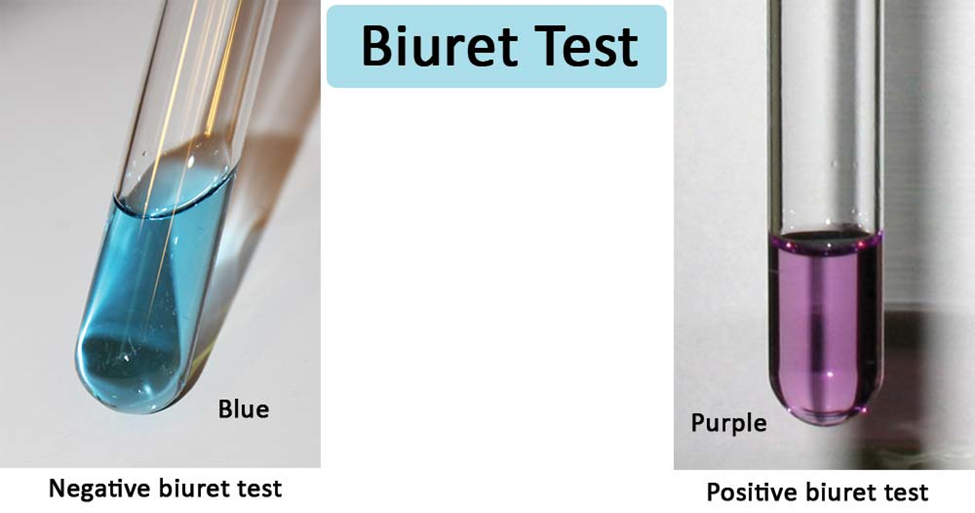
Testing for protein (Biuret test)
Example
Worked Example: Testing for Protein
To test a food sample for the presence of protein:
- Place a food sample in a test tube
- Add an equal amount of Biuret reagent to the water
- Add water to a second test tube (this is the control)
Results:
- If protein is present, the Biuret reagent turns a violet (purple) colour
- If protein is absent, the Biuret reagent stays blue
Testing for fat (brown paper test)
Example
Worked Example: Testing for Fat
To test a food sample for the presence of fat:
- Rub a food sample onto brown paper
- On a second piece of brown paper, place a drop of water (this is the control)
- Shine light through both pieces of paper
Results:
- If fat is present, the paper becomes translucent (light shines through it)
- If fat is absent, there is no translucent stain on the paper
Important
Exam tip: Remember that translucent means light can shine through, but you cannot see clearly through it (unlike transparent, where you can see clearly through).
Lifestyle choices
The lifestyle choices you make have a significant effect on your health. Two particularly important areas are physical activity and smoking.
Benefits of regular exercise

Regular physical activity provides numerous health benefits:
- Lowers blood pressure
- Strengthens muscles
- Maintains mobility (keeps joints flexible)
- Reduces body fat
- Decreases stress levels
- Oxygenates the body (improves oxygen delivery to tissues)
- Strengthens the heart
- Reduces risk of diabetes
- Boosts mood (makes you feel happier)
- Boosts immune system (helps fight infections)
- Strengthens bones
- Increases lifespan
How much exercise do you need?
It is recommended that young people take part in moderate to vigorous physical activity for at least 60 minutes each day. However, many benefits can be experienced with just 20 minutes of vigorous exercise, five days a week.
Note
All the activities shown in the benefits diagram count as exercise. Moderate exercise would be brisk walking, mowing the lawn or dancing. You do not need to join a gym or play competitive sports to stay healthy - just stay active!
Smoking and health
Smoking is extremely harmful to health. The statistics are alarming:
Important
Half of all smokers die from smoking-related diseases. In Ireland, this accounts for approximately:
- Cancer: 44% of deaths
- Circulatory diseases: 30% of deaths
- Respiratory diseases: 25% of deaths
- Digestive diseases: 1% of deaths
It is reckoned that at least 19% of all deaths are caused by smoking each year in Ireland from tobacco use. This is about 7,000 people per year.
The best choice for your health is to never start smoking. If you do smoke, stopping will provide immediate and long-term health benefits.
Remember!
Summary
Key Points to Remember:
-
Health is more than just being free from illness - it includes physical, mental and social wellbeing.
-
Both genetics and environment affect your health - the relationship is: genotype + environment = phenotype.
-
Inherited disorders like cystic fibrosis and sickle cell anaemia are caused by mutations in genes passed from parents to children.
-
A balanced diet is essential for good health - follow the food pyramid and include all food groups in the correct proportions. Drink at least eight glasses of water daily.
-
Regular exercise provides many health benefits - aim for at least 60 minutes of moderate to vigorous activity daily to strengthen your heart, muscles, and bones, reduce stress, and lower disease risk.