The Periodic Table and Writing Chemical Formulas (Junior Cert Science): Revision Notes
📚Revision Notes
The Periodic Table and Writing Chemical Formulas
Introduction to the periodic table
The periodic table is a powerful tool in chemistry that organises all known chemical elements in a systematic way. Scientists call it the 'Periodic' Table because the properties of elements show repeating patterns at regular intervals.
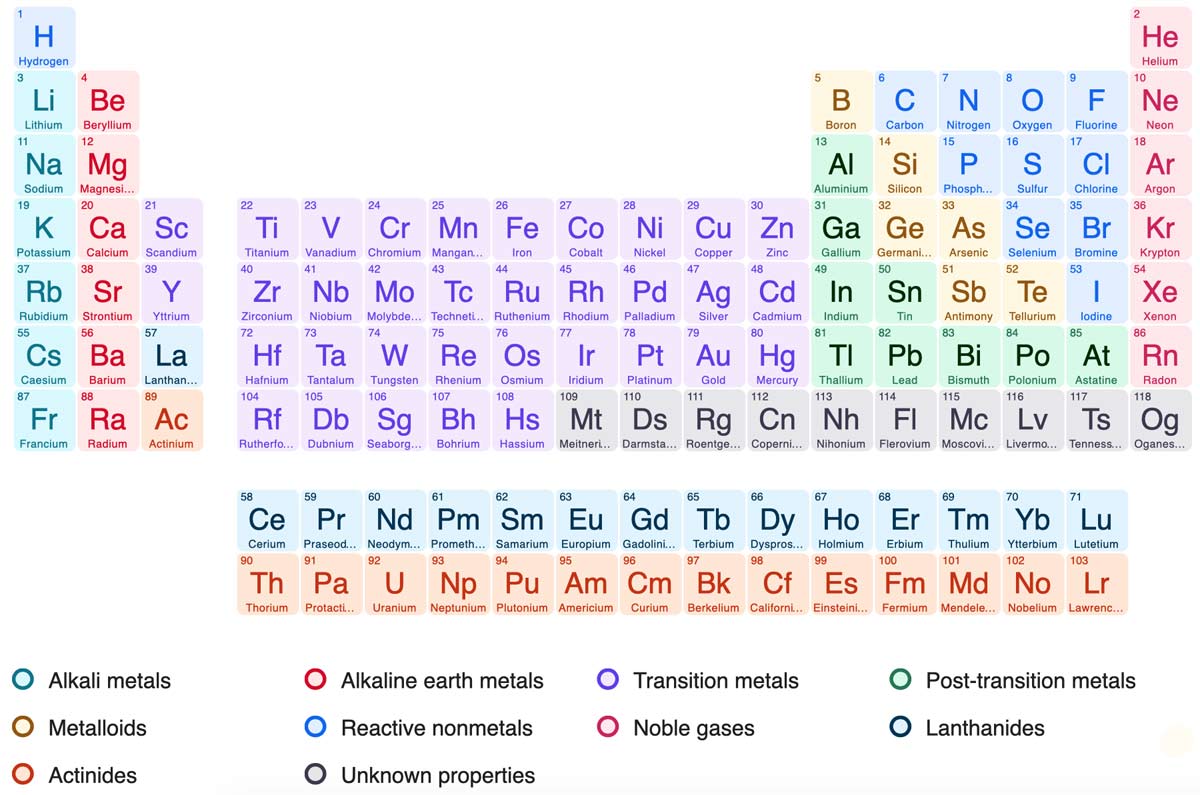
Elements are arranged in order of increasing atomic number (the number of protons in the nucleus). For example, lithium has protons, sodium has protons, and potassium has protons.
Note
The periodic table is one of the most important tools in chemistry. It not only organizes elements systematically but also helps predict how elements will react with each other. Understanding how to read and use the periodic table is essential for writing chemical formulas.
Structure of the periodic table
The periodic table has two main organisational features:
Groups are the vertical columns of elements. There are eight main groups, labelled with Roman numerals from I to VIII. Elements in the same group share similar chemical properties because they have the same number of electrons in their outer shell. This is really important because the outer shell electrons determine how an element will react.
Periods are the horizontal rows of elements. There are seven periods in the periodic table, labelled through . The period number tells you how many electron shells an atom of that element has. For example, all elements in period have three electron shells.
Important
Key Relationship: The group number (for Groups I-VII) tells you exactly how many electrons are in the outer shell. For example:
- Group I elements have 1 outer electron
- Group II elements have 2 outer electrons
- Group VII elements have 7 outer electrons
This pattern is crucial for predicting how elements will bond!
Reading element information
Each element in the periodic table contains important information displayed in a standard format:
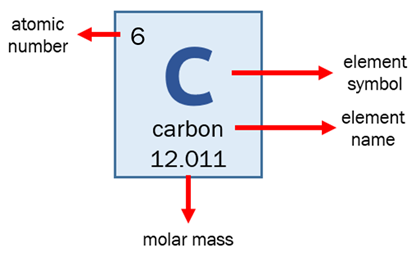
- Atomic number: This is shown at the top. It tells you the number of protons in the nucleus. Since atoms are neutral, the atomic number also equals the number of electrons.
- Element symbol: A one or two-letter abbreviation (e.g., C for carbon, Na for sodium).
- Element name: The full name of the element.
- Mass number (or relative atomic mass): This appears at the bottom. It represents the total number of protons and neutrons in the nucleus.
Note
Exam Tip: In an examination, you do not need to draw individual protons and neutrons in the nucleus. Writing the atomic number (e.g., "p") and the number of neutrons (e.g., "n") is sufficient.
Drawing Bohr structures of atoms
The Bohr model helps us visualise the structure of atoms by showing how electrons are arranged in shells around the nucleus. Here's how to draw a Bohr structure step by step:
Step 1: Work out the number of protons and neutrons
Find the element in the periodic table and identify:
- The atomic number (number of protons)
- The mass number (total of protons and neutrons)
- Calculate the number of neutrons by subtracting: neutrons mass number atomic number
Step 2: Show the arrangement of electrons
The atomic number tells you the number of electrons in a neutral atom. These electrons are arranged in shells around the nucleus:
- The first shell () can hold up to electrons
- The second shell () can hold up to electrons
- The third shell () can hold up to electrons (for elements )
Count from left to right across the periodic table to determine the electron configuration.
Note
Remember the shell filling order: Electrons always fill the innermost shell first before moving to the next shell. Think of it like filling seats in a theatre - you fill the front rows before moving to the back!
Example
Worked Example: Drawing the Bohr structure of argon
Let's work through argon (Ar) as an example:
Step 1: Find argon in the periodic table. Its atomic number is and its mass number is . Therefore, argon has:
- protons (from the atomic number)
- neutrons (calculated as )
Step 2: Since the atomic number is , argon has electrons. These are arranged as:
- electrons in the first shell ()
- electrons in the second shell ()
- electrons in the third shell ()
We write this electron configuration as 2,8,8.
The complete Bohr structure shows three concentric circles representing the electron shells, with dots representing the electrons positioned around them. The nucleus is labelled with p and n.
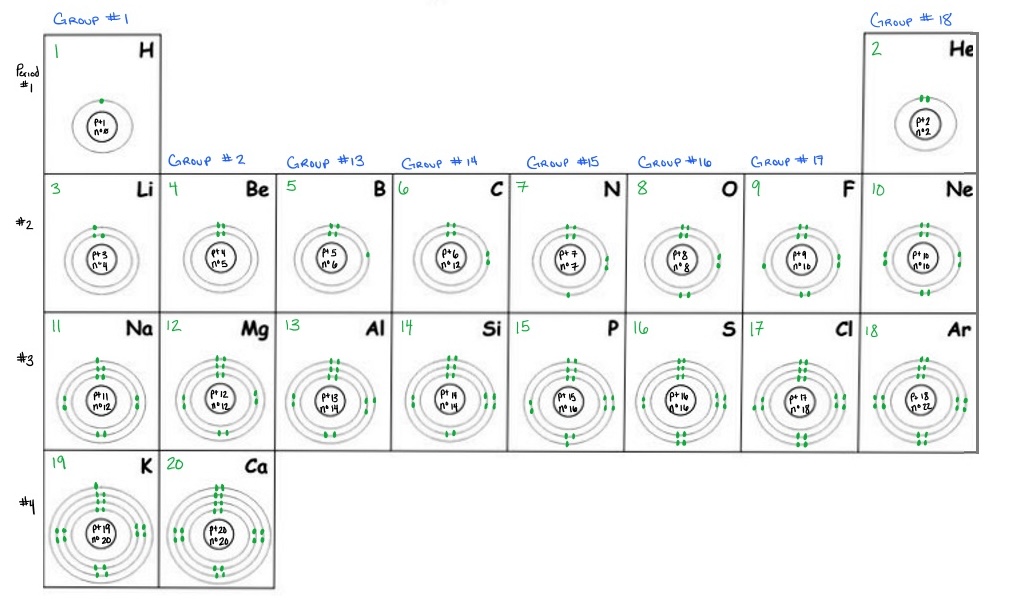
This diagram shows Bohr structures for the first elements in the periodic table. Notice the patterns: elements in the same group have the same number of electrons in their outer shell.
Using the periodic table to predict ratios of atoms in ionic compounds
The periodic table helps us understand how elements combine to form compounds. When metal atoms react with non-metal atoms, they form ionic compounds through the transfer of electrons.
What are ions?
Important
An ion is a charged atom or group of atoms. Ions form when atoms gain or lose electrons:
- Cations are positively charged ions formed when atoms lose electrons
- Anions are negatively charged ions formed when atoms gain electrons
Group I elements: Losing one electron
Elements in Group I (such as lithium, sodium, and potassium) have one electron in their outer shell. These elements are highly reactive because they easily lose this single outer electron to form ions with a positive charge of .
When a sodium atom loses one electron, it forms a sodium ion (Na). The electron configuration changes from to , leaving the atom with one more proton than electrons, giving it a positive charge.
Group II elements: Losing two electrons
Elements in Group II (such as magnesium and calcium) have two electrons in their outer shell. These elements lose both outer electrons to form ions with a positive charge of .
When magnesium burns (such as in sparklers or fireworks), it loses two electrons to form Mg ions. The electron configuration changes from to .
Group VII elements: Gaining one electron
Elements in Group VII (such as fluorine, chlorine, and bromine) have seven electrons in their outer shell. These elements are very reactive because they readily gain one electron to complete their outer shell, forming ions with a negative charge of .
When a chlorine atom gains one electron, it forms a chloride ion (Cl). The electron configuration changes from to . The extra electron makes the atom negatively charged.
Note
Pattern Recognition: Notice how atoms tend to gain or lose electrons to achieve a full outer shell (usually 8 electrons, like the noble gases). This is called the "octet rule" and it's the driving force behind chemical bonding.
Formation of ionic compounds
Important
An ionic bond is the force of attraction between oppositely charged ions in a compound. When metal atoms react with non-metal atoms, electrons transfer completely from the metal to the non-metal. Opposite charges attract each other, binding the ions together in an ionic bond.
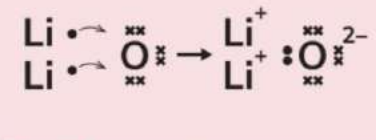
For example, when lithium reacts with oxygen:
- Each lithium atom (Group I) loses electron to form Li
- The oxygen atom (Group VI) gains electrons to form O
- Two lithium atoms are needed to provide the two electrons that one oxygen atom requires
- The compound formed is lithium oxide with the formula LiO
Writing formulas of ionic compounds
To write the formula of an ionic compound, you need to balance the positive and negative charges so they equal zero overall. Here's the method:
- Identify which group each element belongs to
- Determine the charge on each ion
- Work out the ratio needed to balance the charges
- Write the formula with the metal first, then the non-metal
Example
Worked Example: Sodium chloride
Let's look at the reaction between sodium and chlorine:
- Sodium is in Group I, so it loses electron to form Na
- Chlorine is in Group VII, so it gains electron to form Cl
- One Na ion pairs with one Cl ion
- The formula is NaCl (sodium chloride, or common table salt)
Example
Worked Example: Magnesium oxide
- Magnesium is in Group II, so it loses electrons to form Mg
- Oxygen is in Group VI, so it gains electrons to form O
- One Mg ion pairs with one O ion
- The formula is MgO
Charge check: ✓
Example
Worked Example: Lithium oxide
Using the periodic table:
- Lithium is in Group I, so it will lose electron to form Li
- Oxygen is in Group VI, so it will gain electrons to form O
- To balance the charges, we need two Li ions for every one O ion
- Therefore, the formula of lithium oxide is LiO
Charge check: ✓
Using the periodic table to predict ratios of atoms in covalent compounds
Not all compounds are ionic. When non-metal atoms combine with other non-metal atoms, they form covalent compounds by sharing electrons rather than transferring them.
What are covalent compounds?
Important
A covalent bond is the force of attraction between atoms in a molecule when pairs of electrons are shared. Unlike ionic bonding where electrons are transferred, in covalent bonding both atoms share electrons to complete their outer shells.
A molecule is a group of atoms joined together. It is the smallest particle of an element or compound that can exist independently. Examples include H, O, HO, and CH.
Patterns in the periodic table
The periodic table reveals patterns in how different groups of elements combine with hydrogen:
- Group VII elements combine with one hydrogen atom (e.g., HCl, HF, HBr)
- Group VI elements combine with two hydrogen atoms (e.g., HO, HS)
- Group V elements combine with three hydrogen atoms (e.g., NH, PH)
- Group IV elements combine with four hydrogen atoms (e.g., CH, SiH)
- Group III elements combine with three hydrogen atoms (e.g., BH, AlH)
Note
Spotting the Pattern: Notice how the number of hydrogen atoms that combine with an element relates to its position in the periodic table. This pattern helps you predict formulas for compounds you've never seen before!
Group IV: Methane (CH)
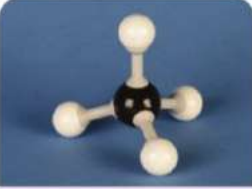
Methane is the simplest formula of a compound containing carbon. Carbon is in Group IV, which means it has four electrons in its outer shell and needs four more to complete it.

Each hydrogen atom shares one electron with the carbon atom. The carbon atom shares four electrons (one with each of four hydrogen atoms), forming four covalent bonds. The carbon and hydrogen atoms are joined, or bonded, together.
Since sharing electrons creates a chemical bond, we say methane has four covalent bonds. Therefore, the formula of methane is CH.
Group V: Ammonia (NH)
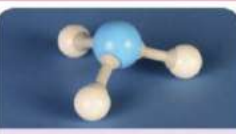
Nitrogen is in Group V, so it has five electrons in its outer shell. A nitrogen atom combines with three hydrogen atoms to form ammonia.
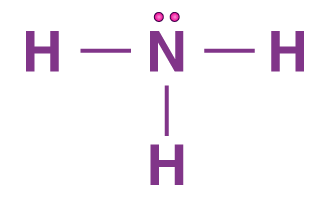
Each hydrogen atom shares one electron with the nitrogen atom, and the nitrogen shares three electrons (one with each hydrogen). This creates three covalent bonds. Notice that nitrogen has one pair of electrons not involved in bonding - this is called a lone pair.
The formula of ammonia is NH.
Group VI: Water (HO)
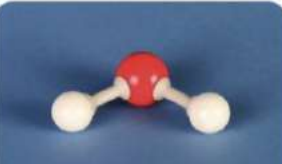
Oxygen is in Group VI, which means it has six electrons in its outer shell. An oxygen atom combines with two hydrogen atoms to form water.
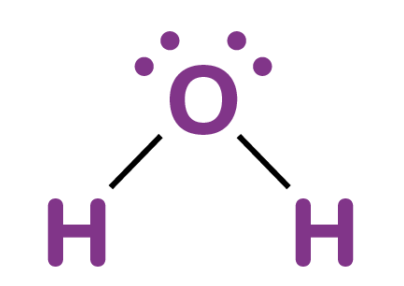
To get eight electrons in the outer shell, the oxygen atom shares two electrons (one with each hydrogen atom). This forms two covalent bonds. The oxygen atom has two lone pairs of electrons in its outer shell that are not involved in bonding.
The formula of water is HO.
Group VII: Hydrogen chloride (HCl) and hydrogen fluoride (HF)

Elements in Group VII have seven electrons in their outer shell. When a chlorine atom combines with a hydrogen atom, they share one pair of electrons to form hydrogen chloride.
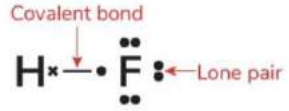
Fluorine is also in Group VII. To get eight electrons in the outer shell of a fluorine atom, one electron must be shared with one hydrogen atom. The covalent bond forms between the hydrogen and fluorine atoms. The fluorine atom has three lone pairs.
The formula of hydrogen fluoride is HF.
More complex covalent compounds
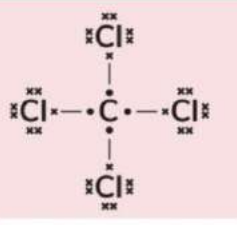
Carbon tetrachloride (CCl) is formed when one carbon atom combines with four chlorine atoms. Each chlorine atom shares one electron with the central carbon atom, forming four covalent bonds. In the CCl molecule, each chlorine atom simply replaces one hydrogen atom from methane (CH).
Group III: Aluminium hydride (AlH)
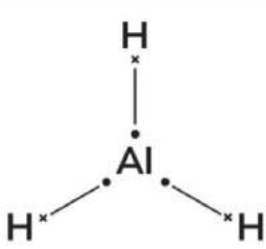
Aluminium is in Group III, meaning it has three electrons in its outer shell. An aluminium atom combines with three hydrogen atoms to form aluminium hydride. Three covalent bonds are formed between the aluminium atom and the three hydrogen atoms.
Therefore, the formula of aluminium hydride is AlH.
Summary of covalent compound formulas
Here is a summary showing examples of covalent compounds from different groups:
| Group | Examples of covalent compounds |
|---|---|
| Group VII | H—Cl, H—F, H—Br |
| Group VI | H—O—H, H—S—H |
| Group V | NH, PH, PCl |
| Group IV | CH, CCl, SiH |
| Group III | BH, BCl, AlCl |
Note
Exam Tip: In your examination, you could be asked to write formulas for compounds of other elements such as chlorine, fluorine, or bromine. Remember that these atoms combine in the same ratios as hydrogen. Therefore, simply replace the hydrogen atoms with the same number of atoms of these elements to find the correct formula.
Summary
Remember!
Key Points to Remember:
-
The periodic table organises elements by increasing atomic number, with elements sharing similar properties arranged in vertical groups.
-
Groups indicate the number of outer shell electrons (for Groups I-VII), which determines how elements will bond. Period numbers show how many electron shells an atom has.
-
Ionic compounds form when metal atoms transfer electrons to non-metal atoms. Group I elements lose electron, Group II lose electrons, and Group VII elements gain electron.
-
Covalent compounds form when non-metal atoms share electrons. The group number helps predict how many bonds an element will form: Group IV forms bonds, Group V forms bonds, Group VI forms bonds, and Group VII forms bond.
-
To write chemical formulas correctly, you need to understand whether the compound is ionic (balance charges) or covalent (count shared electrons). The periodic table is your essential tool for predicting both types of formulas.