Food and Drink (Junior Cert Spanish): Revision Notes
📚Revision Notes
Food and drink
Learning food and drink vocabulary is essential for everyday conversations in Spanish. This topic covers everything you need to know about expressing food preferences, ordering in restaurants, shopping for groceries, and understanding Spanish food culture.
Basic food vocabulary
Understanding different food categories will help you organise your Spanish vocabulary more effectively. Each category contains essential items you'll encounter in daily life.
Note
When learning Spanish food vocabulary, always learn the definite article (el, la, los, las) together with each noun. This will help you remember the gender and make your Spanish sound more natural.
Meat and protein
| Spanish | English |
|---|---|
| la carne | the meat |
| el pollo | the chicken |
| el jamón | the ham |
| el jamón serrano | the cured ham |
| el cerdo | the pork |
| el cordero | the lamb |
| la carne de res | the beef |
| el bistec | the steak |
| el pavo | the turkey |
| el huevo | the egg |
Example sentences:
- Me gusta mucho el pollo con patatas. (I really like chicken with potatoes.)
- Mi hermana no come carne. (My sister doesn't eat meat.)
- ¿Tienes jamón serrano? (Do you have cured ham?)
Note
When talking about food preferences, use "me gusta" + singular food item or "me gustan" + plural food items. This pattern is crucial for expressing likes and dislikes in Spanish.
Fish and seafood
| Spanish | English |
|---|---|
| el pescado | the fish |
| el bacalao | the cod |
| las gambas | the prawns |
| los mejillones | the mussels |
| los calamares | the squid |
| los mariscos | the seafood |
Example sentences:
- El pescado está muy fresco hoy. (The fish is very fresh today.)
- Me encantan las gambas a la plancha. (I love grilled prawns.)
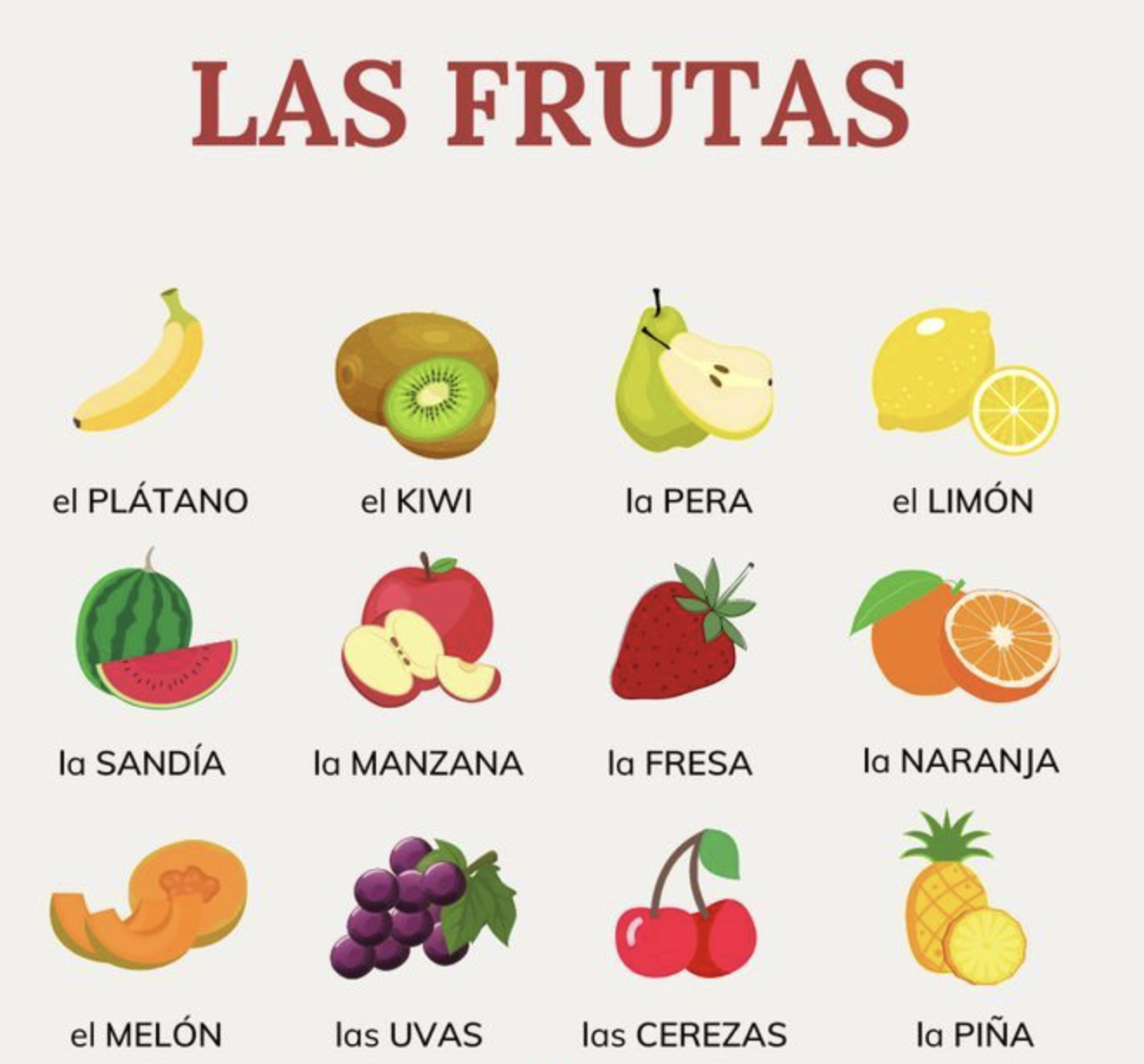
Fruits
| Spanish | English |
|---|---|
| la fruta | the fruit |
| la manzana | the apple |
| la naranja | the orange |
| el plátano | the banana |
| las fresas | the strawberries |
| las frambuesas | the raspberries |
| las uvas | the grapes |
| la piña | the pineapple |
| las cerezas | the cherries |
| la sandía | the watermelon |
Example sentences:
- Como una manzana cada día. (I eat an apple every day.)
- Las fresas están muy dulces. (The strawberries are very sweet.)
- ¿Cuánto cuestan las naranjas? (How much do the oranges cost?)
Vegetables
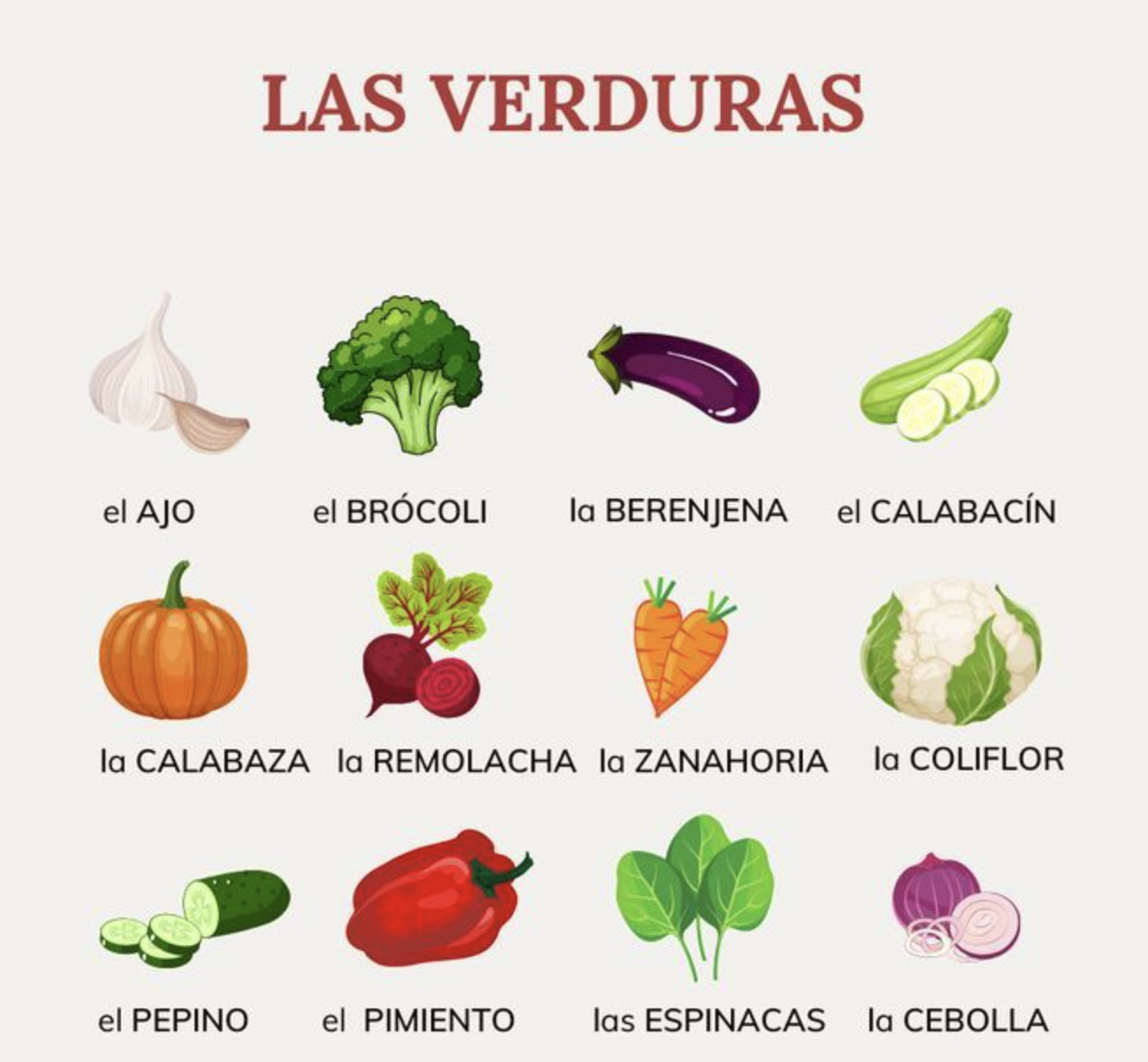
| Spanish | English |
|---|---|
| las verduras | the vegetables |
| las patatas | the potatoes |
| los tomates | the tomatoes |
| las zanahorias | the carrots |
| los pimientos | the peppers |
| las cebollas | the onions |
| los champíñones | the mushrooms |
| los guisantes | the peas |
| los pepinos | the cucumbers |
| la espinaca | the spinach |
Example sentences:
- Las verduras son muy sanas. (Vegetables are very healthy.)
- Necesito patatas para hacer tortilla. (I need potatoes to make an omelette.)
Note
Notice that las patatas is used in Spain, while las papas is more common in Latin America. This is a key regional difference to remember.
Drinks vocabulary
Non-alcoholic drinks
| Spanish | English |
|---|---|
| las bebidas | the drinks |
| el agua | the water |
| el agua con gas | the sparkling water |
| el agua sin gas | the still water |
| el café | the coffee |
| el té | the tea |
| el zumo | the juice |
| la limonada | the lemonade |
| el batido | the smoothie/milkshake |
Alcoholic drinks
| Spanish | English |
|---|---|
| el vino | the wine |
| el vino blanco | the white wine |
| el vino tinto | the red wine |
| la cerveza | the beer |
Example sentences:
- Bebo mucha agua durante el día. (I drink lots of water during the day.)
- ¿Prefieres té o café? (Do you prefer tea or coffee?)
- Una cerveza, por favour. (One beer, please.)
Dairy products and other items
| Spanish | English |
|---|---|
| los lácteos | the dairy products |
| la leche | the milk |
| el queso | the cheese |
| la mantequilla | the butter |
| el yogur | the yoghourt |
| los huevos | the eggs |
| el helado | the ice cream |
| el pan | the bread |
| el arroz | the rice |
Restaurant vocabulary
Understanding restaurant terminology helps you navigate dining experiences more confidently.
| Spanish | English |
|---|---|
| el entrante | the starter |
| el plato principal | the main course |
| el plato | the dish/plate |
| el sabor | the taste |
| fresco/a | fresh |
| casero/a | homemade |
| la miel | the honey |
| la crema | the cream |
| batido/a | whipped |
Example sentences:
- ¿Qué vas a tomar de entrante? (What are you going to have as a starter?)
- El plato principal está delicioso. (The main course is delicious.)
- Esta comida casera está muy buena. (This homemade food is very good.)
Shopping for food
When shopping for groceries, you'll need to know containers and quantities.
| Spanish | English |
|---|---|
| el cartón | the carton |
| el frasco | the jar |
| el paquete | the packet |
| el kilo | the kilo |
| la lata | the tin |
| la docena | the dozen |
Example sentences:
- Quiero un kilo de manzanas, por favour. (I want a kilo of apples, please.)
- ¿Tienes una lata de tomates? (Do you have a tin of tomatoes?)
- Necesito una docena de huevos. (I need a dozen eggs.)
Table setting vocabulary
Knowing table setting terms is useful for dining situations.
| Spanish | English |
|---|---|
| la mesa | the table |
| el tenedor | the fork |
| el cuchillo | the knife |
| la cuchara | the spoon |
| el plato | the plate |
| el vaso | the glass |
| la taza | the cup |
| el bol | the bowl |
| la servilleta | the napkin |
| la botella | the bottle |
| la jarra | the jug |
| la pajita | the straw |
Example sentences:
- Pon los tenedores a la izquierda del plato. (Put the forks to the left of the plate.)
- ¿Puedes traer otro vaso, por favour? (Can you bring another glass, please?)
Grammar focus: expressing preferences with gustar and encantar
The verb gustar (to like) works differently from English. The thing you like is the subject of the sentence, and the person doing the liking is the indirect object.
Important
Critical Grammar Pattern: Remember that with both "gustar" and "encantar", the verb agrees with the thing being liked, not the person doing the liking. This is the opposite of how "to like" works in English.
Gustar conjugation patterns:
- me gusta = I like (+ singular item)
- me gustan = I like (+ plural items)
- te gusta/gustan = you like
- le gusta/gustan = he/she likes / you (formal) like
- nos gusta/gustan = we like
- os gusta/gustan = you (plural, Spain) like
- les gusta/gustan = they like / you (plural, formal) like
Example
Worked Example: Using Gustar Correctly
Step 1: Identify what is being liked
- Item: el pescado (singular) → use "gusta"
- Items: las naranjas (plural) → use "gustan"
Step 2: Choose the correct indirect object pronoun
- For "I like" → me
- For "you like" → te
Step 3: Construct the sentence
- Me gusta el pescado. (I like fish.)
- Me gustan las naranjas. (I like oranges.)
Example sentences:
- Me gusta el pescado. (I like fish.)
- Me gustan las naranjas. (I like oranges.)
- ¿Te gusta la paella? (Do you like paella?)
- Nos gustan los caramelos. (We like sweets.)
Encantar (to love/really like)
Encantar follows exactly the same pattern as "gustar" but expresses stronger preference.
Example sentences:
- Me encanta la paella. (I love paella.)
- Me encantan los caramelos. (I love sweets.)
Spanish food culture
Spain has a rich gastronomic tradition that varies by region. Understanding these dishes helps you appreciate Spanish culture.
Note
Spanish Regional Cuisine
Spanish food culture varies significantly by region. Each area has its own specialties, cooking methods, and traditional ingredients. Learning about these dishes gives you insight into Spanish history and culture.
Las tapas
Tapas are small portions or servings of food. Some of the most famous tapas include Spanish omelette, cured ham, prawns, mussels, cheese, olives and spicy potatoes. Traditionally tapas are served in bars with a drink. Tapas are eaten throughout Spain but are known as pinchos in the north of the country.
El gazpacho
Gazpacho is basically a cold soup. The ingredients include tomatoes, peppers, garlic and peppers. It's very refreshing and very popular in places like Andalusia where it gets very hot during summer.
La tortilla española
It's very important to note that a tortilla in Latin America is not the same as a tortilla in Spain. In Spain tortillas are made with eggs, potatoes and onions. Sometimes there's chorizo, ham or spinach as well.
La paella
Paella originally comes from Valencia. The ingredients for making paella include chicken or seafood, vegetables and much more. But the key to a delicious paella is the rice. You have to use Calasparra Rice because it absorbs all the flavours of the paella. Sometimes the rice in paella is yellow because another ingredient is saffron, which is a spice.
Useful restaurant phrases
Understanding these essential dining phrases will help you communicate confidently in Spanish restaurants.
Phrase bank for dining out:
- ¿Qué vas a tomar? (What are you going to have?)
- Quisiera... (I would like...)
- Me gustaría... (I would like...)
- ¿Qué hay de entrante? (What is there for starter?)
- La cuenta, por favour. (The bill, please.)
- ¿Cuánto cuesta? (How much does it cost?)
- ¿Algo más? (Anything else?)
- No, gracias. Es todo. (No, thanks. That's everything.)
Common mistakes and fixes
Important
Avoiding Common Errors
These are the most frequent mistakes students make when talking about food in Spanish. Pay special attention to these patterns to improve your accuracy.
Using muy vs mucho with food
- Correct: La comida está muy buena. (The food is very good.)
- Incorrect: La comida está mucho buena.
- Fix: Use muy before adjectives, mucho before nouns or after verbs.
Gustar agreement errors
- Correct: Me gustan las manzanas. (I like apples.)
- Incorrect: Me gusta las manzanas.
- Fix: Use gustan with plural items, gusta with singular items.
Article usage with food
- Correct: Me gusta el café. (I like coffee - in general)
- Correct: Quiero un café. (I want a coffee - specific)
- Fix: Use definite articles when talking about food in general, indefinite when ordering specific items.
Translation practice
Example
Translation Exercise: Food and Drink
Practice these translations to test your understanding of food vocabulary and grammar patterns.
Spanish to English:
- Me encantan las gambas a la plancha.
- ¿Tienes agua sin gas?
English to Spanish: 3. I would like a kilo of tomatoes, please. 4. The homemade paella is delicious.
Answers:
- I love grilled prawns.
- Do you have still water?
- Quisiera un kilo de tomates, por favour.
- La paella casera está deliciosa.
Summary
Key Points to Remember:
- Food vocabulary is organised into logical categories: meat, fish, fruit, vegetables, drinks, and dairy products
- The verb gustar works differently from English - the thing you like is the subject, and you need to match the verb with singular or plural items
- Spanish food culture includes famous dishes like paella, tapas, gazpacho, and tortilla española, each with regional significance
- When shopping for food, learn quantity words like kilo, docena, and paquete to communicate effectively